

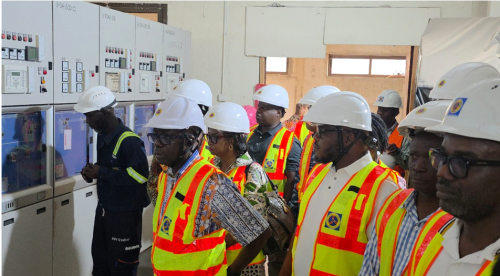
The Managing Director of the Electricity Company of Ghana (ECG), Ing. Kwame Kpekpena, has conducted an on-site inspection of critical infrastructure projects in Kumasi, pledging that residents will see a meaningful improvement in electricity supply within six months as the company pushes ahead with its GH¢3.46 billion Capital Investment Programme.
The visit, which took in several active project sites across the Ashanti Region, focused on upgrades designed to relieve pressure on the city’s overloaded distribution network and address a persistent power crisis that has hit households, businesses, and the water supply chain.
Central to the programme is the reconstruction of a 16-kilometre sub-transmission line from Neoplan to Barekese, which serves the Ghana Water Company Limited’s (GWCL) Barekese Water Treatment Plant, a principal source of potable water for Greater Kumasi. In March alone, power outages cut productivity at the Barekese Water Treatment Plant by 30 percent. ECG says the existing line lacked the capacity to transmit power reliably, requiring a temporary diversion during reconstruction to protect water production.
Kpekpena was clear that the current disruptions are not a generation problem. “We have adequate generation capacity, but limitations in our network sometimes affect our ability to deliver power to end-users,” he said, drawing a distinction between the current distribution-level constraints and the load-shedding crises of previous years.
Within three months, ECG expects to resolve localised faults, including low-voltage issues such as blown fuses and phase imbalances across communities. Sixty-five distribution transformers are being deployed immediately, with total installations projected at between 300 and 400 units by the end of the programme. Two major transformers are also scheduled for replacement before year-end.
Work on the Anwomaso-Kaase substation link is also expected within three months, forming part of broader efforts to strengthen the medium-voltage network feeding Greater Kumasi. The city currently relies on two Bulk Supply Points (BSPs) at Ridge and Anwomaso, and Kpekpena said getting electricity efficiently from those nodes into communities is the core challenge. “The challenge is not just taking power from the Ghana Grid Company (GRIDCo), but ensuring we can move it efficiently into communities. These projects are aimed at removing those bottlenecks,” he said.
General Manager for Special Projects Ing. Frederick Kwabena Bediako acknowledged technical complications, including swampy terrain, multiple underground cable joints requiring rehabilitation, and the need to share right-of-way corridors with GRIDCo, which is simultaneously upgrading its own transmission network. These factors have caused some delays and required the realignment of towers. The Boadi Junction to Kaase project, valued at approximately US$6.8 million at contract inception, is expected to significantly improve interconnection between the two BSPs. Once complete, ECG expects to move up to 120 megavolt-amperes (MVA) of power from the Anwomaso BSP through Boadi to Kaase and onward to Ridge. Conductors are being upgraded from 265 to 400 capacity to enable this expanded evacuation.
Ashanti Regional Minister Dr Frank Amoakohene, who received ECG’s management team during the visit, commended the ongoing interventions and urged management to expedite works to improve power reliability across the region.

