

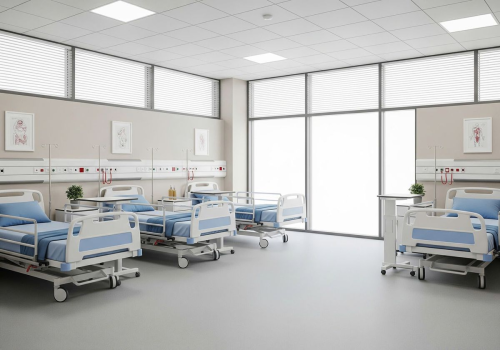
Ghana’s hospital bed deficit is significantly more severe than headline figures suggest, with fresh research data showing the country trails global and continental benchmarks by a wide margin even after a decade of capacity expansion, as structural financing failures render thousands of beds functionally unusable.
Analysis from the C-Nergy Thought Leadership Series found that Ghana’s hospital bed density stands at 0.9 beds per 1,000 people, well below Africa’s regional average of 1.3, the global average of 2.7, and the World Health Organization’s (WHO) recommended minimum of five beds per 1,000 people. Over 80 countries, including Ghana, fall below the WHO’s recommended minimum, and the African region has historically recorded the lowest hospital bed per capita average globally.
Total beds in Ghana grew from just over 24,000 in 2016 to more than 32,000 by 2024, a significant expansion. Yet that growth has been outpaced by population pressure and a rising burden of chronic disease. Stroke alone now accounts for 37 percent of deaths per 100,000 people, placing mounting strain on emergency and intensive care units that were already critically scarce before the surge in complex admissions.
The geographic distribution of those beds compounds the problem. Greater Accra and Ashanti regions each command up to 5,000 beds, while northern areas including the Savannah Region remain severely underserved. That imbalance drives a structural dysfunction in the referral system, where district and regional hospitals, understaffed and underequipped, route patients upward to tertiary facilities that were never designed to absorb the volume. At Komfo Anokye Teaching Hospital (KATH), medical staff describe wards filled beyond capacity, emergency units congested, and healthcare workers forced to make difficult decisions daily, with patients in critical condition sometimes redirected to other facilities simply because no bed is available.
Rural and peri-urban patients face the most dangerous delays. Limited ambulance coverage and poor transport infrastructure mean that what would be manageable conditions elsewhere become emergencies by the time patients reach a referral centre. The human cost of that journey was made vivid in February 2026, when a 29-year-old engineer, Charles Amissah, died after emergency medical technicians spent nearly three hours ferrying him between three hospitals, all of which declined to admit him due to unavailability of beds.
The C-Nergy research identifies a less visible dimension of the crisis: beds that exist on paper but are rendered non-functional by National Health Insurance Scheme (NHIS) reimbursement delays that leave hospitals unable to maintain supplies, equipment, and staffing at the levels required to operate every available space. President John Dramani Mahama addressed this directly in the 2026 State of the Nation Address (SONA), directing that no patient must be turned away from any facility and instructing the Ministry of Health to issue new guidelines ensuring emergency patients are received even under makeshift conditions. The government has also outlined plans for accelerated hospital capacity investment including Ridge Hospital Phase II, completion of the Police Hospital project, La General Hospital, the Sewua Regional Hospital, and the Afari Military Hospital in the Ashanti Region.
The analysis frames these commitments as necessary but insufficient without a fundamental shift in how health infrastructure is financed. It calls for capital allocation to health at a scale comparable to investment in energy and roads, alongside targeted bonds and decentralised financing mechanisms. Without those structural reforms, it concludes, no bed will continue to mean no care for the most vulnerable Ghanaians.

