

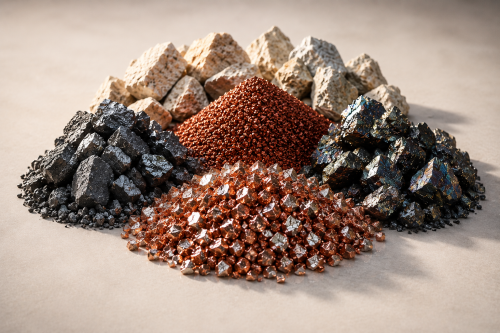
A new analysis argues that critical minerals have become instruments of state power rather than ordinary commodities, with profound consequences for global trade, security and industrial policy as the competition for lithium, cobalt, rare earth elements, graphite and copper intensifies across the world’s major economies.
Drawing on classical political philosophy and realist International Relations (IR) theory, the analysis contends that states have always treated certain strategic resources as matters of high politics rather than routine trade, and that the current race to secure critical mineral supply chains represents a continuation of that logic adapted to the realities of technological transformation and shifting global power.
The argument draws on Aristotle’s concept of self-sufficiency as a precondition for stable governance, Hobbes’ framework of sovereign responsibility for protecting the material conditions of order, and Zbigniew Brzezinski’s geopolitical analysis in The Grand Chessboard, which positioned resource endowments as central to long-term national primacy. The analysis updates those frameworks for the present moment, arguing that minerals essential to batteries, semiconductors, defence technologies and renewable energy infrastructure now occupy the same strategic significance that oil did during the 1970s crises, when consuming nations were forced to confront how deeply their civilised order depended on access to a single resource they did not control.
The return of explicit industrial policy across major economies is framed not as a retreat from globalisation but as its predictable maturation under great power competition. The United States Inflation Reduction Act and the European Union (EU) Critical Raw Materials Act are presented as expressions of what realist theorists would call self-help behaviour: states moving to secure the material base of their technological and economic sovereignty rather than entrusting it to markets that adversaries can weaponise.
The analysis invokes the concept of weaponised interdependence, developed by scholars Henry Farrell and Abraham Newman, to describe how dominant positions in global supply chain networks can be exploited coercively. In the critical minerals context, that dominance manifests most acutely in midstream processing and refining capacity rather than in raw extraction, with a concentration of capabilities for lithium, rare earth elements, cobalt and graphite creating single-point vulnerabilities for economies that have not invested in alternative processing capacity.
Africa, Latin America, Central Asia and the Arctic are identified as the primary arenas where these strategic competition dynamics are playing out, as resource-rich regions become sites of active investment, diplomatic engagement and influence projection by major powers seeking to diversify supply away from concentrated sources.
The analysis concludes with a direct implication for policy and industry: businesses, governments and institutions that treat critical minerals purely as technical inputs to green energy technologies are operating with an incomplete map. Those that integrate the geopolitical and statecraft dimension, and approach these resources with the gravity their strategic nature demands, will be better positioned to navigate a global environment in which the material conditions of national power are once again the subject of explicit competition between states.

