

Britain has publicly exposed a covert Russian operation in which three submarines spent more than a month probing critical undersea infrastructure north of the United Kingdom, with Defence Secretary John Healey issuing a direct warning to President Vladimir Putin on Thursday.
The submarines included an Akula-class nuclear-powered attack vessel and two deep-sea units from Russia’s Main Directorate of Deep-Sea Research, known as GUGI, a military programme designed to survey underwater infrastructure during peacetime and then damage or destroy it during conflict.
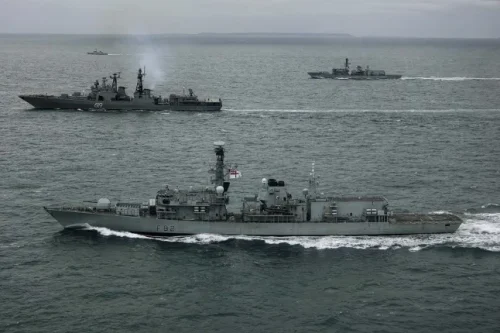
The Royal Navy deployed the Type 23 frigate HMS St Albans, RFA Tidespring, and Merlin helicopters to track the attack submarine, working alongside Royal Air Force P-8 maritime patrol aircraft in a round-the-clock operation conducted with allied nations. British aircraft flew more than 450 hours, the frigate covered several thousand nautical miles, and 500 personnel were involved in the response.
Healey told reporters that the UK worked with Norway and other allies, and accused Moscow of exploiting the distraction of the conflict in the Middle East to intensify activity against Europe. He said British forces quickly determined that the Akula submarine was deployed as a decoy while the two GUGI vessels focused on infrastructure near the seabed.
“We see your activity over our cables and our pipelines,” Healey said, addressing Putin directly. “Any attempt to damage them will not be tolerated and will have serious consequences.”
Healey stressed the strategic value of the undersea network, noting that it carries approximately half of the gas supply that heats British homes and 99 percent of international telecommunications and data traffic. Officials confirmed no infrastructure was damaged during the operation.
Norway’s defence ministry said the activity represented a further development of Russia’s ability to map and potentially sabotage critical Western infrastructure at ocean depths.
The UK has recorded a 30 percent increase in Russian vessels operating near its waters over the past two years. In response, the government announced an additional £100 million for P-8 submarine-hunting aircraft and confirmed the continued expansion of the Atlantic Bastion programme, which combines autonomous systems, advanced sensors, and warships into an integrated submarine-hunting force.

