

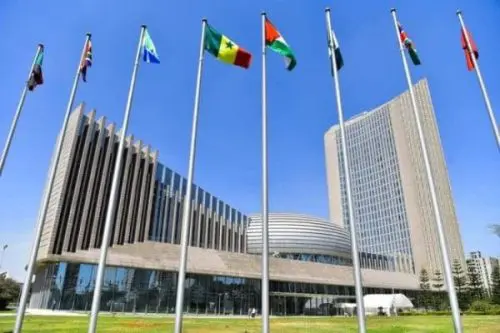
The 48th Ordinary Session of the African Union (AU) Executive Council concluded on Thursday in Addis Ababa with foreign ministers calling for enhanced continental unity, sustainable development, and collective action to address pressing challenges facing Africa.
The two day meeting, held under the 39th AU Summit framework, elected 10 members to the Peace and Security Council (PSC) of the AU for a two year term starting April 1, 2026. Somalia, Democratic Republic of the Congo (DRC), Gabon, Uganda, Morocco, Lesotho, South Africa, Benin, Côte d’Ivoire, and Sierra Leone secured seats on the premier peace and security organ.
Somalia’s election marks the country’s first membership on the PSC, signaling diplomatic progress after years of internal security challenges. Morocco secured the North African seat with 34 votes in the first round, defeating Libya.
Tete Antonio, Angolan Minister of External Relations and outgoing chair of the executive council, emphasized the AU’s commitment to strengthening continental governance, advancing peace and security, and accelerating implementation of Africa’s shared development agenda in his concluding remarks.
The session assessed strategic engagement with the Group of 20 (G20), building on momentum from the summit held in South Africa. Ministers underscored the need for strengthening cooperation with G20 member states to access funding sources and finance continental development programs.
Foreign ministers appreciated tangible progress on the African Continental Free Trade Area (AfCFTA) Agreement and specialized agencies, stressing the need for innovative financing and inclusion of the private sector, civil society, and philanthropic foundations to accelerate development.
The session highlighted the critical importance of the AU’s 2026 theme on water and sanitation, framing water as a vital collective resource requiring preservation amid climate change and as a tool for peace and cooperation. Antonio revealed 400 million people in Africa still lack water for daily livelihood needs, while over 800 million Africans lack basic hygiene services.
Ministers noted the significant gap between required and available investment in water and sanitation infrastructure across the continent. The session called for urgent mobilization of resources to address this development challenge affecting health, economic productivity, and social stability.
The executive council prepared items for consideration by the Assembly of Heads of State and Government scheduled for February 14 to 15. Ministers examined draft agendas and decisions, received updates on implementation of previous council decisions, and discussed reports from ministerial committees covering assessment contributions, African candidatures in international systems, and Agenda 2063 implementation.
Mahmoud Ali Youssouf, AU Commission Chairperson, addressed the opening session on Wednesday, emphasizing water must be protected as a shared resource and a driver of cooperation amid climate change. He noted that while Gabon and Guinea have returned to constitutional order, instability and terrorism persist in parts of the continent.
The session reaffirmed that AfCFTA and AU institutions remain central to driving integration, backed by innovative financing and stronger partnerships with Africa’s private sector and civil society organizations.

