

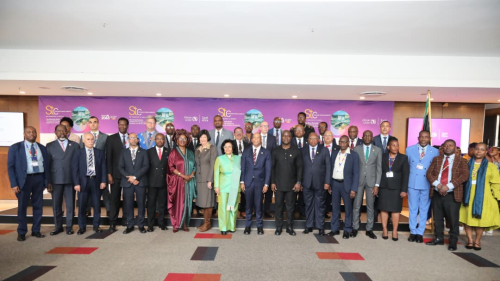
African transport and energy ministers have closed a landmark four-day session in Johannesburg with a series of policy endorsements designed to accelerate the continent’s infrastructure buildout, as new data underscores the economic toll of chronic underinvestment across roads, railways, ports, and power systems.
The Fifth Ordinary Session of the African Union (AU) Specialised Technical Committee on Transport and Energy (STC-T&E), held from April 27 to 30, 2026, at the Sandton Convention Centre in Johannesburg and hosted by South Africa, brought together ministers and senior technical experts from across the continent. The session convened under the theme “The Africa We Build: Transport and Energy as Catalysts for Africa’s Prosperity.”
Ministers were presented with figures highlighting the scale of the problem. Africa’s infrastructure deficit is reducing gross domestic product (GDP) growth by up to two percent annually, generating productivity losses of as much as 40 percent, and pushing transport costs to levels as high as 175 percent above global averages. Against that backdrop, 600 million people remain without electricity and nearly one billion lack access to clean cooking solutions.
The session reviewed progress on flagship continental programmes including the Programme for Infrastructure Development in Africa (PIDA), the Single African Air Transport Market (SAATM), the African Single Electricity Market (AfSEM), and the Grand Inga Hydropower Project. Ministers endorsed continental studies on aviation infrastructure, railway expansion, and port modernisation, alongside frameworks promoting green ports and digitalisation across logistics systems. Two new instruments were adopted: the African E-Mobility Framework and the Pan-African Action Plan for Active Mobility (PAAPAM), signalling a shift toward sustainable and climate-aligned transport systems.
On energy, ministers reviewed the African Energy Transition Strategy and Action Plan and reaffirmed commitments to expanding access while balancing industrial growth with sustainability goals. The session also formally noted the entry into force of the Revised African Maritime Transport Charter in August 2025 and the African Road Safety Charter in March 2026, both described as significant advances in regulatory alignment across member states. A new Bureau was elected to steer the Committee’s work for the next two years.
AU Commissioner for Infrastructure and Energy, Lerato Mataboge, framed the challenge as one of structural dependence rather than resource scarcity. She described the STC-T&E as the continent’s principal ministerial decision-making organ, tasked with ensuring coherence and decisive action in infrastructure delivery. Ministers called for infrastructure investment to be scaled to at least 4.5 percent of GDP, with stronger mobilisation of private capital and blended financing mechanisms.
South Africa’s Minister of Electricity and Energy, Kgosientsho Ramokgopa, described the current moment as a strategic inflection point, arguing that transport and energy systems must be treated as a unified economic platform rather than separate policy areas.
Discussions repeatedly returned to the theme of implementation, with ministers calling for integrated transport corridors, cross-border energy connectivity, and what they described as local beneficiation to reduce Africa’s dependence on raw commodity exports. Progress on the African Integrated Railway Network and the Abidjan-Lagos Highway, a flagship corridor stretching more than 1,000 kilometres and valued at approximately 15 billion United States dollars, were cited as proof of momentum.
The AU Commission reaffirmed its commitment to working with AUDA-NEPAD, the African Development Bank (AfDB), the United Nations Economic Commission for Africa (UNECA), and other partners to mobilise resources and accelerate project delivery. The adopted Ministerial Declaration and Experts’ Report will guide implementation until the next ordinary session.

