

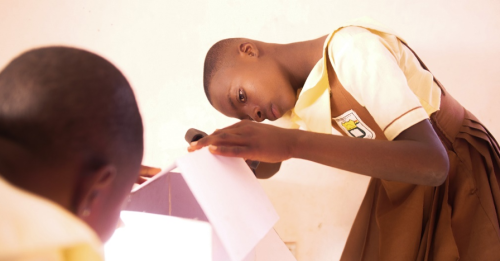
Every dry season, fires tear through farmland on the outskirts of Jirapa in the Upper West Region, destroying crops and leaving families with little to show for their harvest. For one 12-year-old student, that annual devastation has become the motivation behind one of the most practical innovations to emerge from a digital education programme operating across rural Ghana.
Miltiades, a student at Ganaa Memorial Junior High School, is among hundreds of young people in the final weeks of the Telecel Foundation’s DigiTech Academy third cohort. Her team is refining a bushfire-detection robot designed to identify unusual heat or smoke, move toward the source, and release water to contain the fire before it spreads. The team is also exploring how to wire an alert system that sends emergency signals directly to the Jirapa fire service.
The third cohort of the programme is made up of 500 students from 19 schools across five regions, with 70 percent of places reserved for female students. Graduation ceremonies, where students will present completed robotics, coding, and digital solutions, are expected to take place in their respective communities at the end of March as the academic term closes.
The project is personal for Miltiades. Bushfires have hit her own family’s maize and shea farm multiple times, and she said the robotics training gave her the tools to respond. “With the robotics training Telecel Foundation is giving us, I want to build something useful,” she said. “At first, robotics felt difficult. The components and tools were confusing. But when I understood how they work, it became a session I enjoy every week.”
To strengthen the real-world relevance of their design, the team visited the local fire service station, where officers explained how fire alerts are received, the most common causes of bushfires in the municipality, and how response teams mobilise. The visit prompted the students to rethink how their robot could work alongside existing emergency systems.
Her father, Robert Dookure, a public health officer and farmer, said the project reflected a challenge that extended well beyond their household. He added that technology alone would not be sufficient, and that community education about fire prevention, particularly among cattle herdsmen and game hunters, remained equally critical.
Across the digital lab at the Commission Information Centre in Jirapa, other student groups are working on automatic irrigation robots, automated waste bins, grass-cutting devices, and digital commerce platforms to promote locally woven Fugu and Kente products.
The DigiTech Academy has expanded considerably since its pilot phase began with 50 students. The first cohort concluded with 700 students from 39 schools across six regions, and the second reached 1,041 students from 47 schools in 10 regions. Since its launch in September 2024, the initiative has reached 2,300 students nationally.
Rita Agyeiwaa Rockson, Head of Foundation, Sustainability and External Communications at Telecel Ghana, said the innovations coming out of this cohort demonstrated what was possible when digital education was rooted in community reality. “It’s inspiring to see young people turn their challenge into purpose and build a solution for their community, because that’s the true power of digital education,” she said.

