Home Blog

Meta Sued Over AI Assisted Layoff Picks

0

Twenty six current and former Meta employees sued the company in federal court in Oakland this week, alleging it used an AI system called Checkpoint to help pick layoff targets.

The case is being described as the first lawsuit against a major American company to challenge the use of AI in deciding who loses their job, and it follows a federal judge’s ruling against the hiring software firm Workday last month in a separate case over AI bias, giving the claim more weight than a single company dispute.

The plaintiffs, whose names were withheld in the filing, include engineers, researchers, managers, designers and a director, all of whom took approved medical or family leave, and all of whom requested or received a disability accommodation, according to the complaint. They are among roughly 8,000 employees Meta cut in May, about 10 percent of its workforce, in a round the company described internally as an efficiency measure tied to its rising AI investment.

The lawsuit alleges Meta’s layoff selections drew on a mix of internal tools, including performance ratings, calibration scores, productivity metrics and dashboards tracking employees’ use of large language models, inputs the plaintiffs say could not be generated by someone on protected leave or working reduced hours because of a disability. About half the plaintiffs, eight women who took maternity or pregnancy related leave and four men who took parental leave, say they were selected shortly after that leave ended. One woman says she was targeted after caregiving and later bereavement leave.

One plaintiff identified as a director alleged a manager discouraged him from taking leave under the Family and Medical Leave Act, warning it would hurt his odds of surviving the cuts, and that Meta did not accommodate a disability he had disclosed. The complaint says Meta never paused its scoring systems for the leave neutral review the law requires.

Meta disputed the claims. “Workforce management and organizational decisions were and are made by people, not AI,” a company spokesperson said.

The plaintiffs are seeking a court order blocking the layoffs, which were set to take effect July 22, while they pursue individual claims through arbitration, as their employment agreements require. Their lawyers argue the request for temporary relief falls outside that arbitration requirement. The suit cites the Family and Medical Leave Act, the Americans with Disabilities Act, the Pregnancy Discrimination Act and the Pregnant Workers Fairness Act.

Meta chief executive Mark Zuckerberg has said he does not expect further company wide layoffs this year. The case adds to a wider debate over algorithmic bias in employment decisions as companies lean more heavily on AI tools for human resources functions, a trend regulators and labor advocates have been watching with increasing concern.

Jana Women Turn Soap Skills Into Livelihoods

0

Dozens of women in Jana, Ghana’s Northern Region, completed soap making, business and savings training under an Adunyame Foundation programme meant to end financial dependence on men.

Community members say women in Jana have historically relied on husbands and fathers for household income. Organisers are trying to break that pattern through technical training, startup capital and a formally organised cooperative rather than a single workshop.

The sessions, hosted at the conference centre of the Jana Chief’s Palace, combined two tracks. One covered business fundamentals: spotting opportunities, bookkeeping, customer service and marketing. The other was hands on, walking participants through liquid soap production, safe chemical handling, quality control and packaging, ending in competency assessments rather than certificates alone.

Ten participants received full startup kits, each containing soap making chemicals, production containers and protective equipment. Organisers estimate every kit can produce roughly 50 bottles of soap and represents about GHS 1,500 in startup value, though that figure comes from the foundation and has not been independently verified.

Sahada Issah, one of the participants, said the value went beyond the recipe itself. Her training, she said, was “not just in soap making but also how we can sell ourselves.” She said she intends to grow the business so the foundation is more impressed on its next visit.

To keep the group intact after training ends, beneficiaries have been formed into a women’s cooperative placed under the patronage of the Jana Queen Mother, a structure meant to pool purchasing, share knowledge and improve accountability among members. The foundation also linked participants to Sinapi Aba Savings and Loans, a microfinance institution that has operated in Ghana since 1994, for weekly susu collections meant to build saving habits ahead of future loan applications.

Sule Binta, another participant, said the group plans to support one another and that the savings link will eventually open access to loans for expansion. She said the training also pushed her to think beyond selling within the village and toward reaching hotels and bigger customers.

Perez Perry Adunyame, the foundation’s project lead, said the programme was not a single visit and that monitoring, mentorship and support for the cooperative would continue under the guidance of the chief’s palace and the Queen Mother.

Frema Adunyame, the foundation’s founder, framed the effort as a response to unemployment and what she called unemployability. The Adunyame Foundation is named for her and has previously focused on girls’ education through its Aketesia Project, a school based mentorship programme launched in 2023. The Jana initiative marks an extension of that work into adult women’s economic independence rather than school age mentorship.

The foundation said it will track outcomes through monthly monitoring visits and business performance assessments, and that continued mentorship will determine whether the cooperative model can sustain itself once the initial kits and training sessions are gone.

Moroccan Journalist Ali Lmrabet Freed Pending Inquiry

Casablanca prosecutors released veteran journalist Ali Lmrabet on Wednesday after questioning him over an investigation into alleged false information, while keeping the case open pending forensic tests.

The release matters because Lmrabet is not an ordinary suspect. He is a Franco Moroccan reporter with a decades long record of clashes with the same judicial system now investigating him, and press freedom groups say his latest arrest fits a pattern rather than a routine case.

According to the King’s Prosecutor at the Casablanca Court of First Instance, Lmrabet was picked up at Tangier airport on July 12 as he entered Morocco from Spain, then transferred to Casablanca for questioning by the national police judiciary brigade. The prosecutor’s office said he was held on the basis of several outstanding warrants tied to digital publications allegedly defaming named individuals and institutions, an allegation that remains under investigation and has not been tested in court.

Reporters Without Borders (RSF) called the arrest deeply troubling and said it reflected a pattern of using the courts to quiet critical journalism in Morocco. RSF said Lmrabet had built his career on the right to information and urged authorities to release him immediately, which they did two days later.

The prosecutor’s statement said Lmrabet was questioned in line with legal procedure and given every right guaranteed by law, including a medical examination. After reviewing case documents, the office ordered his release while continuing the investigation and pending technical examinations of items seized during the arrest, namely two computers, a USB drive and a mobile phone, all of which were returned to him.

Speaking to reporters after his release, Lmrabet said officers who detained him at the airport refused to identify themselves. “They twisted my arm,” he said, adding that treatment changed once he reached the national brigade, where a doctor was called to examine him. The prosecutor’s office did not address these allegations in its statement, and they have not been independently confirmed.

Lmrabet, 66, is a familiar name in Moroccan press freedom disputes. He was jailed for three years in 2003 over articles and cartoons deemed insulting to the monarchy, a term cut short by a royal pardon in 2004 after an eight month prison hunger strike. A separate defamation conviction tied to his reporting on Sahrawi refugee camps kept him barred from practicing journalism in Morocco between 2005 and 2015.

The prosecutor’s office said further legal steps will follow once the investigation and technical examinations are complete.

Land Guards Arrested Again In Katamanso Dispute

0

Six suspected land guards linked to Jeleel Company Limited have been arrested by the Accra Regional Police Command following a violent confrontation over a disputed 41.80-acre parcel of land at Katamanso in Accra.

The suspects were arrested on Thursday, July 16, after allegedly attacking workers engaged by the lawful purchaser of the property, Mr. Ernest Ayi Lamie, who is said to have acquired the land Oyibi chief.

Police reportedly recovered firearms, ammunition, cutlasses, knives and other offensive weapons from the suspects during the operation. They remain in police custody to assist with ongoing investigations.

According to information available, the land dispute had earlier been resolved by the Gborbu Wolumor.

However, despite the initial arrests, the situation allegedly escalated when Jeleel Company Limited was said to have deployed an additional group of about seven suspected land guards to the site. The new group allegedly attacked workers and attempted to halt construction activities, creating fresh security concerns.

Sources indicated that officers from the Accra Regional Police Command were compelled to reinforce security at the location after the renewed confrontation.

One of the arrested suspects reportedly claimed during interrogation that the firearm found in his possession had been supplied by his employer, whom he identified as Hamid Jeleel, described as a deputy manager of Jeleel Company.

The same suspect later allegedly claimed he worked with the National Security Secretariat and that the weapon had been issued to him through that office. However, police sources said he was unable to produce any official identification or documentation to support that assertion.

Authorities are expected to investigate both claims as part of the ongoing inquiry into the source and legality of the recovered weapons.

Police are also holding four additional offensive weapons allegedly assembled by members of the reinforcement group who reportedly mobilised to confront officers and workers at the disputed site.

The incident comes at a time when Ghana has tightened controls on civilian firearm possession. The Ministry of the Interior has suspended and revoked all active individual firearm licences pending a nationwide re-registration exercise.

Under the new regime, gun owners are required to undergo mental health assessments, drug screening and firearm handling training before licences can be renewed. Private security organisations are also prohibited from using firearms.

Meanwhile, reports circulating indicate there was an alleged attempt by a police patrol team from the Accra Regional Police Command, reportedly led by an officer identified only as Adam, to secure the release of the arrested suspects while they were being transported to the police station.

The circumstances surrounding the alleged intervention remain unclear, and the Ghana Police Service has not officially commented on the claim.

Sources familiar with the matter claim that intelligence gathered during ongoing investigations suggests that a senior official at the Presidency, identified as Comrade Gbande, who is reported to be associated with operations at Jubilee House, may have links to Jeleel Company.

The sources further allege that Hamid Jeleel and Jeleel Company have received support from the official in relation to the disputed Katamanso land.

The sources also allege that such actions have undermined the authority of the Ga-Dangme Overlord, the Gborbu Wulomo, over the disputed land and may have emboldened the activities of alleged land guards linked to Jeleel Company, including concerns over the alleged possession of unlicensed firearms.

The suspects are likely to be charged for unlawful possession of firearms, illegal entry, causing damage to property.

Meanwhile, the Overlord of the Ga-Dangme Kingdom, Gborbu Wulomo Shitse Wor Lumor Konor Borketey Laweh Tsuru XXX III, indicated that their office only intervened after the dispute was formally brought to their attention.

However, Jeleel Company first reported the matter to the Office of the Gborbu Wulomo long before the current purchasers of the land from the people of Katamanso.

The intervention of the Office was also prompted by a letter from the Nungua Mantse directing the people of Katamanso to render accounts of all lands alienated within the Nungua traditional area.

The Nungua Mantse noted that it acted within his legitimate authority, recognising that the area falls under the Nungua Stool. As joint custodians of the land, it became necessary for our Office to verify the authenticity and validity of the documents presented by the various parties.

“Throughout this process, Jeleel Company cooperated with and supported the Office of the Gborbu Wulomo in efforts to establish the facts and recover the relevant records relating to the land.”

According to Gborbu Wulormor, he did not sell any land to Ernest Ayi Lamie, but rather the land was acquired from the Oyibi Chief and when there was confrontation on the land, the matter was brought to him for settlement.

He said it was the Regional Minister and the National Security orders that he intervene in an ADR settlement since the land falls within his jurisdiction.

The Gborbu Wulomo has clarified that he did not sell the disputed 41.80-acre parcel of land at Katamanso to either of the two contesting parties.

According to him, his involvement in the matter began only after a series of confrontations over the land between Jeleel Company and the other claimant. The escalating dispute prompted the intervention of the National Security Secretariat and the Accra Regional Police Command, which referred the matter to his office for resolution.

The Gborbu Wulomo explained that, following the referral, he constituted an Alternative Dispute Resolution (ADR) Committee to examine the competing claims, hear all the parties involved, and facilitate an amicable resolution of the dispute.

He stated that after completing its work, the ADR Committee submitted its findings and recommendations, and the report was duly forwarded to both the National Security Secretariat and the Accra Regional Police Command for their consideration and further action.

The Office’s role has been to ensure that the matter is handled fairly, transparently and in accordance with customary law and due process, it indicated.

The ADR process was convened at the request of the National Security Secretariat and the Accra Regional Police Command to clarify the ownership and resolve the longstanding dispute.

He therefore urged the security agencies to ensure a thorough investigation and prosecution of all those found culpable in accordance with the laws of Ghana.

Investigations into the violent land dispute, the recovered weapons and all related allegations are ongoing.

Cedi, Naira, Shilling Slip As Oil Rebounds

0

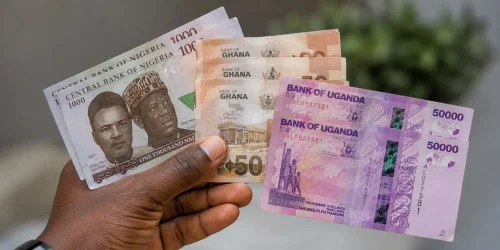
Ghana’s cedi, Nigeria’s naira and Uganda’s shilling all weakened against the dollar this week, with traders citing rebounding oil prices and renewed corporate demand for hard currency.

The cedi traded at 11.53 to the dollar on Thursday, weaker than 11.40 a week earlier, according to LSEG data. Andrews Akoto, head of trading at Absa Bank Ghana, said the dollar is likely to keep strengthening against the cedi as “energy sector FX demand firms alongside rebounding crude oil prices,” and noted the central bank’s last foreign exchange auction drew bids of 311 million dollars against an offer of just 110 million, pointing to unmet demand.

The naira weakened to 1,383 to the dollar on the official market, from 1,379 the previous week, and traded around 1,425 on the street market. Traders linked the pressure partly to the Dangote Petroleum Refinery’s move this week to begin pricing local fuel sales in dollars, which has boosted demand for hard currency, with one trader saying the pressure is likely to persist unless global risk appetite improves.

Uganda’s shilling weakened to 3,685/3,695 to the dollar from 3,680/3,690 a week earlier, with traders attributing the move to dollar demand recovering after large firms cleared mid month tax obligations, and expecting further pressure as import demand rebuilds heading into next week.

The naira’s weakness comes despite sweeping foreign exchange reforms Nigeria has pursued over the past two years, including improved dollar liquidity and tighter monetary policy that have reduced volatility even as demand for foreign currency continues to outpace supply, with lower oil receipts and rising import demand limiting the currency’s recovery.

Ghana’s cedi had been one of Africa’s strongest performing currencies earlier this year, boosted by stronger gold exports, improved foreign exchange inflows and progress under the country’s IMF reform programme, but has lost some of that momentum in recent weeks amid profit taking, seasonal dollar demand and uncertainty in global commodity markets.

The pressure on all three currencies comes as the US dollar strengthens broadly, with expectations that the Federal Reserve will keep interest rates elevated encouraging investors to favor dollar denominated assets over frontier and developing market currencies that depend heavily on portfolio investment and commodity export earnings.

Currency depreciation raises the cost of imports, adds to inflationary pressure and makes servicing foreign currency debt more expensive, risks that fall hardest on countries reliant on imported fuel, food and industrial inputs.

Analysts do not expect a return to the sharper currency volatility of previous years, citing relatively tight monetary policy at several African central banks and stronger export earnings from gold and crude oil that have helped some countries rebuild reserves, though the cedi, naira and shilling are likely to remain among the region’s most closely watched currencies as policymakers weigh exchange rate stability against growth.

Malaysian Banks Build AI But Won’t Trust It

Malaysian banks are rolling out artificial intelligence across fraud detection and customer onboarding, but only a quarter trust its outputs enough to act on them, a new industry survey found.

The findings come from a report titled “AI in Practice: How Malaysia’s Banks and DFIs are Adopting and Governing AI,” jointly produced by the Asian Institute of Chartered Bankers (AICB), research firm Ecosystm and the AICB Chief Risk Officers’ Forum. Drawing on responses from close to 90 senior leaders across commercial banks, digital banks, Islamic banks and development financial institutions (DFIs), the study was launched at AICB’s 4th Malaysian Banking Conference in Kuala Lumpur, opened by Finance Minister II Amir Hamzah Azizan and Bank Negara Malaysia Governor Abdul Rasheed Ghaffour.

The report found banks are already using AI in customer verification, fraud detection, anti money laundering and counter financing of terrorism monitoring, and workforce productivity tools, where machine learning can process large volumes of transactions faster than older rule based systems. Even so, just 25 percent of institutions said they trusted AI generated outputs enough to act on them in key business decisions, and only 20 percent said they actively encourage AI driven decision making across their workforce.

Institutional readiness remains uneven. Forty-four percent of banks and DFIs described themselves as still in a developing stage of AI readiness, while 15 percent said they had reached an established level and just 2 percent called themselves advanced. Only 26 percent said they had a defined AI strategy, even though 44 percent were already building custom AI solutions, a gap the report’s authors said points to isolated experimentation rather than enterprise wide programs tied to business goals.

Workforce constraints were widespread, with 79 percent of respondents reporting AI talent shortages or underdeveloped internal capabilities, and just 34 percent describing meaningful in house AI capability. Only 33 percent said they had structured AI governance and model risk management frameworks in place, a gap regulators are watching closely as they push banks to show AI models are transparent, auditable and subject to human oversight, particularly in lending, compliance and financial crime detection.

AICB Chief Risk Officers’ Forum chairman and RHB Banking Group Chief Risk Officer Dr Chong Han Hwee said AI introduces risks that extend beyond the technology itself, noting that “its risks do not reside solely within the model.”

The pattern mirrors trends elsewhere in Asia Pacific. A separate Money20/20 white paper found 61.2 percent of financial organizations across the region have adopted AI and machine learning, while 35.3 percent remain in an exploratory phase and 3.5 percent have not adopted the technology at all.

AICB said the findings offer a benchmark for the sector as it moves from experimentation toward wider implementation, with trust likely to hinge on stronger governance, more mature risk controls and greater investment in skilled staff.

AI Models Built On Pirated Data, Courts Find

0

Court rulings and settlements over the past two years have found that major AI companies, including some marketed as open source, trained models partly on pirated or scraped material.

The fullest account of how a major company obtained its training data comes from Kadrey v. Meta, a copyright suit brought by authors including Sarah Silverman, Richard Kadrey and Ta-Nehisi Coates. Unsealed court filings showed Meta engineers downloaded books through two piracy sites, Library Genesis and Z-Library, using torrents, with the decision escalated to chief executive Mark Zuckerberg according to internal messages cited by the plaintiffs. One engineer downloaded roughly 81 terabytes of material this way, and one Meta researcher objected internally at the time, writing that “using pirated material should be beyond our ethical threshold.”

A federal judge granted Meta summary judgment on fair use grounds in June 2025, finding the use of the books transformative enough to clear the legal bar, largely because the plaintiffs had not shown the market harm the law requires. A group of five major publishers filed a new class action against Meta and Zuckerberg in May 2026, arguing the earlier ruling overlooked evidence of market substitution. More than 50 AI copyright lawsuits have been filed in the United States since 2023, with roughly 30 still active.

Anthropic, the company behind the Claude chatbot, took a different path, agreeing in September 2025 to pay 1.5 billion dollars, roughly 3,000 dollars for each of about 500,000 books, to resolve Bartz v. Anthropic, a case brought by authors Andrea Bartz, Charles Graeber and Kirk Wallace Johnson over more than 7 million digitized books downloaded from Library Genesis and a second pirate site. It remains the largest publicly reported copyright recovery to date, though final court approval has not yet been granted as of mid-2026, after a judge deferred sign off pending a dispute over late opt-out requests. Anthropic also faces a separate active suit from Concord Music over its training practices.

The underlying ruling in the Anthropic case set out a distinction likely to guide future cases: training a model on legally acquired books can be considered transformative and protected under fair use, but downloading and keeping pirated copies is not, regardless of how the resulting model is later used. Anthropic agreed to destroy the pirated files as part of its settlement without admitting liability.

A different problem surfaced around Stable Diffusion, whose training data is public by design. In 2023, Stanford Internet Observatory researchers examined LAION-5B, an open dataset of billions of image-text pairs, and identified more than 3,200 suspected instances of child sexual abuse material, of which 1,008 were externally validated by the Canadian Centre for Child Protection. LAION, the German nonprofit behind the dataset, took it offline within days.

Stability AI, the company behind Stable Diffusion, separately faced a copyright claim from Getty Images over roughly 12 million photographs it said were used without a license. The UK’s High Court delivered a split verdict in November 2025, rejecting Getty’s copyright claims on the grounds that the model’s weights do not store the images used to train it, while finding limited trademark infringement over Getty’s watermark appearing in generated images, a decision that turned in part on Stability’s training having taken place outside UK jurisdiction rather than resolving whether scraping copyrighted images for training is lawful in principle.

Researchers have separately raised concerns about what they call open washing, where companies market AI systems as open while withholding the data, code and documentation needed to actually audit or reproduce them. Meta’s Llama models have drawn particular scrutiny for releasing model weights publicly while keeping the composition of their training data undisclosed. The Open Source Initiative published a formal Open Source AI Definition in October 2024 requiring enough information about training data to allow a model to be substantially recreated, a bar researchers say almost no major open model has met since.

Regulators are still catching up. The European Union’s AI Act now requires general purpose AI providers to publish a summary of the content used to train their models, and the UK government is due to publish its own report on copyright and AI training. In the United States, the issue remains largely in the hands of courts deciding cases individually, producing a split outcome so far: paying for data and transforming it appears to be lawful, while taking it for free from a pirate site is a cost that has eventually come due for the companies involved.

12 Killed In Konongo Highway Crash

0

Twelve people died and 44 were injured when a cargo truck, a passenger bus and a fuel tanker collided on the Kumasi to Accra highway near Konongo.

The Ghana National Fire Service (GNFS) confirmed the collision occurred in the early hours of Thursday near Konongo Anglican Basic School in the Ashanti Region. GNFS Public Relations Officer Alex King Nartey said the crash involved a Tata passenger bus travelling from Accra toward Bole, a DAF cargo truck carrying tomatoes from Kumasi to Accra, and an empty fuel tanker.

Preliminary findings from the GNFS indicate the cargo truck attempted to overtake another vehicle on a slope, lost control and collided head on with the oncoming bus, after which the fuel tanker ran into the crash site, though the service said the tanker did not significantly add to the casualties.

Nartey said the crash resulted in “12 fatalities, comprising nine males and three females,” while a separate 44 people were injured, 30 of them critically. Some earlier reports had put the toll as high as 13, citing eyewitness accounts, though the GNFS’s confirmed figure stands at 12.

The fire service, working with other emergency responders, extricated trapped victims, secured the scene and helped restore traffic flow along the highway after the crash.

The crash adds to a run of serious accidents on the Kumasi to Accra highway in the Ashanti Region in recent days, including a collision at Juaso on July 13 that killed three people and injured 15.

DDEP Bonds Lead GH¢954 Million GFIM Session

Ghana’s fixed income market processed about GH¢953.89 million across 419 trades on Thursday, with DDEP bonds outpacing treasury bills for the largest share of turnover.

Domestic Debt Exchange Programme (DDEP) bonds led the session on the Ghana Fixed Income Market (GFIM), recording GH¢482.19 million across 23 trades, ahead of treasury bills, which followed with GH¢350.42 million spread across 377 transactions, the widest participation of any segment. Sell and buy back trades on Government of Ghana (GoG) notes and bonds added GH¢109.12 million across 16 deals, while corporate bonds contributed GH¢12.16 million over three trades. No new or old GoG notes and bonds changed hands outside the DDEP and sell buy back categories.

The most active DDEP instrument was a bond maturing February 10, 2032, with a 9.10 percent coupon, which traded GH¢223.61 million across three deals at a yield of 14.54 percent and a closing price of 79.6460 cedis per 100 cedis face value.

Among treasury bills, a bill maturing July 12, 2027, was the most active, recording GH¢80.88 million across 34 transactions at a yield of 12.78 percent and a closing price of 88.7542 cedis.

The largest sell and buy back trade involved a bond maturing February 5, 2036, with a 9.70 percent coupon, which changed hands for GH¢36 million across two deals at a yield of 13.90 percent. On the corporate side, a bond maturing August 31, 2026, with a 13.00 percent coupon led activity, recording GH¢12.06 million across two trades at a closing price of 99.4176 cedis.

Thursday’s session brought total activity on the market to 419 transactions, with the DDEP bond segment’s outsized share standing out against the treasury bill dominated pattern that has typically characterized recent trading days.

GSE Composite Index Gains As Volumes Slide

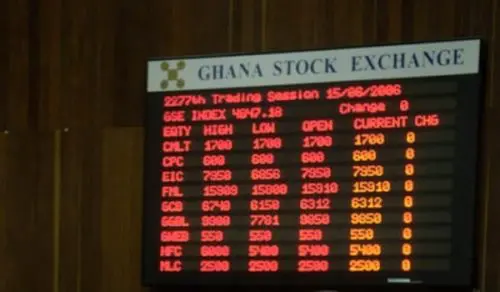
The GSE Composite Index rose to 14,896.64 points on Thursday, even as trading volumes and value fell sharply through the week on the Ghana Stock Exchange.

The benchmark GSE Composite Index (GSE-CI) gained 39.62 points on Thursday to close at 14,896.64, up from 14,857.02 the previous session, part of a 69.85 percent rise since the start of the year. The GSE Financial Stocks Index (GSE-FSI), which tracks listed banks and other financial institutions, moved in the opposite direction, falling 76.89 points to 8,181.33, though it remains up 76.05 percent year to date, ahead of the broader market’s gain.

Trading activity slowed steadily through the week. Volume peaked on Monday at close to 15 million shares worth GH¢289.95 million, before falling to 3.79 million shares on Tuesday, 6.28 million on Wednesday and just 2.39 million shares worth GH¢9.89 million by Thursday, the lightest session of the week.

Market capitalization eased over the same period, slipping from GH¢286.56 billion on Monday to GH¢284.74 billion by Thursday, even as the Composite Index itself edged higher, a divergence that reflects how the index’s movement is weighted toward specific large constituents rather than the market as a whole.

The week’s activity followed a period in which MTN Ghana and Kasapreko had featured among the exchange’s most actively traded stocks by value, a pattern that has driven much of the turnover on the bourse in recent weeks as investors continue to digest strong year to date gains across both the Composite and Financial Stocks indices.

Access Bank PLC Sells Down Ghana Stake

Access Bank PLC has sold a 7.44 percent stake in its Ghanaian subsidiary on the Ghana Stock Exchange, deepening local ownership of the bank.

The parent group sold 12,085,318 ordinary shares in Access Bank (Ghana) PLC on the Ghana Stock Exchange (GSE) on July 15, with all required regulatory approvals in place, including a no objection from the Bank of Ghana.

The bank said the sale drew strong participation from a diversified pool of buyers, including pension funds, institutional investors and high net worth individuals.

Managing Director Pearl Nkrumah said the transaction reflected the bank’s continued commitment to “deepening local ownership and liquidity in our shares,” adding that the focus remains on converting the scale the bank has built into sustained value for stakeholders.

Access Bank Ghana listed on the GSE through an initial public offering that made it the exchange’s 11th bank listing and the first by a Nigerian owned lender, raising GH¢29.62 million against a GH¢21 million minimum requirement at the time. Ownership following that listing was split roughly 75 percent to parent company Access Bank PLC, 10 percent to a Ghanaian pension fund and the remainder among other institutions and individuals, though the parent’s stake has since been trimmed through further sales such as this one.

The sale comes as Access Bank Ghana shares have performed strongly this year, having gained close to 97 percent since January, among the better performers on the exchange.

Access Bank Ghana is a full service commercial bank and member of the Access Group, one of Africa’s largest banking groups, offering services to corporate, commercial, retail and public sector customers across the country. IC Securities (Ghana) Ltd acted as adviser and executing broker on the transaction.

Community Development in action as Bekwai MP Ralph Poku-Adusei delivers

0

Residents of several communities within the Bekwai Constituency have received a major development boost following the latest interventions by the Member of Parliament for Bekwai, Hon. Ralph Poku-Adusei, aimed at improving transportation, education, and local economic activities.

The latest support package benefited the communities of Kensere-Biribowomanmu-Pampaso, Amanhyia, and Sarfokrom, where ongoing development projects initiated by residents received both financial and material assistance to speed up completion.

The presentation of the support was led by the Bekwai Constituency New Patriotic Party (NPP) Chairman, Mr. Fred Nkansah, together with members of the constituency executives, on behalf of the Member of Parliament.

At Kensere-Biribowomanmu-Pampaso, community members had appealed for urgent assistance after a recently reshaped road became nearly unusable due to persistent heavy rains. The muddy and slippery condition of the road disrupted transportation, making it difficult for farmers and traders to move their produce to nearby markets.

In response, Hon. Ralph Poku-Adusei donated several truckloads of gravel and provided an estimated GH₵15,000 to facilitate the compacting of the road surface.

The intervention is expected to restore safe access for motorists and pedestrians while improving economic activities within the area.

The MP also extended support to the community of Amanhyia, where work is nearing completion on a three-unit teachers’ quarters. Through Chairman Fred Nkansah, a cheque was presented to help complete the remaining works, including painting and final finishing before the facility is officially handed over.

The teachers’ accommodation project is expected to address the long-standing challenge of inadequate housing for educators, a situation that has contributed to teacher absenteeism and delays in reporting to school.

Education stakeholders believe the completion of the facility will create a better working environment for teachers while enhancing the quality of teaching and learning in the community.

Meanwhile, traders in Sarfokrom also received financial assistance to complete the construction of a modern market shed. The support was presented through the Assembly Member to help accelerate work on the project.

When completed, the market shed will provide traders with a secure and comfortable place to conduct business, improve trading conditions, and stimulate commercial activities within the community.

Addressing residents after the presentations, Hon. Ralph Poku-Adusei reiterated that sustainable development is most effective when communities identify their own priorities and work together towards achieving them.

He noted that his responsibility as a Member of Parliament is to complement such initiatives by providing the necessary resources needed to transform community ideas into completed projects.

According to the MP, supporting locally driven development initiatives ensures that public resources directly address the most pressing needs of the people while strengthening community ownership of development projects.

Community leaders and beneficiaries expressed gratitude to Hon. Ralph Poku-Adusei and the Bekwai Constituency NPP leadership, led by Chairman Fred Nkansah, for responding promptly to their requests and demonstrating commitment to improving living conditions across the constituency.

The latest interventions further reinforce the MP’s development agenda, which continues to prioritize practical solutions that improve livelihoods, strengthen education, and expand economic opportunities throughout the Bekwai Constituency.

Img Wa


NYA Falls Short On Disability Inclusion Target

0

The National Youth Authority reached just 1.5 percent of its own five percent target for disability inclusion in its apprenticeship programme last year, even as its chief executive urged young Ghanaians on Wednesday to become job creators rather than job seekers.

The gap matters because it sits directly against the inclusive language the same official used at the same event, raising the question of how far the agency’s rhetoric on reaching every young person matches its own results on the ground.

Osman Ayariga, chief executive of the National Youth Authority (NYA), addressed the World Youth Skills Day 2026 event organised by the Commission for Technical and Vocational Education and Training under the theme “Skills for a Shared Future,” held at the Accra City Hotel. He told participants that government cannot employ every young person and that entrepreneurship, innovation and skills development must now carry more of that weight.

“Government cannot employ every young person. We must empower young people to become job creators instead of only job seekers,” he said.

Ayariga pointed to the National Apprenticeship Programme, Youth Resource Centres and the Youth Industrial Parks Initiative as the Authority’s main tools for building practical skills, mentorship and access to equipment for young entrepreneurs. He said the Authority is working to reach young women, persons with disabilities, rural youth and other vulnerable groups, adding that development is only meaningful when opportunities reach everyone.

That inclusion goal has proven harder to meet than to state. Ayariga disclosed that the National Apprenticeship Programme set a target of allocating five percent of last year’s training slots to persons with disabilities, but only 1.5 percent of beneficiaries were people with disabilities, a shortfall he did not attribute to a specific cause.

He called on industry players to expand internships, apprenticeships and mentorship opportunities for young people, and urged parents to support technical and vocational career paths rather than steering children only toward traditional academic routes. He listed digital skills, artificial intelligence literacy, financial literacy, communication, teamwork and adaptability as the competencies young people need for the future economy.

Ayariga said the National Youth Authority would continue working with government, the private sector and development partners to expand opportunities for young Ghanaians, adding that investing in youth skills now secures the country’s prosperity later.

World Youth Skills Day is marked globally each July 15 under a UNESCO-led framework promoting vocational, digital and entrepreneurial skills among young people.

Obom Chief Alleges Torture By Kasoa Police

The Asafoatse of Obom, Prince Nii Amartey, has accused Kasoa Divisional Police officers of torturing him for hours after arresting him over a 15 year old murder allegation he denies.

None of the specific claims in this account have been independently verified, and the Ghana Police Service has not issued a public response to them. The allegation lands, however, against a wider record of complaints about policing conduct in Kasoa that predates this case, which is why rights advocates say it deserves an independent look rather than an internal review alone.

According to Prince Nii Amartey, the ordeal began on Wednesday, July 1, when workers at his block factory told him prospective buyers wanted to purchase about 3,000 building blocks. He said the supposed buyers turned out to be plain clothed police officers who told him only that he would learn the reason for his arrest once they reached the station. At the Kasoa Divisional Police Headquarters, he said, investigators accused him of murdering a man 15 years earlier over a land sale at Adeiso, an allegation he says he challenged repeatedly and that officers never supported with evidence.

Prince Nii Amartey alleges that his denials led a Crime Officer to order subordinates to assault him, first behind the station, where he says he was handcuffed and suspended from a tree for about 30 minutes, and later in a locked room. He said he was moved that night to an isolated bush area, where he received a phone call telling him to say his last prayers.

“I honestly believed I would never return home alive,” he said.

He also alleges that GH₵7,000 in cash and his mobile phones were seized during his arrest and have not been returned. He says he collapsed in custody, was treated first at a Kasoa clinic and later at Ridge Hospital in Accra and the Obom Polyclinic, and was eventually granted police enquiry bail.

His family says lawyers who went to the station asked police to produce the complainant and relatives of the alleged murder victim and that neither appeared, a gap they say deepened their doubts about the case.

Kasoa has drawn complaints of police misconduct before. A US State Department human rights report on Ghana previously documented a case in the town in which officers allegedly demanded payment from a crime victim before pursuing prosecution, part of a broader pattern the report said made Ghanaians reluctant to file formal complaints against police over fears the force used would be dismissed as justified.

Prince Nii Amartey is calling on President John Dramani Mahama, the Inspector General of Police and the Interior Minister to order an independent investigation. He says he believes the case may be connected to his resistance to an alleged land grabbing scheme in the Obom area, a link that has not been established. He says he is seeking accountability rather than revenge.

The Ghana Police Service has not commented publicly on the allegations, and no charges or internal findings have been announced.

Vietnam, AfCFTA Secretariat Explore Stronger Trade Partnership

The African Continental Free Trade Area (AfCFTA) Secretariat has reaffirmed its commitment to deepening economic cooperation with global partners following high-level discussions with a delegation from the Socialist Republic of Vietnam aimed at expanding trade and investment ties between Africa and Southeast Asia.

On behalf of the Secretary-General of the AfCFTA Secretariat, H.E. Wamkele Mene, the Chief of Staff, Mr. Rui Livramento, welcomed a high-level Vietnamese delegation led by the country’s Deputy Minister of Foreign Affairs, Hon. Nguyen Minh Hang, at the AfCFTA Secretariat headquarters in Accra on 2 July 2026.

The meeting underscored the growing importance of strategic partnerships in supporting Africa’s continental integration agenda and unlocking new opportunities for trade, investment, industrialization and sustainable economic development.

Discussions focused on exploring practical areas of cooperation between the Government of Vietnam and the AfCFTA Secretariat, with particular emphasis on enhancing trade relations, promoting investment, strengthening private sector collaboration, and facilitating knowledge exchange in areas that can accelerate the implementation of the AfCFTA.

The engagement comes at a time when the AfCFTA has transitioned from negotiations to full-scale implementation, with increasing emphasis on building partnerships that enhance Africa’s productive capacity, improve market access and integrate African businesses into regional and global value chains.

Vietnam, one of Asia’s fastest-growing economies and an emerging manufacturing and export powerhouse, has developed extensive expertise in industrial development, export promotion, digital transformation and SME competitiveness. These experiences present valuable opportunities for collaboration with African countries seeking to leverage the AfCFTA to drive industrialization and expand intra-African trade.

The meeting also reflected the AfCFTA Secretariat’s broader strategy of engaging international partners that can contribute technical expertise, investment and innovation to support the realization of a single African market of more than 1.4 billion people with a combined GDP exceeding US$3.4 trillion.

As implementation of the Agreement gathers momentum across the continent, the AfCFTA Secretariat continues to strengthen diplomatic and economic partnerships with countries and institutions around the world that share Africa’s vision of creating a more integrated, competitive and prosperous continental economy.

The discussions concluded with a shared commitment to deepen engagement and explore mutually beneficial initiatives that will strengthen economic cooperation between Vietnam and Africa under the framework of the African Continental Free Trade Area.


Women Must Be At The Centre Of Africa’s Trade Transformation – AfCFTA Secretary-General

0

The Secretary-General of the African Continental Free Trade Area Secretariat, H.E. Wamkele Mene, has asserted that Africa’s economic transformation will depend significantly on the ability of women entrepreneurs to participate fully in continental trade,

Speaking at the HerAfCFTA Regional Conference 2026 in Abuja, Nigeria, H.E. Mene emphasized that women are already among the most active drivers of trade across Africa and must therefore be placed at the centre of the continent’s economic integration agenda.

He noted that unlocking the full potential of women-owned and women-led enterprises is not only a matter of inclusion, but also a strategic requirement for Africa’s long-term growth, industrialization and prosperity.

According to the Secretary-General, the AfCFTA provides a historic opportunity to address the long-standing barriers that have prevented many women from expanding their businesses beyond national borders. These barriers include limited access to finance, inadequate trade information, high transportation and logistics costs, complex customs procedures, weak business networks and restricted access to formal markets.

H.E. Mene described the AfCFTA Protocol on Women and Youth in Trade as the first legally binding instrument of its kind in the world which is a major instrument designed to respond to women and youth-led businesses.

The Protocol is intended to create a more inclusive continental trading system by removing obstacles that disproportionately affect women and young entrepreneurs. It also seeks to expand access to finance, improve market opportunities and strengthen the participation of women in higher-value sectors of the African economy.

These sectors include manufacturing, logistics, digital technology, mining, agriculture, professional services and regional value chains. Increased participation in such sectors would enable women to move beyond small-scale and informal trade into more productive, competitive and export-oriented businesses.

H.E. Mene stressed, however, that the adoption of the Protocol alone would not be sufficient. Its impact will ultimately depend on how effectively governments and other stakeholders translate its provisions into practical support for women entrepreneurs.

This will require coordinated action by African governments, the private sector, development partners, banks and other financial institutions. National institutions will also need to align their trade, industrial, financial and entrepreneurship policies with the objectives of the Protocol.

Priority interventions should include affordable financing, targeted training, improved digital and physical infrastructure, simplified trade procedures and stronger cross-border business networks. Women entrepreneurs must also be provided with timely information on market opportunities, rules of origin, customs requirements and available trade-support services.

Financial institutions have an especially important role to play by designing products that reflect the realities of women-owned businesses, many of which struggle to meet conventional collateral requirements despite operating viable enterprises.

The private sector can also support implementation through supplier development programmes, mentorship, technology transfer and the inclusion of women-owned enterprises in regional supply and value chains.

The Secretary-General’s remarks reinforced the broader vision of the AfCFTA as an instrument for inclusive economic transformation. As implementation gathers momentum across the continent, the Agreement is expected to create new opportunities for enterprises to access larger markets, attract investment and expand production.

For these benefits to be widely shared, however, women must not remain on the margins of Africa’s trading system. They must be supported as producers, manufacturers, exporters, service providers and investors.

The HerAfCFTA Regional Conference therefore served as an important platform for strengthening collaboration and renewing commitment to turning the Protocol on Women and Youth in Trade into tangible opportunities.

Africa’s economic future, H.E. Mene concluded, will be stronger when women are equipped with the finance, skills, infrastructure and networks required to grow their businesses and trade confidently across the continent.

Finding My Place at UBA: A Creative’s GMAP Journey

0

When Adelaide Phoebi Nettey graduated from Kwame Nkrumah University of Science and Technology (KNUST), she never imagined her passion for design would lead her to banking.

Today, she is a Graphic Artist at UBA Ghana, having joined through the Graduate Management Acceleration Programme (GMAP).

For many graduates, landing a meaningful first job is a challenge.

Through GMAP, UBA is creating opportunities for young professionals from diverse backgrounds to learn, grow, and thrive.

“My GMAP Journey at UBA Ghana” is a series featuring participants as they share their experiences and the lessons shaping their careers.

This week, Adelaide shares how GMAP helped her find her place at UBA Ghana.

1. Before joining GMAP, what did you think working in a bank would be like and what’s been the biggest surprise?

To be honest, I thought banking was mainly about the people you see in the banking hall. I had no idea how much work happens behind the scenes. The biggest surprise has been seeing how many different departments, teams and processes work together to keep everything running smoothly.

2. Who were you before GMAP, and how has the program changed you so far? What part of yourself have you discovered most?

Before GMAP, I was an outsourced staff. The program taught me to embrace opportunities when they come and showed me that I am capable of growing beyond my comfort zone.

3. What has been your toughest moment in the program, and how did you get through it?

One of the toughest parts was learning alongside colleagues from different African countries.

Communication wasn’t always easy because many discussions required translation, but there wasn’t always enough time for that. We also faced challenges with the exam browser. Honestly, I got through it with the support of my Ghanaian teammates. We prepared together, encouraged one another, and kept reminding ourselves why we started.

4. What’s something about working in a bank that people completely misunderstand?

Personally, I think a lot of people assume that if you work in the back office, your job isn’t very busy or demanding because you’re not dealing directly with customers. That’s far from the truth. There is a lot of work happening behind the scenes, and it requires you to multitask, collaborate with others, solve problems quickly, and deliver quality work within tight deadlines.

5. What skill has mattered most in your role that you didn’t learn in school? How did you learn it on the job?

The most important skill I’ve gained is adaptability. I’ve also learned how valuable it is to understand different parts of the team’s work so I can step in and help when needed. I developed these skills by being willing to learn, observing my colleagues, asking questions, and taking on new responsibilities whenever the opportunity came.

6. How has this experience changed your career goals?

This experience has shown me that I can achieve more than I ever thought was possible. It has taught me that with dedication, hard work, and a willingness to learn, I can succeed in banking or any career path I choose to pursue. It has given me the confidence to embrace new opportunities and keep challenging myself to grow.

7. What honest advice would you give to someone applying for GMAP today? And what advice would you give to young people exploring their work options?

Come with an open mind and be ready to learn. The program is challenging, but every experience helps you grow. Also, don’t let your academic background limit you. Be willing to learn, adapt, and take on new opportunities.

8. How did you react to your first salary, and what did you buy for yourself?

Receiving my first salary felt unreal because… I mean wow. It reminded me of the fact that hard work pays off and that motivated me to keep giving my best. I honestly can’t remember the first thing I bought for myself, but I clearly remember setting aside my tithe as a way of thanking God for bringing me this far.

9. Beyond the title or pay, what has this experience meant to you personally?

This experience has helped me grow both personally and professionally. It has built my confidence, expanded my knowledge, and shown me the value of embracing new challenges.

10. Would you recommend UBA as an employer of choice and why? what about the culture, people, or opportunities makes it stand out for you?

Absolutely. I would recommend UBA any day because it provides great opportunities to learn, grow, and challenge yourself. The work environment is supportive, the people are always willing to help, and you’re encouraged to think on your feet and develop new skills. It’s a place where you can grow both personally and professionally.

Beyond developing future leaders, the UBA GMAP continues to show that talent comes in many forms. By investing in young professionals from diverse backgrounds, the programme provides a platform for individuals like Adelaide to bring their unique skills, embrace new opportunities, and grow within the banking industry.

Morocco Commits 400 Troops To Gaza Force

0

Morocco signed an agreement in Rabat on Wednesday committing 400 troops to the international force tasked with stabilizing Gaza during its postwar transition.

The commitment puts a concrete number on what has so far been described only in general terms, and it lands awkwardly at home. Morocco normalized relations with Israel in 2020 under the Abraham Accords, and that normalization has drawn repeated street protests in Rabat since the Gaza war began, which makes this deployment a domestic balancing act as much as a foreign policy statement.

Foreign Minister Nasser Bourita and Defence Minister Delegate Abdeltif Loudyi signed the agreement on behalf of Morocco, receiving Nickolay Mladenov, the high representative of the Gaza Peace Council, and the commander of the International Stabilization Force (ISF). Officials said Morocco is the first country to formalize an agreement of this kind with the Peace Council, building on commitments it made at the council’s founding meeting in Washington in February.

Under the deal, Morocco will send senior Royal Armed Forces officers into the ISF joint command, where they are expected to help monitor the ceasefire, secure aid corridors and support border security. Personnel from the Royal Gendarmerie and the General Directorate of National Security will help train a new Palestinian police force meant to gradually take over public order duties. Morocco also plans to build a military field hospital to serve both the international force and the Gazan population, and to fund programmes aimed at countering extremism and building tolerance.

Bourita described the agreement as consistent with Morocco’s long standing position on the conflict. “The Royal Vision has always been consistent,” he said, reaffirming Morocco’s support for a Palestinian state on the 1967 borders with East Jerusalem as its capital, alongside Israel.

The ISF operates under a mandate set out in United Nations Security Council Resolution 2803, adopted in November after months of negotiation over whether the force would need a UN mandate at all. Officials describe its role as protecting civilians, enabling the return of displaced residents and creating conditions for reconstruction, not acting as an occupying force or taking sides.

Morocco has backed its position with aid as well as diplomacy. The kingdom says it has delivered close to 280 tonnes of humanitarian and medical aid to Gaza since the war began, including a shipment moved by an overland route negotiated with the parties involved, and its Bayt Mal Al Quds Agency has channeled more than 2.2 million dollars toward social, health and heritage projects benefiting Palestinians, particularly in East Jerusalem. Officials say Morocco was also the first country to pay into the Peace Council’s budget.

Reconstruction needs in Gaza remain enormous, with hospitals, schools, water networks and housing severely damaged and rebuilding costs estimated in the tens of billions of dollars. Moroccan officials say the ISF role is meant to support that recovery rather than substitute for a broader political settlement, which they maintain still depends on an eventual two state solution.

Bayport Profit Triples On Deposit Shift

0

Bayport Savings and Loans more than tripled its profit in the first half of 2026, as a shift toward customer deposits reshaped how the lender funds itself.

Unaudited results for the six months ended June 30 showed profit after tax rising to GH¢82.52 million from GH¢26.47 million a year earlier, a 211.8 percent increase, while profit before tax nearly tripled to GH¢118.26 million from GH¢38.55 million. Net interest income doubled to GH¢220.22 million.

The improvement tracked a continued shift in Bayport’s funding mix. Customer deposits jumped to GH¢1.55 billion from GH¢471.59 million, more than tripling, while borrowings fell to GH¢386.83 million from GH¢481.04 million and loans from shareholders dropped to GH¢30.96 million from GH¢106.55 million, continuing a move away from costlier wholesale funding that the company has pursued since 2025.

Total assets grew 77.1 percent to GH¢2.44 billion, driven by a 68 percent rise in loans and advances to customers, to GH¢1.87 billion, and cash and cash equivalents that more than quadrupled to GH¢325.09 million.

Asset quality improved alongside the growth. The non performing loan ratio fell to 8.1 percent from 12.6 percent a year earlier, continuing a decline that saw the company’s full year 2025 ratio already meet the Bank of Ghana’s maximum NPL threshold set for the end of 2026, a year ahead of schedule. The capital adequacy ratio edged up to 12.2 percent from 11.9 percent, above the regulatory minimum, and the company reported no defaults on statutory liquidity requirements.

Earnings per share rose to 0.7033 pesewas from 0.2256 pesewas. The results extend a run of stronger performance for the payroll lender, which posted profit before tax above GH¢100 million for the first time in full year 2025 after years of relying heavily on borrowings and shareholder funding.

Bayport, a subsidiary of Mauritius based Bayport Management Ltd, is licensed by the Bank of Ghana to provide micro credit and other financial services and operates from 44 locations nationwide, including 10 service centres and 33 agency offices. The results were signed by directors Akwasi Aboagye and Pearl Esua-Mensah.

KOSPI Swings Test Asia’s Markets, China Watches

0

Wild swings in South Korea’s KOSPI, which briefly fell into a bear market before rebounding, are prompting investors to reassess risk across Asia, including in China.

The index hit an intraday record of 9,385.59 points on June 19 before tumbling more than 20 percent to enter a technical bear market on July 8, when it closed at 7,246.79. It has since clawed back some of those losses and remains up around 76 percent for the year, still the best performing major equity market globally despite the turmoil.

Much of the volatility has centered on Samsung Electronics and SK Hynix, which together now account for roughly half of the KOSPI’s total weight, up from about a quarter at the end of last year, and drove close to 70 percent of the index’s gains before the sell off. Single stock leveraged exchange traded funds tied to the two chipmakers, popular with South Korea’s retail investors known as the Ants, have amplified the swings, triggering repeated trading halts on the Korea Exchange, including its 37th such pause of the year this week.

The turbulence stems largely from a reassessment of artificial intelligence spending, after doubts emerged on Wall Street over whether heavy AI infrastructure investment by companies such as Microsoft and Meta will generate matching returns, triggering a broader pullback in chip stocks that spread from the United States to Asia. Analysts have also pointed to South Korea’s central bank, which raised its benchmark rate a quarter point to 2.75 percent this week in a new tightening cycle aimed at curbing inflation.

Because South Korea and China compete for many of the same international investment flows, analysts said a prolonged correction in Seoul could push some investors toward Chinese equities if valuations there look more attractive, while renewed confidence in Korean stocks could keep drawing capital away from China. The effect on Chinese markets is expected to depend on what is driving the swings: if it reflects profit taking after a strong rally, the spillover should stay limited, but broader doubts about Asian growth or earnings could pressure Chinese stocks too.

China’s equity market has struggled to sustain momentum despite a series of government support measures, weighed down by soft domestic demand, a prolonged property downturn and slower growth, even as authorities have tried to encourage longer term investment.

Technology stocks are likely to remain the main channel for any spillover, since Chinese markets are increasingly driven by technology and AI related companies just as South Korea’s benchmark is dominated by semiconductor firms. A shift in sentiment toward the sector could ripple across both markets.

While there is no sign of immediate contagion, investors are watching earnings, monetary policy and geopolitical developments for signs of where capital flows across Asia head next, with South Korea’s post correction direction seen as an early signal for confidence in the region’s equities more broadly.

Sam George: Regulation Must Match Pace Of Trust

0

Ghana must move faster on digital infrastructure and cybersecurity to keep public trust in digital finance, Communications Minister Sam George said, days after regulators revoked Zeepay’s licence.

Speaking at the Financial Architecture Summit in Accra, held under the theme “Innovation for Stability: Central Banking, Digital Finance and the New Architecture of Ghana’s Financial Future,” George said public confidence, not technology alone, would determine whether the country’s expanding digital payments sector succeeds. “Innovation must move at the speed of opportunity, but regulation must move at the speed of trust,” he said.

He identified interoperability, inclusive by design digital systems and cyber resilience as the three pillars he said should underpin the next phase of Ghana’s digital and financial transformation, alongside reliable digital infrastructure and trusted digital identity systems.

George said the ministry measures digital transformation by whether it changes an ordinary life for the better, and called on financial institutions, fintech firms and technology providers to build secure, transparent and accessible digital solutions that widen financial inclusion while protecting consumers.

Bank of Ghana Governor Johnson Pandit Asiama, who also addressed the summit, announced that the central bank had completed a new Digital Banking Framework and accompanying draft guidelines, now ready for stakeholder consultation ahead of implementation. He said the framework reflects a financial system no longer defined only by banks and banking halls but increasingly by digital platforms and payment networks.

Asiama also updated progress on regulating virtual assets following last year’s passage of the Virtual Asset Service Providers Act, saying the central bank and the Securities and Exchange Commission are developing licensing requirements and implementation guidelines. He pointed to a new directive requiring financial institutions to strengthen board level expertise in cyber risk management, alongside what he described as Ghana’s first comprehensive framework governing the use of artificial intelligence in areas such as fraud detection, credit scoring and customer service, plus new rules on the adoption of cloud technology.

The summit’s emphasis on trust and oversight comes days after the Bank of Ghana revoked the electronic money licence of Zeepay, one of the country’s best known fintech firms, over cash backing shortfalls and unresolved governance concerns, a case officials say underscores why closer coordination between regulators, banks and technology firms is needed as Ghana expands its digital financial infrastructure.

CLGA Flags Wild Swings In Assembly Rankings

0

Some Ghanaian assemblies that topped last year’s financial management rankings have fallen to around 90th this year, the Centre for Local Governance Advocacy (CLGA) has warned.

Speaking at a press briefing on the 2025 Public Financial Management Compliance League Table (PFMCLT), CLGA Board Chairman Bernard Joe Appeah said 153 of Ghana’s 261 Metropolitan, Municipal and District Assemblies (MMDAs) scored above the benchmark in the latest assessment, up from just 12 the year before, part of a steady rise since the table launched in 2023.

“Some assemblies were 1st in 2024 and are around the 90th position in 2025,” Appeah said, calling for more consistent performance so that well performing assemblies can serve as models for others.

La Dade Kotopon Municipal Assembly topped the 2024 edition of the table, though CLGA has not specified which assemblies it was referring to in describing this year’s sharp reversals. Bia East District Assembly led the 2025 rankings, with Nkwanta South Municipal Assembly climbing from last place to second and Asokwa Municipal Assembly rising from 46th to third, showing gains can move just as sharply in the other direction.

Appeah also raised concerns about a persistent gap between internal and external audit findings at many assemblies, saying more work is needed to understand why the two frequently diverge, and urging closer scrutiny of the issue rather than treating it as a routine discrepancy.

Beyond financial management, Appeah called on assemblies to improve public engagement, noting that although the law requires them to hold town hall meetings and report their performance to residents, many rarely do so. He said stronger citizen participation remains essential to improving local governance and speeding up development.

He also urged journalists to maintain their watchdog role without partisan influence, saying reporters should understand governance issues well enough to help the public make sense of them.

The PFMCLT, an independent CLGA initiative, assesses MMDAs on development planning, budgeting, procurement, accounting, financial reporting, internal auditing and external auditing.

Analyst Urges Tiered Rules For Mobile Money

0

Banking analyst Richmond Atuahene is calling for a major overhaul of Ghana’s financial regulation, arguing oversight of mobile money has not kept pace with its growth.

Drawing on recommendations from the International Monetary Fund (IMF) and the Financial Stability Board (FSB), Atuahene argues Ghana needs what he calls activity based regulation, under which any provider performing bank like functions, such as holding customer funds or extending credit, would face comparable rules regardless of whether it is a bank, telecom company or fintech.

He proposes a tiered licensing system in which requirements scale with an institution’s size and systemic importance, so that dominant operators such as MTN Mobile Money would face bank level standards on capital, customer fund protection, liquidity, governance, cybersecurity and anti money laundering controls, while smaller providers continue under lighter rules. He also wants mandatory interoperability so customers can move money across networks and banks without friction.

Atuahene also wants an expanded regulatory sandbox to let fintech firms test new products under supervision before full approval. Ghana already operates a sandbox through the Bank of Ghana, which admitted six fintech firms into the programme in January, and the central bank has separately announced plans to build a continental sandbox and a dedicated fintech legal framework as part of a broader push unveiled at this year’s 3i Africa Summit.

He argues no single regulator can adequately supervise mobile money on its own, since it sits across banking, telecoms, cybersecurity and data protection, and wants closer coordination between the Bank of Ghana, National Communications Authority and Cyber Security Authority through shared information, joint inspections and coordinated risk assessments.

Atuahene also wants a risk based approach that concentrates supervisory resources on larger institutions and higher risk transactions rather than applying identical rules to every provider, arguing this would strengthen stability without adding unnecessary burden on smaller operators.

Looking further ahead, he proposes restructuring Ghana’s financial oversight around the internationally used Twin Peaks model, splitting prudential supervision of banks, insurers and major mobile money operators under the Bank of Ghana from a dedicated Financial Conduct Authority handling consumer protection and market conduct, with a Financial Stability Council monitoring risks across the whole system. South Africa already runs a version of this model, with its Prudential Authority overseeing soundness and a separate Financial Sector Conduct Authority handling conduct.

Atuahene said the goal is not to restrain mobile money’s growth but to make sure “regulation evolves alongside innovation,” calling a smarter, risk based and activity focused framework essential to protecting consumers and preserving Ghana’s long term financial stability.

Tinubu Says Nigeria Making Foundational Economic Progress

0

President Bola Tinubu said Nigeria’s economy is making serious foundational progress despite the pain of reforms his administration has pursued since taking office in 2023.

Tinubu made the comment while receiving a delegation from Deloitte Africa, led by the firm’s Africa chief executive, Ruwayda Redfearn, at the State House in Abuja on Wednesday, a meeting also attended by Finance Minister Taiwo Oyedele and Nigeria Revenue Service chairman Zacch Adedeji. A statement from presidential spokesperson Bayo Onanuga quoted the president describing the reform process as difficult but worthwhile, saying it had been “a harvester of good things, if implemented well.”

Tinubu did not specify which measures he meant, but his government has pointed to the removal of a longstanding fuel subsidy, the unification of the exchange rate system and a package of tax reforms carried out through the newly established Nigeria Revenue Service as the core of the changes since he took office in May 2023.

Independent data lends some support to Tinubu’s account. Official figures cited by the tax authority show headline inflation, which peaked at 34.8 percent in December 2024, easing to about 15.9 percent by mid-2026, while external reserves have grown from under 4 billion dollars in 2023 to more than 50 billion dollars, aided by the subsidy removal and tighter monetary policy. GDP growth has held near 4 percent over the period, and the naira has stabilized under the unified exchange rate system after a sharp initial devaluation.

The picture remains mixed for many Nigerians. Inflation, though down from its peak, remains in double digits and well above pre reform levels, and roughly a third of the population was estimated to be living in extreme poverty in 2025. Public debt has also risen in naira terms even as the debt to GDP ratio has eased.

Deloitte Africa’s leadership praised the reform effort while stressing more needs to be done to translate the gains into everyday benefits. Deloitte West Africa chief executive Yomi Olugbenro said the foundation had been solidly laid, but that the bigger task now was cascading the reforms down to ordinary Nigerians.

Tinubu urged Deloitte, which reported 74 billion dollars in global revenue in 2025, to expand training and recruitment of young Nigerians as part of any deeper partnership with the government.

New NITA Boss Takes Over Amid Reform Push

0

Ghana has named Nana Yaw Amoah-Yeboah as the new head of the National Information Technology Agency (NITA), as government moves to split the agency’s regulatory and commercial functions.

Minister for Communication, Digital Technology and Innovations Samuel Nartey George introduced Amoah-Yeboah as NITA’s new Director-General, succeeding Dr. Mark-Oliver Kevor, who stepped down last month to focus on his re-election bid as the NDC’s Eastern Regional Chairman.

George praised Kevor’s tenure, crediting him with strengthening the National Data Centre and advancing digital government initiatives, work that built on Kevor’s own effort last year to elevate NITA from an agency into a fuller regulatory authority. “We are now transforming NITA from an agency into an authority,” Kevor had said at the time.

George said the new Director-General takes over as government prepares a proposed NITA Act that would separate the agency’s regulatory and commercial functions, a change he said is meant to strengthen governance, improve transparency and position NITA as a more effective regulator of Ghana’s expanding digital economy. He also announced that all payments tied to infrastructure managed by NITA would now go directly to the agency, a move intended to protect public assets and tighten accountability over the country’s digital infrastructure.

George described Amoah-Yeboah as an experienced technology professional with more than a decade in the sector, including work on major government digital transformation projects, and urged him to keep an open door leadership style as the agency evolves.

NITA Board Chair Estelle Akofio-Sowah said she was confident in Amoah-Yeboah’s ability to lead the agency’s next phase and pledged the board’s full support. In his acceptance remarks, Amoah-Yeboah thanked the government for its confidence and pledged to work with the board, management and staff to deliver a secure, innovative and digitally inclusive public service.

EEZZY Foundation Boosts Farmers Day Prize Package

0

The EEZZY Group Foundation has donated a pickup truck, tractor and 20 motorcycles to Ghana’s 42nd National Farmers’ Day awards, adding to a growing list of corporate contributions.

The items were presented at the Ministry of Food and Agriculture (MoFA) in Accra, and Minister Eric Opoku described the donation as one of the largest corporate contributions toward this year’s celebration, aimed at supporting President John Dramani Mahama’s Agriculture for Economic Transformation Agenda.

Opoku said the 2026 National Best Farmer will receive an enhanced package including the EEZZY donated pickup and tractor, a GH¢1.2 million cash prize committed by the Agricultural Development Bank, a longstanding sponsor of the award, along with assorted modern farm inputs and equipment. He said two other corporate partners had already donated additional pickup trucks, bringing the total secured for this year’s awards to three, alongside a 50 seat bus for the country’s best senior high school in practical agriculture.

“When agriculture goes wrong, nothing else in this country can go right,” Opoku said, stressing the sector’s importance to national food security.

Opoku said every donation received last year reached its intended farmer beneficiaries, and pledged the same this year. He added that the National Farmers’ Day Planning Committee, chaired by John Dumelo, would soon publish official bank account details for individuals and organizations wishing to contribute, with the Ministry set to publicly account for all cash and in kind donations once the fundraising drive closes.

The EEZZY Group Foundation’s support for Farmers’ Day follows a similar contribution from Development Bank Ghana, which donated a tractor for the award scheme in November 2025, and comes weeks after EEZZY separately committed GH¢800,000 to support Team Ghana’s preparations for the Commonwealth Games in Glasgow.

This year’s National Farmers’ Day, themed “Our Farmers, Our Food, Our Future,” will be held in Sunyani, the Bono Regional capital, on December 4, preceded by a five day National Agricultural Fair from November 30, organized in partnership with Agrihouse Foundation. The Ministry has approved 32 national award categories spanning crop production, livestock, fisheries, cocoa, research and other areas of the sector.

Iran Retaliates Striking Pentagon Bases in Bahrain, Kuwait and Jordan

During the funeral of the martyred Supreme Leader attended by tens of millions, United States President ordered the bombing of coastal areas

Geostrategic Analysis

Just weeks after the signing of a Memorandum of Understanding (MoU) between the US government and the Islamic Republic of Iran, President Donald Trump resumed the bombing of this West Asian state.

Since April 7 when the administration in Washington claimed it would seek a peace agreement with Tehran, Iran has been viewed internationally as the victor in the war which was launched by the US along with its closest ally in Tel Aviv.

During the opening hours of the unprovoked attacks on February 28, the Ayatollah Sayyed Ali Khamenei and members of his family were killed. Also, an elementary school in the southern region of Iran at Minab was bombed by Pentagon warplanes killing more than 175 children.

Despite these atrocities and more, the Islamic Revolution Guard Corps (IRGC) has been able to wage a defensive campaign against the occupation state of Israel along with US military forces which are scattered throughout West Asia. The strategic Strait of Hormuz, one of the world’s most important shipping routes, has become a pivotal area in determining the status of the international economy.

The funeral of the martyred Supreme Leader was attended by an estimated 47 million people in both Iran and neighboring Iraq. People from throughout Iran celebrated the life of Khamenei while pledging to avenge his targeted assassination.

During the summit of the North Atlantic Treaty Organization (NATO) in Turkiye in early July, Trump spoke disparagingly regarding the Islamic Republic. In the wave of strikes which came during and after the NATO gathering, the Pentagon bombed civilian infrastructure along with imposing another blockade against Iranian ports in the Persian Gulf region.

In subsequent days additional provocations were carried out by the US. These airstrikes and continuing threats were in line with the comments made by the president at the NATO summit where he berated other members of the alliance for not joining the Washington-Tel Aviv war against Iran.

The Memorandum of Understanding between Iran and the US was designed to include Lebanon where Tel Aviv has been bombing for several months. Civilians have been killed in Beirut and other cities under the guise of eliminating the Hezbollah resistance forces which have been active particularly in the southern rural areas.

The White House had falsely stated that the pause in fighting after April 7 when Trump had threatened to eliminate Iran as a civilization, did not include Lebanon. Moreover, the MoU did not include any direct involvement by the occupation regime in Palestine. Consequently, the struggle for the liberation of Palestine and other states throughout the West Asia region is by no means over.

Inside of Palestine, the genocidal onslaught has continued as well. Official figures say that in excess of 73,000 people have been killed in Gaza. Others are still being forced from their homes in the West Bank by settlers, soldiers and other security forces.

In response to these attacks, the Iranian state media outlet Press TV noted that:
“The Islamic Revolution Guards Corps (IRGC) and national army have announced a series of missile and drone strikes against US military positions across Kuwait, Bahrain, and Jordan, describing the attacks as retaliation for American strikes on Iranian territory. The IRGC issued multiple statements early Wednesday detailing the destruction of key US military infrastructure, including a Patriot air defense complex, a satellite communications center, and HIMARS rocket launch platforms in Kuwait. The attacks were carried out under ‘Operation Nasr 2’ in the IRGC’s ‘seventh wave’ of retaliation.” (https://www.presstv.ir/Detail/2026/07/15/772286/Impact-footage-captures-Iranian-strikes-on-US-assets-in-Persian-Gulf-)

The Trump administration remains in a quagmire. Since the failure of Washington and Tel Aviv to overthrow the Iranian government, they are faced with a situation of having to admit defeat or to carry on the military strikes in hopes of weakening Tehran.

As it relates to diplomatic solutions to the present situation, the State Department has proven incapable of settling disagreements in a peaceful manner. Although the White House claims that it has resolved numerous geopolitical conflicts and wars around the world, in reality the international situation remains contentious largely due to the actions of Washington and Tel Aviv.

Regional Warfare Has Global Implications

Iran has been able to regionalize the resistance to the role of imperialism and zionism in West Asia. With the closing of the Strait of Hormuz resulting in the sharp escalation in the price of energy resources and other commodities, Tehran is demonstrating its strategic strength in the defense of its revolution and its allies throughout the region.

The objective of imperialism in the present conjuncture is to maintain dominance across West Asia through the destabilization of the Axis of Resistance. This anti-imperialist and anti-zionist coalition spans from occupied Palestine to Lebanon, Iraq, Iran and Yemen. There are other forces with similar political ideals as the Axis within countries where the state is dominated by regimes which firmly remain within the western camp.

Governments such as the Kingdom of Saudi Arabia, Bahrain, United Arab Emirates, Kuwait, Syria and Jordan are clearly within the orbit of western imperialism. However, there are many working people within these states whose sympathies remain with the Resistance forces. The liberation of Palestine and the removal of the zionist and imperialist threats against the masses of people within the region would constitute a major advancement in forging peace and qualitative development on a world scale.

Iran has stated in the latest phase of this anti-imperialist war that it will continue its vigorous defense of its people and their revolutionary process. According to Press TV:
“The Islamic Revolution Guards Corps (IRGC) says it has launched the third wave of Operation Nasr-2 against US military facilities in Bahrain and Kuwait in retaliation for renewed US aggression against Iranian coastal military positions. In a statement on Tuesday evening, the IRGC said naval and aerospace units carried out a coordinated missile and drone attack under the code name ‘Ya Zain al-Abidin.’ It also warned that continued US military action would prevent the reopening of the Strait of Hormuz and halt regional oil and gas exports. According to the statement, the strikes destroyed several warehouses storing weapons and parts for enemy naval vessels and aircraft at Bahrain’s Sheikh Isa base. The IRGC also said it targeted the MQ-9 drone deployment ramp at Kuwait’s Ali Al Salem Air Base, destroying or damaging several drones. The operation was conducted ‘in response to the aggression carried out this afternoon by the child-killing US army’ against several Iranian armed forces coastal stations, it added.” (https://www.presstv.ir/Detail/2026/07/14/772257/IRGC-pounds-US-military-facilities-Bahrain-Kuwait-warns-oil-exports-at-risk)

The Trump administration is facing the upcoming midterm elections amid high rates of disapproval. Economic issues remain uppermost in the minds of the majority of working people in the U.S. where inflation fueled by imperialist war has negatively impacted the cost of living.

In regard to security issues, opposition to the large-scale deployment of Immigration and Customs Enforcement (ICE) and the Customs and Border Patrol (CBP) agents on the streets of the U.S. has been a cause of great consternation throughout the country. The recent killings of civilians by ICE and CBP has prompted mass demonstrations in Texas and Maine.

Under the threat of losing control of the House of Representatives and Senate in the November elections, the White House has threatened to place greater restrictions on voting rights in numerous states. In the South, the MAGA interests controlling state legislatures have redrawn districts in efforts to ensure the continued domination of their political tendency within the Republican Party. If electoral campaigns failed to reverse the far-right trajectory of Congress, there could very well be an upsurge in mass demonstrations and other forms of resistance to the Trump program.

Senate Democrats Block National Defense Authorization Act (NDAA)

New York Democratic Senator Chuck Schumer led a coalition of Democratic lawmakers in opposing the approval of the NDAA citing the continuing illegal war against Iran. The Senate and the House of Representatives have passed War Powers Resolutions in regard to the unauthorized attacks on the Islamic Republic.

The White House has ignored opposition to the Iran war which has grown in both Houses of Congress. Numerous Republican members of Congress realize the danger posed by the Trump administration by continuing its war against Iran.

Al Mayadeen emphasized the divisions within the Senate saying:
“Republicans sharply criticized Democrats for blocking the legislation, which would authorize approximately $1.15 trillion in defense spending for the upcoming fiscal year in line with the administration’s proposed budget. The bill also includes pay raises for US service members, as well as funding for new unmanned weapons systems and counter-drone technologies that military leaders say are essential for future conflicts. Ahead of the vote, Senate Majority Leader John Thune accused Democrats of politicizing the measure. ‘Democrats have allowed the politics of obstruction to determine so many of their actions for the last year and a half,’ Thune said. ‘I certainly hope that Democrats won’t now put politics ahead of support for our men and women in uniform.’” (https://english.almayadeen.net/news/politics/senate-democrats-block-ndaa-as-schumer-protests-trump-s-war)

These debates illustrate the necessity of eliminating the Pentagon budget. Working and oppressed peoples in the U.S. are suffering from job losses, inflation, state-sanctioned violence and racist political policies while trillions are being wasted on wars which cannot be won by imperialism.

Zoomlion Expands African Footprint as MD Leads Strategic Mission to Transform Nairobi’s Environment

The Managing Director of Zoomlion Ghana Limited, Madam Doris Adjei, has embarked on a strategic working visit to Kenya as part of the company’s broader vision of advancing environmental sustainability, strengthening regional operations and promoting knowledge exchange across Africa.

The visit comes barely a month after Zoomlion Kenya commenced operations in Nairobi under the city’s integrated waste management programme, with the company already making significant progress in transforming the capital’s waste management system.

Madam Adjei’s visit was aimed at gathering first-hand knowledge and insights into Kenya’s operations, engaging stakeholders in the informal sector and assessing ongoing waste management activities in Nairobi and Mombasa to identify opportunities for enhanced operational efficiency and service delivery.

Since operations officially commenced on March 27, 2026, Zoomlion Kenya has evacuated more than 55,000 tonnes of waste from various locations within the city, a performance more than four times the previous evacuation capacity before the company’s intervention.

Before Zoomlion’s intervention, Nairobi had approximately 109 illegal dumpsites spread across different parts of the city, posing serious environmental and public health risks. The company has since commenced a large-scale legacy waste evacuation exercise, involving the clearance and transportation of accumulated waste from illegal dump sites to the designated disposal facility at the Dandora Dumpsite.

As part of the visit, Madam Doris met with staff members and project leads and engaged the Nairobi County authorities to reinforce collaboration. She also visited the renowned Dandora Landfills, where she observed ongoing engineering and waste management interventions aimed at addressing the enormous volume of waste that has accumulated over several decades.

Zoomlion is undertaking major improvements at the Dandora Dumpsite, including the upgrading of internal access roads, reorganisation of tipping operations and the introduction of 24-hour operational systems to improve traffic flow and operational efficiency.

The company is working closely with city authorities to deliver an end-to-end waste management solution aimed at improving sanitation, environmental conditions and public health across the city.

Furthermore, Zoomlion also plans to introduce a modern secondary waste collection system across Nairobi. The initiative will be supported by the construction of four zonal transfer stations, each with a projected handling capacity of between 800 and 1,200 tonnes per day, to improve waste consolidation and transportation efficiency.

In addition, the company is preparing to develop a state-of-the-art 3,600-tonne-per-day waste processing and resource recovery facility at Ruai. According to management of the company, the facility is expected to be commissioned by the end of November 2026 and will support recycling, composting and other resource recovery activities aimed at reducing dependence on landfill disposal while promoting circular economy principles.

This programme is designed to be highly inclusive, with deliberate efforts being made to engage and integrate all key stakeholders, including actors within the informal waste sector, community groups and existing waste management operators, to ensure sustainable implementation and shared economic opportunities.

Chelsea Lead Football’s €100 Million Transfer Club

0

Football has produced 21 transfers worth at least 100 million euros, a combined 2.7 billion euros, with Chelsea buying more of them than any other club.

The figures come from a report by Winsportsonline, which tracked every reported football transfer of at least 100 million euros to date. Chelsea have signed four such players, Kai Havertz, Romelu Lukaku, Enzo Fernandez and Moises Caicedo, spending a combined 450 million euros, ahead of Barcelona’s three signings worth 403 million euros and Real Madrid’s three worth 349 million euros.

On the selling side, no club has produced more than two 100 million euro departures, though four have reached that mark: Borussia Dortmund, Newcastle, Benfica and Bayer Leverkusen. Dortmund lead by income, having collected 275 million euros for Ousmane Dembele and Jude Bellingham, followed by Newcastle, which brought in 253 million euros this year alone by selling Alexander Isak to Liverpool and Sandro Tonali to Tottenham.

English clubs feature prominently on both sides of the ledger, involved in 14 of the 21 qualifying deals. Six of those transfers were English club to English club moves, worth a combined 739 million euros, more domestic nine figure transfers than any other country has produced.

German and Portuguese clubs, by contrast, have sold six players at that level for a combined 748 million euros without any club from either country buying a player at the threshold, underlining their role as the market’s biggest net sellers of elite talent.

Neymar’s 2017 move from Barcelona to Paris Saint Germain remains the most expensive transfer in football history at 222 million euros, followed by Kylian Mbappe’s 180 million euro move from Monaco to PSG the same year.

The 21 transfers analysed are worth a combined 2.701 billion euros, a figure that illustrates how concentrated the market for elite talent has become among a small number of buying clubs even as the pool of selling clubs remains comparatively wide.

Haaland Leads World Cup Instagram Gains

0

Erling Haaland added more Instagram followers than any other player during the World Cup’s knockout rounds, new tracking data shows.

According to an analysis by MyBettingSites.co.uk, which tracks Instagram followers for more than 1,200 players across all 48 nations at the tournament, Haaland gained 12.5 million followers between July 8 and July 16, a rise of 22 percent, taking his total to 69.6 million. England’s Jude Bellingham ranked second for that stage, adding 5.6 million followers, up 12.8 percent, to reach 49.4 million, a gain the data provider linked to his two goal performance against Norway in the quarterfinal. Cristiano Ronaldo placed third for the stage with 3.6 million new followers, a smaller 0.5 percent rise given his already vast base, though his total of 676.6 million remains by far the highest of any player at the tournament, with the firm estimating he could command close to 6.8 million dollars for a single sponsored post.

Other notable gainers for the stage included France’s Michael Olise, Egypt’s Oufa Shobeir and Argentina’s Julian Alvarez, according to the data. On a percentage basis, several Egyptian players tied to their side’s Round of 16 exit against Argentina saw some of the sharpest growth, including Mostafa Ziko, up more than 163 percent, and Haissem Hassan, up close to 116 percent, gains the analysis attributed to standout individual performances in that match. Norway topped the national rankings for the stage, adding a combined 13.6 million followers across its squad, driven almost entirely by Haaland, ahead of Argentina, England and Egypt.

Looking at the tournament as a whole, from June 8 through July 16, Cape Verde goalkeeper Vozinha remains the single biggest gainer, adding 29.3 million followers, a rise the data provider put at more than 92,000 percent given his small starting base. Haaland is closing the gap, having added 28.9 million followers over the same period, a 71.2 percent rise, and could overtake Vozinha before the tournament ends. Ronaldo’s tournament long gain stands at 11 million followers, or 1.7 percent, still enough to keep him well ahead of the field in total followers.

Mexico’s Gilberto Mora, Julian Quinones and Guillermo Ochoa also feature among the tournament’s bigger gainers, while several Brazil, Curacao and Cape Verde players recorded the largest percentage increases from small starting bases. At the national level for the full tournament, Cape Verde leads the combined gains table, followed by Norway, Brazil and Argentina.

MyBettingSites.co.uk said the pattern shows established stars converting deep tournament runs and standout moments into measurable social media growth, with the contrast between Haaland’s rapid rise and Ronaldo’s already enormous base pointing to two different paths to relevance at the tournament.