LATEST ARTICLES

Casablanca: (A.M.) Released After Being Questioned by the Public Prosecutor’s Office


The King’s Prosecutor at the Casablanca Court of First Instance announced on Wednesday the release of the individual identified as (A.M.), after he was questioned about the allegations against him in accordance with the applicable legal provisions.

In a statement, the King’s Prosecutor said that the decision was taken following a review of the various documents in the case file. The Public Prosecutor’s Office also decided to continue the investigation and carry out the necessary technical examinations.

The measure follows an earlier statement concerning the circumstances and reasons behind the arrest of the person concerned. Referred to the Public Prosecutor’s Office on Wednesday, (A.M.) was questioned about the allegations against him in full compliance with the procedures established by law.

The King’s Prosecutor stressed that the individual benefited from all the rights and safeguards guaranteed by law, including the right to undergo a medical examination.

The Public Prosecutor’s Office also ordered the return of the items seized from him, namely two computers, a USB flash drive and a mobile phone.

The appropriate legal action will be taken once the investigation has been completed, the statement concluded.

Six Jeleel Company Land Guards Arrested …Unlicensed Weapons Seized

0

Six suspected land guards linked to Jeleel Company Limited have been arrested by the Accra Regional Police Command following a violent confrontation over a disputed 41.80-acre parcel of land at Katamanso in Accra.

The suspects were arrested on Thursday, July 16, after allegedly attacking workers engaged by the lawful purchaser of the property, Mr. Ernest Ayi Lamie, who is said to have acquired the land from the Gborbu Wolumor of the Nungua Royal Stool.

Police reportedly recovered firearms, ammunition, cutlasses, knives and other offensive weapons from the suspects during the operation. They remain in police custody to assist with ongoing investigations.

According to information available, the land dispute had earlier been resolved by the Gborbu Wolumor, who granted Mr. Lamie permission to commence development works on the property.

However, despite the initial arrests, the situation allegedly escalated when Jeleel Company Limited was said to have deployed an additional group of about seven suspected land guards to the site. The new group allegedly attacked workers and attempted to halt construction activities, creating fresh security concerns.

Sources indicated that officers from the Accra Regional Police Command were compelled to reinforce security at the location after the renewed confrontation.

One of the arrested suspects reportedly claimed during interrogation that the firearm found in his possession had been supplied by his employer, whom he identified as Hamid Jeleel, described as a deputy manager of Jeleel Company.

The same suspect later allegedly claimed he worked with the National Security Secretariat and that the weapon had been issued to him through that office. However, police sources said he was unable to produce any official identification or documentation to support that assertion.

Authorities are expected to investigate both claims as part of the ongoing inquiry into the source and legality of the recovered weapons.

Police are also holding four additional offensive weapons allegedly assembled by members of the reinforcement group who reportedly mobilised to confront officers and workers at the disputed site.

The incident comes at a time when Ghana has tightened controls on civilian firearm possession. The Ministry of the Interior has suspended and revoked all active individual firearm licences pending a nationwide re-registration exercise.

Under the new regime, gun owners are required to undergo mental health assessments, drug screening and firearm handling training before licences can be renewed. Private security organisations are also prohibited from using firearms.

Meanwhile, reports circulating indicate there was an alleged attempt by a police patrol team from the Accra Regional Police Command, reportedly led by an officer identified only as Adam, to secure the release of the arrested suspects while they were being transported to the police station.

The circumstances surrounding the alleged intervention remain unclear, and the Ghana Police Service has not officially commented on the claim.

The suspects are likely to be charged for unlawful possession of firearms, illegal entry, causing damage to property.

Meanwhile, the Overlord of the Ga-Dangme Kingdom, Gborbu Wulomo Shitse Wor Lumor Konor Borketey Laweh Tsuru XXX III, indicated that their office only intervened after the dispute was formally brought to their attention.

However, Jeleel Company first reported the matter to the Office of the Gborbu Wulomo long before the current purchasers of the land from the people of Katamanso.

The intervention of the Office was also prompted by a letter from the Nungua Mantse directing the people of Katamanso to render accounts of all lands alienated within the Nungua traditional area.

The Nungua Mantse noted that it acted within his legitimate authority, recognising that the area falls under the Nungua Stool. As joint custodians of the land, it became necessary for our Office to verify the authenticity and validity of the documents presented by the various parties.

“Throughout this process, Jeleel Company cooperated with and supported the Office of the Gborbu Wulomo in efforts to establish the facts and recover the relevant records relating to the land.”

The Office’s role has been to ensure that the matter is handled fairly, transparently and in accordance with customary law and due process, it indicated.

The ADR process was convened at the request of the National Security Secretariat and the Accra Regional Police Command to clarify the ownership and resolve the longstanding dispute.

He therefore urged the security agencies to ensure a thorough investigation and prosecution of all those found culpable in accordance with the laws of Ghana.

Investigations into the violent land dispute, the recovered weapons and all related allegations are ongoing.

Cedi, Naira, Shilling Slip As Oil Rebounds

0

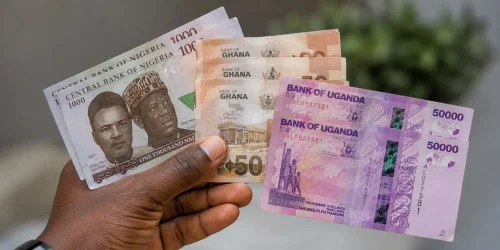
Ghana’s cedi, Nigeria’s naira and Uganda’s shilling all weakened against the dollar this week, with traders citing rebounding oil prices and renewed corporate demand for hard currency.

The cedi traded at 11.53 to the dollar on Thursday, weaker than 11.40 a week earlier, according to LSEG data. Andrews Akoto, head of trading at Absa Bank Ghana, said the dollar is likely to keep strengthening against the cedi as “energy sector FX demand firms alongside rebounding crude oil prices,” and noted the central bank’s last foreign exchange auction drew bids of 311 million dollars against an offer of just 110 million, pointing to unmet demand.

The naira weakened to 1,383 to the dollar on the official market, from 1,379 the previous week, and traded around 1,425 on the street market. Traders linked the pressure partly to the Dangote Petroleum Refinery’s move this week to begin pricing local fuel sales in dollars, which has boosted demand for hard currency, with one trader saying the pressure is likely to persist unless global risk appetite improves.

Uganda’s shilling weakened to 3,685/3,695 to the dollar from 3,680/3,690 a week earlier, with traders attributing the move to dollar demand recovering after large firms cleared mid month tax obligations, and expecting further pressure as import demand rebuilds heading into next week.

The naira’s weakness comes despite sweeping foreign exchange reforms Nigeria has pursued over the past two years, including improved dollar liquidity and tighter monetary policy that have reduced volatility even as demand for foreign currency continues to outpace supply, with lower oil receipts and rising import demand limiting the currency’s recovery.

Ghana’s cedi had been one of Africa’s strongest performing currencies earlier this year, boosted by stronger gold exports, improved foreign exchange inflows and progress under the country’s IMF reform programme, but has lost some of that momentum in recent weeks amid profit taking, seasonal dollar demand and uncertainty in global commodity markets.

The pressure on all three currencies comes as the US dollar strengthens broadly, with expectations that the Federal Reserve will keep interest rates elevated encouraging investors to favor dollar denominated assets over frontier and developing market currencies that depend heavily on portfolio investment and commodity export earnings.

Currency depreciation raises the cost of imports, adds to inflationary pressure and makes servicing foreign currency debt more expensive, risks that fall hardest on countries reliant on imported fuel, food and industrial inputs.

Analysts do not expect a return to the sharper currency volatility of previous years, citing relatively tight monetary policy at several African central banks and stronger export earnings from gold and crude oil that have helped some countries rebuild reserves, though the cedi, naira and shilling are likely to remain among the region’s most closely watched currencies as policymakers weigh exchange rate stability against growth.

Malaysian Banks Build AI But Won’t Trust It

Malaysian banks are rolling out artificial intelligence across fraud detection and customer onboarding, but only a quarter trust its outputs enough to act on them, a new industry survey found.

The findings come from a report titled “AI in Practice: How Malaysia’s Banks and DFIs are Adopting and Governing AI,” jointly produced by the Asian Institute of Chartered Bankers (AICB), research firm Ecosystm and the AICB Chief Risk Officers’ Forum. Drawing on responses from close to 90 senior leaders across commercial banks, digital banks, Islamic banks and development financial institutions (DFIs), the study was launched at AICB’s 4th Malaysian Banking Conference in Kuala Lumpur, opened by Finance Minister II Amir Hamzah Azizan and Bank Negara Malaysia Governor Abdul Rasheed Ghaffour.

The report found banks are already using AI in customer verification, fraud detection, anti money laundering and counter financing of terrorism monitoring, and workforce productivity tools, where machine learning can process large volumes of transactions faster than older rule based systems. Even so, just 25 percent of institutions said they trusted AI generated outputs enough to act on them in key business decisions, and only 20 percent said they actively encourage AI driven decision making across their workforce.

Institutional readiness remains uneven. Forty-four percent of banks and DFIs described themselves as still in a developing stage of AI readiness, while 15 percent said they had reached an established level and just 2 percent called themselves advanced. Only 26 percent said they had a defined AI strategy, even though 44 percent were already building custom AI solutions, a gap the report’s authors said points to isolated experimentation rather than enterprise wide programs tied to business goals.

Workforce constraints were widespread, with 79 percent of respondents reporting AI talent shortages or underdeveloped internal capabilities, and just 34 percent describing meaningful in house AI capability. Only 33 percent said they had structured AI governance and model risk management frameworks in place, a gap regulators are watching closely as they push banks to show AI models are transparent, auditable and subject to human oversight, particularly in lending, compliance and financial crime detection.

AICB Chief Risk Officers’ Forum chairman and RHB Banking Group Chief Risk Officer Dr Chong Han Hwee said AI introduces risks that extend beyond the technology itself, noting that “its risks do not reside solely within the model.”

The pattern mirrors trends elsewhere in Asia Pacific. A separate Money20/20 white paper found 61.2 percent of financial organizations across the region have adopted AI and machine learning, while 35.3 percent remain in an exploratory phase and 3.5 percent have not adopted the technology at all.

AICB said the findings offer a benchmark for the sector as it moves from experimentation toward wider implementation, with trust likely to hinge on stronger governance, more mature risk controls and greater investment in skilled staff.

AI Models Built On Pirated Data, Courts Find

0

Court rulings and settlements over the past two years have found that major AI companies, including some marketed as open source, trained models partly on pirated or scraped material.

The fullest account of how a major company obtained its training data comes from Kadrey v. Meta, a copyright suit brought by authors including Sarah Silverman, Richard Kadrey and Ta-Nehisi Coates. Unsealed court filings showed Meta engineers downloaded books through two piracy sites, Library Genesis and Z-Library, using torrents, with the decision escalated to chief executive Mark Zuckerberg according to internal messages cited by the plaintiffs. One engineer downloaded roughly 81 terabytes of material this way, and one Meta researcher objected internally at the time, writing that “using pirated material should be beyond our ethical threshold.”

A federal judge granted Meta summary judgment on fair use grounds in June 2025, finding the use of the books transformative enough to clear the legal bar, largely because the plaintiffs had not shown the market harm the law requires. A group of five major publishers filed a new class action against Meta and Zuckerberg in May 2026, arguing the earlier ruling overlooked evidence of market substitution. More than 50 AI copyright lawsuits have been filed in the United States since 2023, with roughly 30 still active.

Anthropic, the company behind the Claude chatbot, took a different path, agreeing in September 2025 to pay 1.5 billion dollars, roughly 3,000 dollars for each of about 500,000 books, to resolve Bartz v. Anthropic, a case brought by authors Andrea Bartz, Charles Graeber and Kirk Wallace Johnson over more than 7 million digitized books downloaded from Library Genesis and a second pirate site. It remains the largest publicly reported copyright recovery to date, though final court approval has not yet been granted as of mid-2026, after a judge deferred sign off pending a dispute over late opt-out requests. Anthropic also faces a separate active suit from Concord Music over its training practices.

The underlying ruling in the Anthropic case set out a distinction likely to guide future cases: training a model on legally acquired books can be considered transformative and protected under fair use, but downloading and keeping pirated copies is not, regardless of how the resulting model is later used. Anthropic agreed to destroy the pirated files as part of its settlement without admitting liability.

A different problem surfaced around Stable Diffusion, whose training data is public by design. In 2023, Stanford Internet Observatory researchers examined LAION-5B, an open dataset of billions of image-text pairs, and identified more than 3,200 suspected instances of child sexual abuse material, of which 1,008 were externally validated by the Canadian Centre for Child Protection. LAION, the German nonprofit behind the dataset, took it offline within days.

Stability AI, the company behind Stable Diffusion, separately faced a copyright claim from Getty Images over roughly 12 million photographs it said were used without a license. The UK’s High Court delivered a split verdict in November 2025, rejecting Getty’s copyright claims on the grounds that the model’s weights do not store the images used to train it, while finding limited trademark infringement over Getty’s watermark appearing in generated images, a decision that turned in part on Stability’s training having taken place outside UK jurisdiction rather than resolving whether scraping copyrighted images for training is lawful in principle.

Researchers have separately raised concerns about what they call open washing, where companies market AI systems as open while withholding the data, code and documentation needed to actually audit or reproduce them. Meta’s Llama models have drawn particular scrutiny for releasing model weights publicly while keeping the composition of their training data undisclosed. The Open Source Initiative published a formal Open Source AI Definition in October 2024 requiring enough information about training data to allow a model to be substantially recreated, a bar researchers say almost no major open model has met since.

Regulators are still catching up. The European Union’s AI Act now requires general purpose AI providers to publish a summary of the content used to train their models, and the UK government is due to publish its own report on copyright and AI training. In the United States, the issue remains largely in the hands of courts deciding cases individually, producing a split outcome so far: paying for data and transforming it appears to be lawful, while taking it for free from a pirate site is a cost that has eventually come due for the companies involved.

12 Killed In Konongo Highway Crash

0

Twelve people died and 44 were injured when a cargo truck, a passenger bus and a fuel tanker collided on the Kumasi to Accra highway near Konongo.

The Ghana National Fire Service (GNFS) confirmed the collision occurred in the early hours of Thursday near Konongo Anglican Basic School in the Ashanti Region. GNFS Public Relations Officer Alex King Nartey said the crash involved a Tata passenger bus travelling from Accra toward Bole, a DAF cargo truck carrying tomatoes from Kumasi to Accra, and an empty fuel tanker.

Preliminary findings from the GNFS indicate the cargo truck attempted to overtake another vehicle on a slope, lost control and collided head on with the oncoming bus, after which the fuel tanker ran into the crash site, though the service said the tanker did not significantly add to the casualties.

Nartey said the crash resulted in “12 fatalities, comprising nine males and three females,” while a separate 44 people were injured, 30 of them critically. Some earlier reports had put the toll as high as 13, citing eyewitness accounts, though the GNFS’s confirmed figure stands at 12.

The fire service, working with other emergency responders, extricated trapped victims, secured the scene and helped restore traffic flow along the highway after the crash.

The crash adds to a run of serious accidents on the Kumasi to Accra highway in the Ashanti Region in recent days, including a collision at Juaso on July 13 that killed three people and injured 15.

DDEP Bonds Lead GH¢954 Million GFIM Session

Ghana’s fixed income market processed about GH¢953.89 million across 419 trades on Thursday, with DDEP bonds outpacing treasury bills for the largest share of turnover.

Domestic Debt Exchange Programme (DDEP) bonds led the session on the Ghana Fixed Income Market (GFIM), recording GH¢482.19 million across 23 trades, ahead of treasury bills, which followed with GH¢350.42 million spread across 377 transactions, the widest participation of any segment. Sell and buy back trades on Government of Ghana (GoG) notes and bonds added GH¢109.12 million across 16 deals, while corporate bonds contributed GH¢12.16 million over three trades. No new or old GoG notes and bonds changed hands outside the DDEP and sell buy back categories.

The most active DDEP instrument was a bond maturing February 10, 2032, with a 9.10 percent coupon, which traded GH¢223.61 million across three deals at a yield of 14.54 percent and a closing price of 79.6460 cedis per 100 cedis face value.

Among treasury bills, a bill maturing July 12, 2027, was the most active, recording GH¢80.88 million across 34 transactions at a yield of 12.78 percent and a closing price of 88.7542 cedis.

The largest sell and buy back trade involved a bond maturing February 5, 2036, with a 9.70 percent coupon, which changed hands for GH¢36 million across two deals at a yield of 13.90 percent. On the corporate side, a bond maturing August 31, 2026, with a 13.00 percent coupon led activity, recording GH¢12.06 million across two trades at a closing price of 99.4176 cedis.

Thursday’s session brought total activity on the market to 419 transactions, with the DDEP bond segment’s outsized share standing out against the treasury bill dominated pattern that has typically characterized recent trading days.

GSE Composite Index Gains As Volumes Slide

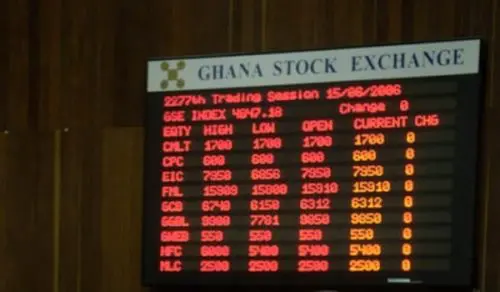
The GSE Composite Index rose to 14,896.64 points on Thursday, even as trading volumes and value fell sharply through the week on the Ghana Stock Exchange.

The benchmark GSE Composite Index (GSE-CI) gained 39.62 points on Thursday to close at 14,896.64, up from 14,857.02 the previous session, part of a 69.85 percent rise since the start of the year. The GSE Financial Stocks Index (GSE-FSI), which tracks listed banks and other financial institutions, moved in the opposite direction, falling 76.89 points to 8,181.33, though it remains up 76.05 percent year to date, ahead of the broader market’s gain.

Trading activity slowed steadily through the week. Volume peaked on Monday at close to 15 million shares worth GH¢289.95 million, before falling to 3.79 million shares on Tuesday, 6.28 million on Wednesday and just 2.39 million shares worth GH¢9.89 million by Thursday, the lightest session of the week.

Market capitalization eased over the same period, slipping from GH¢286.56 billion on Monday to GH¢284.74 billion by Thursday, even as the Composite Index itself edged higher, a divergence that reflects how the index’s movement is weighted toward specific large constituents rather than the market as a whole.

The week’s activity followed a period in which MTN Ghana and Kasapreko had featured among the exchange’s most actively traded stocks by value, a pattern that has driven much of the turnover on the bourse in recent weeks as investors continue to digest strong year to date gains across both the Composite and Financial Stocks indices.

Access Bank PLC Sells Down Ghana Stake

Access Bank PLC has sold a 7.44 percent stake in its Ghanaian subsidiary on the Ghana Stock Exchange, deepening local ownership of the bank.

The parent group sold 12,085,318 ordinary shares in Access Bank (Ghana) PLC on the Ghana Stock Exchange (GSE) on July 15, with all required regulatory approvals in place, including a no objection from the Bank of Ghana.

The bank said the sale drew strong participation from a diversified pool of buyers, including pension funds, institutional investors and high net worth individuals.

Managing Director Pearl Nkrumah said the transaction reflected the bank’s continued commitment to “deepening local ownership and liquidity in our shares,” adding that the focus remains on converting the scale the bank has built into sustained value for stakeholders.

Access Bank Ghana listed on the GSE through an initial public offering that made it the exchange’s 11th bank listing and the first by a Nigerian owned lender, raising GH¢29.62 million against a GH¢21 million minimum requirement at the time. Ownership following that listing was split roughly 75 percent to parent company Access Bank PLC, 10 percent to a Ghanaian pension fund and the remainder among other institutions and individuals, though the parent’s stake has since been trimmed through further sales such as this one.

The sale comes as Access Bank Ghana shares have performed strongly this year, having gained close to 97 percent since January, among the better performers on the exchange.

Access Bank Ghana is a full service commercial bank and member of the Access Group, one of Africa’s largest banking groups, offering services to corporate, commercial, retail and public sector customers across the country. IC Securities (Ghana) Ltd acted as adviser and executing broker on the transaction.

Community Development in action as Bekwai MP Ralph Poku-Adusei delivers

0

Residents of several communities within the Bekwai Constituency have received a major development boost following the latest interventions by the Member of Parliament for Bekwai, Hon. Ralph Poku-Adusei, aimed at improving transportation, education, and local economic activities.

The latest support package benefited the communities of Kensere-Biribowomanmu-Pampaso, Amanhyia, and Sarfokrom, where ongoing development projects initiated by residents received both financial and material assistance to speed up completion.

The presentation of the support was led by the Bekwai Constituency New Patriotic Party (NPP) Chairman, Mr. Fred Nkansah, together with members of the constituency executives, on behalf of the Member of Parliament.

At Kensere-Biribowomanmu-Pampaso, community members had appealed for urgent assistance after a recently reshaped road became nearly unusable due to persistent heavy rains. The muddy and slippery condition of the road disrupted transportation, making it difficult for farmers and traders to move their produce to nearby markets.

In response, Hon. Ralph Poku-Adusei donated several truckloads of gravel and provided an estimated GH₵15,000 to facilitate the compacting of the road surface.

The intervention is expected to restore safe access for motorists and pedestrians while improving economic activities within the area.

The MP also extended support to the community of Amanhyia, where work is nearing completion on a three-unit teachers’ quarters. Through Chairman Fred Nkansah, a cheque was presented to help complete the remaining works, including painting and final finishing before the facility is officially handed over.

The teachers’ accommodation project is expected to address the long-standing challenge of inadequate housing for educators, a situation that has contributed to teacher absenteeism and delays in reporting to school.

Education stakeholders believe the completion of the facility will create a better working environment for teachers while enhancing the quality of teaching and learning in the community.

Meanwhile, traders in Sarfokrom also received financial assistance to complete the construction of a modern market shed. The support was presented through the Assembly Member to help accelerate work on the project.

When completed, the market shed will provide traders with a secure and comfortable place to conduct business, improve trading conditions, and stimulate commercial activities within the community.

Addressing residents after the presentations, Hon. Ralph Poku-Adusei reiterated that sustainable development is most effective when communities identify their own priorities and work together towards achieving them.

He noted that his responsibility as a Member of Parliament is to complement such initiatives by providing the necessary resources needed to transform community ideas into completed projects.

According to the MP, supporting locally driven development initiatives ensures that public resources directly address the most pressing needs of the people while strengthening community ownership of development projects.

Community leaders and beneficiaries expressed gratitude to Hon. Ralph Poku-Adusei and the Bekwai Constituency NPP leadership, led by Chairman Fred Nkansah, for responding promptly to their requests and demonstrating commitment to improving living conditions across the constituency.

The latest interventions further reinforce the MP’s development agenda, which continues to prioritize practical solutions that improve livelihoods, strengthen education, and expand economic opportunities throughout the Bekwai Constituency.

Img Wa