Ghana insurance assets triple but reach few Ghanaians

0

Ghana’s insurance assets have more than tripled since 2019 to about GHS 21.9 billion, yet the sector still covers barely 1 percent of the economy, a new analysis says.

The study, from C-NERGY Global Holding, puts industry assets at GHS 21.9 billion in 2025, up from GHS 6.5 billion in 2019, and gross premiums at GHS 8.95 billion, up from GHS 3.21 billion. Spending per person has more than doubled in six years to about GHS 202. Even so, penetration sits near 1 percent, against roughly 3 percent across Africa and 5.4 percent worldwide. The Bank of Ghana’s most recent financial stability review also pegs it at about 1 percent.

The report argues the growth is misleading. Rather than new customers, it reflects inflation, higher premium prices and selling more cover to the same narrow set of corporate clients. Regulators have made a similar point: the National Insurance Commission found that inflation above 23 percent in 2024 wiped out almost all of the sector’s nominal gains, leaving real growth close to flat.

About 70 percent of Ghanaians still have no commercial cover, C-NERGY says, because products assume a formal, salaried life that many do not lead. It cites three barriers. Fixed monthly premiums do not fit traders with irregular daily earnings. Trust is thin, despite insurers paying roughly GHS 9.2 million in claims a day, because settlements can be slow and terms opaque. And financing that would help small firms remains underdeveloped.

To close the gap, the report calls for embedded insurance, cover bundled into mobile services, everyday purchases or microloans people already use, and products built around how households actually earn and spend. The insurance regulator has moved in that direction, running a sandbox since 2024 to test new products.

The sector has shown it can build wealth. The harder task, the report says, is protecting the majority still without any cover.
AFROMART fair to target 10,000 jobs, US$1bn investment

0

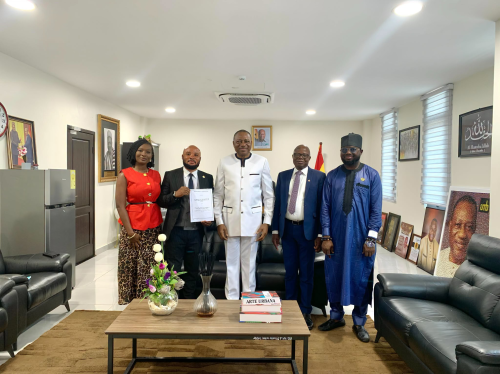
The Labour Ministry has signed a deal to stage a jobs and trade fair it says will create 10,000 jobs and attract over US$1 billion in investment interest.

The Ministry of Labour, Jobs and Employment and the Global Africa ACP Chamber of Trade and Investment signed a memorandum of understanding to run AFROMART 2026, a 72 hour event later this year that pairs a trade exhibition with a job fair and an investment forum. Organisers expect it to draw more than 75,000 people, register over 100,000 job seekers and host 300 employers and 1,000 exhibitors from more than 60 countries.

The push comes as more than three million young Ghanaians are looking for work, by the Ministry’s count. The 10,000 jobs the fair is meant to deliver are a small share of that, and organisers describe them as only a start. The government has named the event week the National Week of Employment.

Labour Minister Rashid Pelpuo said the plan turns policy into action, promising a system that matches job seekers with openings in real time. Beyond the event, the partners plan a digital platform to keep matching workers with jobs after it ends.

The chamber’s global president, Prince Davidson, said the platform would use artificial intelligence to link applicants to work in Ghana and abroad, including Europe, Canada, the Gulf, the Caribbean and the Americas, and would also handle interview scheduling, skills tests and employer services.

The Ministry tied the fair to its National Employment Policy, the 24 Hour Economy and the African Continental Free Trade Area. It adds to other government jobs efforts, among them a national Labour Market Information System due this year and the 24 Hour Economy’s target of 1.7 million jobs.

Extend labour laws to informal workers, Vice President says

0

Ghana should widen its labour laws to cover the informal sector, which employs more than 70 percent of workers, the Vice President told a labour conference in Ho.

Opening the three day annual National Labour Conference, Vice President Jane Naana Opoku-Agyemang said informal workers have little social protection and scant say in national labour talks, and often cannot press for better conditions or take industrial action. She urged workers to cut out lateness and absenteeism and to back the government’s 24 Hour Economy policy.

Development partners used the gathering to push productivity and decent work as paired drivers of growth. Magdalena Wüst, Deputy Head of Cooperation at the Swiss embassy, said the two reinforce each other: firms that treat workers well tend to be more competitive, and secure jobs make workers more productive. Productivity, she added, means working smarter through skills, technology and better practices, not simply working harder.

Wüst said lasting productivity gains rest on shared responsibility among employers, workers, government and training providers, and that regular social dialogue can defuse workplace tensions before they turn into disputes. Switzerland supports the effort through its Productivity Ecosystems for Decent Work programme, run by the Swiss State Secretariat for Economic Affairs.

On trade, she linked competitiveness and jobs to smoother customs, better logistics, lower costs and modern borders as Ghana implements the African Continental Free Trade Area and pursues industrialisation. Investment in skills, quality infrastructure and productivity systems, she said, will matter most as the country tries to become a regional trade hub, with gains aimed at women and young people.

Norway’s Silje Vevatne, of the Royal Norwegian Embassy, said technological change, shifting populations and climate pressures make social dialogue and strong labour institutions more important, and that the Norwegian Agency for Development Cooperation also backs the programme. The conference drew government officials, organised labour, employers, researchers and development partners.

Book urges Ghana to split its galamsey fight

Ghana should split its fight against illegal mining, or galamsey, crushing foreign financed operations while formalising poverty driven ones, an environmental analyst argued at an Accra book launch.

Yaw Amoyaw-Osei, founder and executive chairman of the Centre for Environment and Health Research and Training and head of Green Advocacy Ghana, made the case at the launch of his book, The Last Dig, which uses storytelling to press for Strategic Environmental Assessment in policy. He said the country keeps failing because it treats every kind of galamsey as one problem. Prof. Daniel Wubah, president of Millersville University in the United States, praised the book for framing galamsey as a governance failure.

He drew a line between two forms. Organised criminal mining, which he said is often financed by foreign interests and wrecks forests and rivers, should be shut down completely. Poverty driven mining by unemployed Ghanaians, he argued, needs formalisation, regulation and support rather than raids alone, a route he said would create livelihoods and starve the foreign money behind the damage.

Amoyaw-Osei said the burden should not sit with central government alone. He wants the National House of Chiefs to hold chiefs answerable where galamsey runs on their lands, police commanders answerable for mining in their areas, and metropolitan, municipal and district chief executives to be elected so they answer to residents. “If there is galamsey in your district, you must answer for it,” he said.

The book also proposes district environmental task forces to watch communities and check on unexplained arrivals, particularly foreigners, before organised mining can take hold.

He widened his criticism to flooding, questioning why parts of Accra still flood despite the money spent on the Greater Accra Resilience and Integrated Development Project. He blamed weak enforcement of environmental rules, poor sanitation and district assemblies that he said were not doing their job, and urged local authorities to clear drains, manage waste and apply the laws already on the books.

Ghana already has enough studies and policy on both galamsey and flooding, he said, and its real gap is turning them into action. He put the country’s central failure down to implementation, accountability and enforcement.

EOCO witness disputes GH¢49m special operations claim

0

An investigator told an Accra court that a memo accounting for GH¢49.1 million as “special operations” spending was an afterthought unsupported by evidence, in the Adu-Boahene trial.

Frank Marshall Cromwell, a Staff Officer with the Economic and Organised Crime Office and the fourth prosecution witness, gave the evidence on Wednesday under questioning by the Deputy Attorney General at the Accra High Court. The money had been earmarked to buy government cybersecurity software. Former National Signals Bureau Director General Kwabena Adu-Boahene and the others on trial deny the charges.

Cromwell said about GH¢9.54 million, or US$1.75 million, went to the Israeli firm ISC Holdings for the software, and no further payment followed. The rest, he testified, moved into a private account, was withdrawn by individuals and either handed to Adu-Boahene or paid into other accounts on his instructions. By August 2020, he said, almost all of it was gone, leaving about GH¢600,000.

On that basis, the witness said, a memo dated 6 May 2025 that sought to account for the money as special operations did not fit the evidence. He also pointed to a 2 May 2025 letter from the Auditor General to the Attorney General stating that Adu-Boahene had not declared his assets while heading the bureau.

The accused deny wrongdoing. The defence has argued that the funds pre-financed genuine, time sensitive security operations, and an earlier prosecution witness, the bureau’s former head of finance, told the court she knew of no theft and that no audit query or adverse finding had flagged any missing money.

Those on trial, among them Adu-Boahene, his wife Angela Adjei Boateng and Advantage Solutions Limited, face charges that include stealing, money laundering and causing financial loss to the state. The court adjourned the case to Thursday, 2 July, when the defence is due to begin its cross examination of Cromwell.

Tema Oil Refinery returns to profit but seeks debt relief

0

Tema Oil Refinery (TOR) posted its first profit in nine years in 2025 but is pressing government to release GH¢1.6 billion it is owed and clear inherited debt.

At its 18th annual general meeting in Accra on Tuesday, Managing Director Edmond Kombat put the profit at about GH¢1.1 billion after tax, from GH¢1.42 billion before tax, and said revenue grew 18.2 percent to GH¢285.9 million, the most the refinery has earned in a decade.

Much of that profit came from a foreign exchange gain of about GH¢1.38 billion rather than from refining, and the company remains deeply insolvent. Kombat said negative equity of GH¢4.53 billion was its biggest financial problem over the medium term, though the accumulated deficit had narrowed to GH¢7.87 billion from GH¢8.96 billion.

To repair the balance sheet, he said he had opened talks with government on recapitalisation, mainly by releasing TOR’s outstanding share of receivables under the Energy Sector Levy Act, which he put at no less than GH¢1.6 billion. Board Chairman Nayon Bilijo said about GH¢3.4 billion had been collected for TOR under the levy, of which GH¢1.47 billion had already gone to cut its debt.

Bilijo said the board that took office in July 2025 inherited about US$517 million in debt, among it US$128 million owed to Sahara Oil, US$97 million to government, US$78.9 million to the Volta River Authority, US$58 million to the Ghana National Petroleum Corporation and US$41 million to BP. “These debts, though inherited, continue to serve as stark reminders of past activities,” he said.

The refinery has trimmed what it can. Total debt fell 13 percent to GH¢2.33 billion, long term borrowings dropped 27 percent to GH¢695.5 million, and trade and other payables fell 22.5 percent to GH¢5.52 billion.

Energy and Green Transition Minister John Jinapor said the Finance Ministry had ordered a full audit of state energy agencies’ balance sheets, by a firm such as PricewaterhouseCoopers, to strip out government linked debt so firms like TOR can borrow commercially while rates are lower.

Kombat said the crude distillation unit resumed refining in December, processing about 600,000 barrels that month, and the residue fluid catalytic cracking unit, central to profitability, is due back by July 2026. The refinery also closed a six year audit gap, delivering seven sets of audited accounts, prepared with KPMG, to the State Interests and Governance Authority. He has told Parliament that Ghana spends about US$400 million a month importing fuel, a bill a working refinery could cut sharply.

Ghana inflation hits 2026 high before rate decision

0

Ghana’s inflation rose to 5.3 percent in June, its third straight monthly climb, driven by local goods and services ahead of the central bank’s next rate decision.

The rate is up from 3.7 percent in May and marks the highest reading this year, though it sits well below the 13.7 percent of June 2025 and remains less than half that level. Government Statistician Alhassan Iddrisu, who presented the figures in Accra on 1 July, said inflation had bottomed at 3.2 percent in March before turning up again.

Most of the pressure is homegrown. The Ghana Statistical Service (GSS) reported that locally produced goods, with inflation of 6.7 percent, accounted for close to 87 percent of the headline rate, while imported items rose just 2.3 percent. Non food inflation quickened to 6.3 percent from 4.1 percent and made up more than two thirds of the total, and food inflation edged up to 3.9 percent.

Transport swung to 9.1 percent from negative 2.8 percent a month earlier, a jump Bloomberg linked to higher fuel prices tied to the war in the Middle East. Housing and utilities rose 7.9 percent, education 8.7 percent and restaurants and accommodation 8.2 percent. Services inflation, at 9.4 percent, kept running ahead of goods at 3.7 percent.

The monthly picture was calmer. Prices rose only 0.2 percent between May and June, down from 1.1 percent, so the pace of increases slowed even as the yearly figure climbed. GSS said the broader fall in inflation was still on track but flagged non food costs, services and local supply as areas to watch. “The recent increase deserves close attention to safeguard the gains achieved,” Iddrisu told reporters.

Price movements varied widely across the country. The North East Region recorded the steepest inflation at 10.2 percent, while Bono East saw prices fall by 4.4 percent. Ashanti at 7.8 percent and Greater Accra at 5.8 percent together made up about 63 percent of the headline rate. Ginger led individual items at 102.5 percent, ahead of shrimps and mango, while maize and some vegetables cost less than a year earlier.

The figures land before the Bank of Ghana sets interest rates later this month. GSS urged the government to hold to tight fiscal and monetary policy and to clear supply bottlenecks in storage, irrigation, transport and market logistics, the pressures now doing most to push local prices up.

Enterprise Group lifts dividend 30% as profit dips

0

Enterprise Group PLC raised its dividend 30 percent for 2025 even as annual profit slipped, blaming a stronger cedi and the absence of a one time reinsurance gain.

Shareholders approved a final dividend of 16.4 pesewas per share at the insurer’s 16th annual general meeting, up from 12.6 pesewas a year earlier. Group Chief Executive Officer Daniel Larbi-Tieku said profit after tax fell about 4 percent to GH¢352.8 million from GH¢366 million in 2024.

He tied the drop to the cedi’s appreciation, which trimmed premium and investment income earned in foreign currency, and to the absence of a GH¢253 million reinsurance gain that had flattered the 2024 accounts.

The core business grew. Insurance revenue climbed about 10 percent to GH¢1.75 billion from GH¢1.58 billion, led by the general insurance line, and total assets rose roughly 22 percent to GH¢4.81 billion on heavier holdings of debt securities. Larbi-Tieku said investment income and underwriting results both improved over the year.

At Enterprise Insurance, the group’s non life arm, profit after tax fell 56 percent to GH¢31 million, which Managing Director Akosua Ansah-Antwi attributed to foreign exchange losses and higher reinsurance costs. Service revenue there still rose 17 percent to GH¢803 million as claims costs fell, and the unit launched a digital claims platform, Claims Xpress, alongside new travel and asset protection products.

The year was the first of a 2025 to 2027 plan to double the group’s revenue and profit. Chairman Keli Gadzekpo said Enterprise had held up through currency swings and shifting interest rates by sticking to its strategy. The company said it was ready for Ghana’s new risk based capital rules and was strengthening capital at its Nigerian life business to meet limits there. Auditors PricewaterhouseCoopers gave the accounts a clean opinion, and shareholders returned three directors to the board.

Prove NLA’s ‘GH₵3bn Giveaway’ Allegation – Razak Opoku Dares The Fourth Estate

0

Former Public Relations Officer of the National Lottery Authority (NLA), Razak Kojo Opoku, has renewed his challenge to the Media Foundation for West Africa (MFWA) and its investigative outlet, The Fourth Estate, to provide evidence supporting their claim that the NLA handed over a GH₵3 billion business to a private company.

According to Mr. Opoku, nearly a year after the allegation was published, neither The Fourth Estate nor the Executive Director of MFWA, Sulemana Braimah, has presented facts, audited accounts or official financial records to substantiate the claim.

In a Facebook post, Mr. Opoku questioned the credibility of the report and accused the journalists involved of failing to adhere to basic standards of fact-checking and verification.

“Almost a year now, this dishonest dude has not been able, through facts, data and audited accounts of NLA, to substantiate this unfounded allegation that the NLA was generating GH₵3 billion business and gave it away to a private company,” he wrote.

He further alleged that some journalists were engaging in what he described as interest-driven investigative journalism aimed at damaging the reputation of indigenous Ghanaian businesses.

The controversy stems from a Fourth Estate publication which alleged that the NLA handed over a GH₵3 billion business to private gaming company, KGL and raised concerns about the Authority’s financial management.

Responding to the allegations in an earlier interview, Mr. Opoku described the publication as “factually incorrect and misleading,” insisting that the NLA had never generated GH₵3 billion annually and therefore could not have transferred such a business to any private entity.

“It is totally untrue and misleading for anyone to suggest that NLA gave away a GH₵3 billion business. The NLA does not even generate that amount annually,” he stated.

He argued that available financial records contradict the claim, noting that the Authority’s total revenue between 2017 and 2020 stood at approximately GH₵1.47 billion, with expenditure of about GH₵1.385 billion over the same period.

Mr. Opoku further stated that historical revenue figures from 2012 to 2016 ranged between GH₵242 million and GH₵402 million annually, stressing that the Authority had never generated as much as GH₵500 million in any single year during that period.

“When the figures show clearly that NLA has never generated GH₵3 billion, it beats logic for any media organisation to make such a claim,” he said.

Touching on the relationship between the NLA and KGL, Mr. Opoku maintained that the arrangement is a licensing agreement rather than a procurement contract.

According to him, KGL operates under the supervision of the NLA and has partnered the Authority for about seven years to help improve revenue generation.

“It is a licence agreement, not a procurement contract. KGL works under the regulatory supervision of NLA and has contributed to efforts aimed at enhancing revenue mobilisation,” he explained.

The dispute continues to generate debate over the accuracy of financial claims surrounding the NLA and the role of investigative journalism in scrutinising public institutions.

Newmont gives Legon hospital Gh₵290,000 in equipment

0

A University of Ghana clinic that now serves as a district hospital has received medical equipment worth over GHS 290,000 from Newmont to ease shortages straining its wards.

The facility began as a service point for university staff and their dependants before growing into a hospital that treats surrounding communities and takes referrals from as far as the Mampong Hospital in the Eastern Region. Its internal medicine department, which handles emergencies and critically ill patients, had been working with too little equipment, slowing work and affecting patient outcomes.

Newmont supplied patient monitors, hospital beds with mattresses, infusion pumps, an electrocardiogram machine, suction machines, ward screens, drip stands and bedside cabinets. The hospital expects the items to improve monitoring and treatment and to make patients more comfortable.

The donation answered a direct request from the department, driven by the hospital’s Chief Nursing Officer, Grace Kumi. Presenting the equipment, Newmont’s Director of Communications and External Relations, David Johnson, said a shortage of critical equipment remains one of the biggest obstacles to good care, and that skilled staff cannot work well without the right tools.

Professor Godwin Abeka-Nkrumah, who chairs the hospital’s management committee and serves as the university’s Director of Institutional Advancement, received the items and thanked Newmont on behalf of Vice Chancellor Professor Nana Aba Appiah Amfo. He said the equipment would sharpen patient monitoring and ease the load on staff, and gave an assurance that it would be kept in working order. Hospital Director Dr Afua Amoabeng also welcomed the support.

The gift follows other recent health donations by the mining company, among them medical equipment worth more than GHS 2 million handed to the Korle Bu Teaching Hospital in January for its intensive care and paediatric cancer units, and a separate donation to health facilities in Tano North in February.