Award-winning Ghanaian Afro-dancehall musician Stonebwoy has expressed sympathy for victims of the devastating floods that swept through parts of Accra, while calling for urgent measures to prevent similar disasters in the future.
Reacting to the flooding, which left several communities submerged and claimed lives, the “Jejereje” hitmaker took to his X (formerly Twitter) page to share a heartfelt message to affected families.
“Seeing the flood reports across the capital. My heart is with every family and community affected,” he wrote.
Beyond expressing condolences, Stonebwoy stressed that preventing future flooding is a shared responsibility, urging Ghanaians to adopt environmentally responsible practices. He advised the public against dumping refuse into drainage systems, constructing buildings on waterways, and encouraged households to build proper drainage channels to improve the flow of water.
“Beyond today, we all have a role to play — by not dumping refuse in drainage systems, avoiding building structures in waterways, and ensuring that households construct proper drainage systems to help ease water flow,” he stated.
The musician also appealed to government authorities to take immediate action by desilting existing drains and expanding major drainage channels to accommodate increasing volumes of rainwater.
“I also plead with the authorities to urgently desilt and, where needed, widen and reconstruct major drainage channels across the capital to cope with increasing water volumes. Please stay safe, look out for one another, and follow all safety advisories from NADMO and the relevant authorities,” he added.
Accra experienced widespread flooding on June 29, 2026, following hours of torrential rainfall that left several roads impassable and stranded commuters across the city.
The disaster also resulted in deaths, extensive property damage, and severe disruptions to vehicular movement in several parts of the capital, prompting renewed calls for improved drainage infrastructure and stricter enforcement of environmental regulations.
The Chief Executive Officer of the Environmental Protection Authority (EPA), Prof. Nana Ama Browne Klutse, is leading a high-powered delegation to Samreboi in the Western Region today June 30, 2026 to assess the extent of damage caused by the recent flooding, which has been widely linked to illegal mining (galamsey) activities.
The delegation includes the Deputy Chief Executive Officer in charge of Operations, Prof. Michael Ayamga-Adongo; the Director of Mining, Ing. Michael Sandow Ali; the Director of Corporate Affairs, Mrs. Audrey Quarcoo; and other senior officials of the Authority.
During the visit, the delegation will tour flood-affected communities in Samreboi, pay courtesy calls on the chiefs of Tigarekrom and Aboifie, engage residents at a community durbar, visit victims of the flooding, and inspect temporary shelters housing displaced persons. The team is also expected to assess the humanitarian conditions of affected residents and gather first-hand information to guide the Authority’s response.
Speaking to journalists in Takoradi after paying a courtesy call on the Western Regional Minister, Joseph Nelson, ahead of the visit, Prof. Klutse said the EPA is considering dredging and re-engineering rivers and waterways whose natural channels have been altered or blocked by illegal mining activities to reduce the recurring flooding in the region.
“EPA will assess the situation in Samreboi and, going forward, we are considering dredging and re-engineering many of these water bodies that have either been blocked or diverted for illegal mining activities, which are contributing to the flooding we are seeing in the Western Region,” she said.
Parts of the Western and Central regions were recently submerged following heavy rains, with Samreboi and Cape Coast among the hardest-hit areas as floodwaters inundated homes, businesses and public infrastructure.
The floods marked a worrying expansion of the disaster into areas that were previously less prone to severe flooding, highlighting the growing environmental impact of illegal mining and poor land-use practices.
In Cape Coast, three people lost their lives, while three women sustained injuries during the flooding.
In the Western Region, the torrential rains caused two major rivers and several waterways to overflow their banks, triggering widespread flooding in Samreboi and surrounding communities in the Wassa Amenfi area. The area has for years been a hotspot for uncontrolled illegal mining, popularly known as galamsey.
The EPA says its intervention forms part of its mandate under the Environmental Protection Act, 2025 (Act 1124) to protect the environment and implement measures aimed at mitigating the loss of lives and destruction of property resulting from environmental degradation and climate-related disasters.
The Authority is expected to use findings from the assessment to develop both immediate and long-term interventions to restore affected waterways and reduce the risk of future flooding in mining communities.
Chief Executive Officer of the Environmental Protection Authority (EPA), Prof. Nana Ama Browne Klutse, has renewed calls for a nationwide ban on Styrofoam, arguing that the material remains one of the major contributors to Ghana’s growing plastic pollution challenge and the recurrent flooding being experienced in Accra and other urban centres.
Her renewed appeal aligns with President John Dramani Mahama’s commitment to phase out Styrofoam as part of broader efforts to strengthen environmental protection, improve waste management, and reduce the impact of flood disasters across the country.
Prof. Klutse made the remarks following the devastating floods that swept through parts of southern Ghana, including Accra, on Monday, June 29, 2026 leaving a number of people dead, displacing thousands of residents, and causing extensive damage to homes, businesses, and public infrastructure.
Speaking during a courtesy call on the Western Regional Minister, Joseph Nelson, at the Western Regional Coordinating Council, the EPA Chief executive officer stressed that while intense rainfall remains a natural trigger for flooding, human-induced environmental degradation continues to worsen the severity of flood events.
According to her, three principal factors account for the recurring floods in Accra, namely heavy rainfall, the obstruction of natural drainage systems through unregulated developments on waterways, wetlands, and the indiscriminate disposal of plastics, Styrofoam, and other solid waste into drains and water bodies.
“The heavy rain is one of them. We also see that the pathways for water to flow into major rivers and wetlands are blocked because people have built on waterways. Another difficulty we have is the Styrofoam, plastics, and other waste materials dumped into flowing waters that are supposed to drain into the sea. These choke the pathways and prevent water from flowing freely,” she explained.
Prof. Klutse noted that although extreme rainfall cannot be prevented, effective environmental management and responsible waste disposal can significantly minimise flood risks by ensuring drainage channels remain free from obstructions.
She disclosed that the EPA, with the backing of President John Dramani Mahama, will intensify efforts to enforce the planned ban on Styrofoam while engaging manufacturers, retailers, and other stakeholders on a phased strategy to eliminate single-use plastics nationwide.
According to her, sustained enforcement, coupled with public cooperation, could substantially reduce the incidence of flooding in Accra and other major cities.
“If we agree on the ban and Ghanaians cooperate with us, by May, June and July next year, we believe we will not see flooding in our waterways and major cities as we do today,” she stated.
The EPA Chief further appealed to households and communities to adopt environmentally responsible practices, particularly by avoiding indiscriminate waste disposal and protecting natural drainage corridors, describing public participation as critical to reducing disaster risks and safeguarding lives and property.
Prof. Klutse is currently in the Western Region to assess the environmental impact of illegal mining (galamsey)-induced flooding in Samreboi, where rising water levels have inundated several communities in recent days.
She is expected to lead a high-powered EPA delegation to the affected communities to evaluate the extent of the environmental damage, assess ecological risks, and recommend appropriate mitigation and restoration measures.
Meanwhile, the Western Regional Minister, Joseph Nelson, expressed appreciation to EPA for mitigating environmental bunerabilities at the same time raising concerns over the persistent flooding affecting parts of the region.
Joseph Nelson also indicated that the Western Regional Coordinating Council is implementing a series of interventions aimed at improving drainage infrastructure, strengthening environmental enforcement, and enhancing flood mitigation measures.
The Chief Executive Officer of the National Youth Authority (NYA), National Youth Authority, Osman Ayariga Esq., has expressed deep sympathy for residents affected by Monday morning floods in parts of Accra following heavy rainfall.
In a Facebook post, he shared words of solidarity with victims and called for caution and collective support for emergency responders.
“I greatly sympathize with flood victims! Let’s try to stay safe! Support the rescue team’s effort in saving human life and property!” he wrote.
His message comes as torrential rains triggered widespread flooding across Accra and surrounding communities, severely disrupting transportation and daily activities.
Flood situation across Accra and Tema
The flooding has left major roads and intersections heavily affected. The Tetteh Quashie Interchange area has been choked with traffic, with vehicles stranded for long periods.
The section under the rail line overpass from the Spintex Road roundabout near Action Chapel towards the Accra Polo Grounds and Hajj Village has also been submerged, leading to severe congestion.
The National Disaster Management Organisation (NADMO) has issued an alert indicating that both Accra and Tema are experiencing flooding.
Other heavily affected areas include Abeka, Lapaz, Achimota, Dzorwulu, Tesano, Kaneshie, Darkuman Junction, and sections around the Kwame Nkrumah Interchange, where motorists have been forced to navigate submerged roads or abandon routes entirely.
In the western corridor, commuters along the Accra–Kasoa stretch through Mallam and the Weija Barrier on the N1 Highway have also experienced major disruptions, with floodwaters covering large sections of the road.
Emergency response and impact
The Ghana National Fire Service has deployed rescue teams to assist in affected areas as vehicles struggle through flooded streets and some homes and shops in low-lying communities are inundated.
Residents in areas such as Atomic in Madina and parts of Achimota have also reported rising water levels, forcing occupants to move belongings to safer locations.
Authorities continue to urge the public to exercise caution as emergency teams work to manage the situation and restore normalcy.
President John Dramani Mahama has attributed the devastating floods that swept through parts of Accra on Sunday, June 29, to the combined effects of climate change, poor urban planning and human activities, while announcing a nationwide crackdown on buildings and other structures obstructing the capital’s drainage system.
Speaking after an aerial inspection of flood-hit communities, President Mahama expressed sympathy to families who lost property in the disaster and assured affected residents of immediate government support.
“I wish to express my deepest sympathy to all those who have lost property as a result of today’s floods. The damage has been extensive, and many families have been severely affected,” he said.
According to the President, preliminary data showed that about 140 millimetres of rainfall fell over Accra on Sunday, making it one of the heaviest single-day downpours recorded in recent years. He noted that the highest single-day rainfall recorded last year was about 56 millimetres.
Mahama said the increasing intensity of rainfall is evidence of changing climate patterns, citing data from the Ghana Meteorological Agency indicating that rainfall in Accra has risen significantly over the past three years. He explained that within a 30-day period in June 2024, the capital recorded about 85 millimetres of rainfall, which increased to 172 millimetres in June 2025 and approximately 333 millimetres in June 2026.
“This means that our waterways no longer have sufficient time to recover before more rain falls,” he said, adding that rainfall occurred on about 22 days in June this year, leaving only a few dry days.
Beyond climate change, the President blamed poor planning and indiscriminate development for worsening the flooding situation. He said rapid urbanisation had led to buildings being constructed along the natural paths of streams that previously carried floodwaters safely into the Atlantic Ocean.
He stressed the need for major engineering interventions to reopen blocked waterways and improve the city’s drainage infrastructure.
Mahama also condemned illegal waste disposal practices, saying residents continue to dump refuse into drains and wetlands, reducing their capacity to absorb floodwaters.
During the aerial inspection, he said government observed several wetlands being used as illegal dumping sites where operators of tricycles paid to dispose of refuse. According to him, some individuals later reclaim and sell the land for housing development, further increasing the risk of flooding.
“We must therefore tackle this challenge from both an engineering and an enforcement perspective by opening blocked channels and identifying structures obstructing the natural flow of water,” he stated.
The President announced that the National Security Council would meet urgently to address the flooding crisis, after which all Metropolitan, Municipal and District Assemblies would be directed to identify structures obstructing major drainage channels within their jurisdictions.
He said the identified buildings would be demolished, while the resulting debris would also be cleared to prevent further obstruction of waterways.
“There is no point demolishing a structure if the debris is left behind to continue obstructing the waterways,” he said.
Mahama acknowledged that previous attempts to remove structures from waterways had attracted criticism, but maintained that decisive action was necessary to protect lives and property.
He also outlined a long-term strategy to reduce pressure on Accra through the development of a new growth centre outside the capital. The project, expected to span about 20 years, will involve relocating some major government institutions and providing roads, water and electricity to support the new city.
To support victims of the floods, the President directed the National Disaster Management Organisation (NADMO) to identify affected households and provide immediate assistance. He also instructed the Minister for Finance to release money from the Contingency Fund to support relief efforts.
Mahama commended the Ghana Armed Forces, the National Disaster Management Organisation, the Ghana Police Service, the Ministry of Works, Housing and Water Resources, emergency response teams and the 48 Engineers Regiment for their swift rescue operations, saying their efforts helped prevent a greater tragedy.
He urged Ghanaians to adopt better sanitation practices and avoid developing in flood-prone areas, stressing that lasting solutions require both government intervention and public cooperation.
“We must find a permanent solution to the flooding challenge in Accra,” the President said. “This time, we must act differently.”
MTN Ghana has reaffirmed its commitment to empowering Micro, Small and Medium Enterprises (MSMEs) through digital innovation, capacity building and strategic partnerships aimed at accelerating business growth and economic development.
The commitment was reiterated at the launch of the national celebration of the 2026 World Micro, Small and Medium Enterprises (MSME) Day in Accra, held under the theme, “Elevating the Future Generation of Ghana’s MSMEs Through Digital Empowerment and Innovation.”
Senior Manager for SME Sales, Partnerships and Business Broadband, Mr Mohammed Abubakari-Sidick
Speaking on behalf of the Chief Enterprise Business Officer of MTN Ghana, Angela Mensah-Poku, the Senior Manager for SME Sales, Partnerships and Business Broadband, Mr Mohammed Abubakari-Sidick, described MSMEs as the backbone of Ghana’s economy and called for sustained investment in the sector.
He said while World MSME Day celebrates the contribution of entrepreneurs to national development, it should also serve as a platform for stakeholders to provide practical support to help businesses thrive.
Mr Abubakari-Sidick commended the Ghana Enterprises Agency (GEA) for sustaining the annual celebration over the past decade, describing it as a key driver of Ghana’s entrepreneurial ecosystem.
He noted that MTN Ghana’s 30-year presence in the country underscores the critical role MSMEs play in economic growth, adding that entrepreneurs remain the driving force behind thriving communities and local commerce.
MTN Business Programmes and SME Support
According to him, MTN Business continues to invest in digital infrastructure and enterprise solutions that enable small businesses to improve efficiency, expand their customer base and conduct secure digital transactions.
He highlighted the company’s MTN SME Accelerate Programme, which provides entrepreneurs with business support through sector-specific training, one-on-one SME clinics and the annual MTN SME Awards.
Mr Abubakari-Sidick disclosed that more than 700 SMEs in Ho, Kumasi and Koforidua have benefited from the programme this year, with plans underway to extend the initiative to Tamale, Takoradi and Accra.
As part of the celebration, MTN Ghana also announced its support for the MSME Business Pitch Competition, under which five entrepreneurs will receive GH¢30,000 each and an MTN YellowBiz package to support business growth.
He said the initiative aligns with MTN Business’ vision of equipping entrepreneurs with digital tools and innovative solutions needed to compete in an increasingly technology-driven economy.
Call for Collaboration to Strengthen MSME Ecosystem
Mr Abubakari-Sidick called on government, development partners and the private sector to deepen collaboration and invest in policies, platforms and partnerships that will expand opportunities for Ghanaian entrepreneurs.
He reaffirmed MTN Ghana’s commitment to building an inclusive business ecosystem that provides enterprises of all sizes with the technology, skills and support required for sustainable growth.
Director Of Administration At The Ministry Mr Yaw Sakyi
Government to Roll Out Financing Support Programme for MSMEs
Delivering a speech on behalf of the Minister for Trade, Agribusiness and Industry, Elizabeth Ofosu-Adjare, the Director of Administration at the Ministry, Mr Yaw Sakyi, announced that government will introduce a dedicated financing support programme to help MSMEs prepare bankable business proposals and improve access to credit.
He said the initiative will be implemented in collaboration with the Ghana Enterprises Agency (GEA) and other strategic partners to equip entrepreneurs with the skills to develop, present and defend investment-ready business proposals before financial institutions.
The Minister described MSMEs as the backbone of Ghana’s economy, noting their contribution across agriculture, agribusiness, manufacturing, trade, services, technology and the creative industries while creating jobs and driving local economic development.
She reaffirmed government’s commitment to ensuring that no entrepreneur is left behind amid rapid digital transformation.
“The future of enterprise may be technology-driven, but it must remain rooted in people, opportunity, dignity and inclusion,” she said.
She disclosed that between the third quarter of 2025 and the first quarter of 2026, the Ghana Enterprises Agency, working with the Ministry and its partners, provided business development services to more than 306,000 MSMEs nationwide.
According to her, the support included business advisory services, capacity building, coaching and start-up assistance, with 70 per cent of beneficiaries being women-led enterprises.
She added that 95,000 youth-led businesses benefited from programmes including the Business in a Box Project, the Ghana Jobs and Skills Project and the Harnessing Agriculture Productivity and Prosperity for Youth Project.
The Minister further revealed that 3,000 businesses received training in digital skills, e-commerce and artificial intelligence readiness, while 12,000 enterprises were supported to formalise their businesses.
She added that 13,000 MSMEs either received financing or were linked to financial institutions, while 6,000 businesses benefited from market access and export readiness support across all 16 regions.
Despite the progress, she acknowledged that access to affordable finance, technology adoption, standards compliance, packaging, market access and business sustainability remain key challenges confronting the sector.
She noted that many entrepreneurs struggle to secure financing because they are unable to prepare proposals that meet the requirements of financial institutions.
To address this, she said the Ministry, in collaboration with the GEA and strategic partners, will introduce a financing support programme to train entrepreneurs in developing bankable proposals and pitching them effectively to investors and lenders.
She also identified standards compliance as a major barrier preventing many Ghanaian businesses from accessing export opportunities under trade agreements with the European Union and the United Kingdom.
She said the Ministry is working closely with the Ghana Standards Authority, the Food and Drugs Authority and other regulatory bodies to support MSMEs to meet international sanitary, food safety and quality standards.
She further announced that a dedicated certification support programme for MSMEs will soon be launched through the Ministry and GEA platforms to support businesses in obtaining required certifications for international markets.
She reaffirmed government’s commitment to creating an enabling environment for business through policies and programmes that promote enterprise development, agribusiness, export expansion, digital trade, market access and job creation.
GEA Launches MSME Digital Gateway
The Chief Executive Officer of the Ghana Enterprises Agency (GEA), Margaret Ansei, said Ghana’s MSMEs must embrace digital transformation to remain competitive in a rapidly evolving global economy.
She described the launch of the MSME Digital Gateway as a major milestone in efforts to build a stronger, more inclusive and digitally empowered MSME ecosystem.
Mrs Ansei said the platform, developed in partnership with the United Nations Development Programme (UNDP), provides entrepreneurs with market intelligence, business information and digital connectivity.
She also announced the integration of the Ghana Entrepreneurship Policy Toolkit, developed with GIZ, into the platform to simplify regulatory processes and support business growth.
She reaffirmed GEA’s commitment to supporting entrepreneurs and building a resilient ecosystem where businesses can thrive.
UNDP Highlights MSMEs as Backbone of Economy
Mr Niloy Banerjee, United Nations Development Programme (UNDP) Ghana Resident Representative, has underscored the critical role of Micro, Small and Medium Enterprises in driving economic growth, describing them as the backbone of Ghana’s economy.
Mr Banerjee made the remarks during the launch of the MSME Digital Gateway in Accra, a platform developed through collaboration between the Ghana Enterprises Agency (GEA), UNDP and other development partners.
He said SMEs account for nearly 90 per cent of businesses and more than 70 per cent of private sector employment, stressing that their contribution to job creation has become even more critical amid rapid technological transformation.
He noted that with the rise of digitalisation and artificial intelligence, economic growth has become increasingly “jobs inelastic,” meaning employment does not grow at the same pace as GDP, making SMEs essential as job creators and a key economic buffer.
According to him, SMEs across agriculture and commodity value chains remain among the highest contributors to employment per unit of production, reinforcing their importance in inclusive development.
He added that SMEs contribute between one-fifth and one-quarter of Ghana’s GDP, depending on the measurement period, stressing that “there is nothing we cannot achieve through the agency of SMEs.”
Mr Banerjee announced that UNDP, in partnership with the Ghana Enterprises Agency (GEA), GIZ and other UN agencies, has supported the development of the MSME Digital Gateway, designed as a one-stop resource centre and digital marketplace for small businesses.
He explained that the platform includes an e-commerce component that enables both business-to-business (B2B) and business-to-consumer (B2C) transactions among MSMEs.
He further revealed that three UN agencies contributed to different components of the initiative, including support for Ghana’s e-commerce strategy and the development of a digital identity system for SMEs to securely store and manage business information.
Mr Banerjee said the project reflects a long-term partnership aimed at strengthening digital inclusion and improving access to markets for small businesses.
He commended the Ghana Enterprises Agency and partner institutions for the collaboration, noting that the initiative had been developed through sustained technical engagement.
Despite the heavy rains during the event, he praised stakeholders for attending, describing it as evidence of the importance of the initiative to Ghana’s entrepreneurial ecosystem.
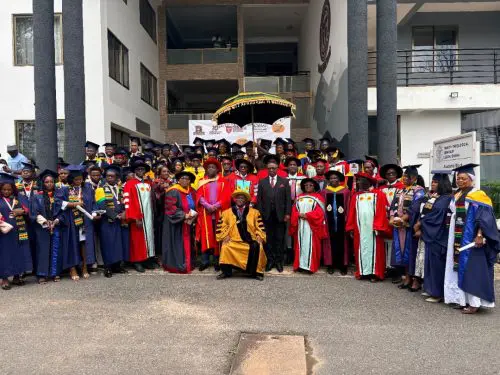
The President of Southshore University College, Professor N.N.N. Nsowah-Nuamah, has challenged African universities to rethink higher education by producing graduates who will lead the artificial intelligence (AI) revolution rather than simply adapt to technologies developed elsewhere.
Addressing the university’s 10th Congregation Ceremony in Accra on Saturday, Prof. Nsowah-Nuamah said AI is no longer a futuristic concept but a transformative force reshaping economies, industries and education across the globe.
“The question is not whether AI will change the world. It already has. The more important question is: What kind of people will guide that change?” he told graduates.
He said AI is revolutionising healthcare, business, engineering, research and education, making it necessary for universities to shift from knowledge transfer to developing innovators, critical thinkers and ethical leaders capable of solving complex problems.
According to him, Southshore University College, formerly Dominion University College, is embracing that challenge by positioning itself as a centre for research, innovation and artificial intelligence.
“This is the first congregation under our new name, and it represents a new direction for the university,” he said.
Prof. Nsowah-Nuamah stressed that success in the AI era would depend less on memorising information and more on creativity, adaptability, critical thinking and the ability to ask the right questions.
“Information is now abundant, and intelligent systems can retrieve facts almost instantly. The graduates who will thrive are not those who merely know the answers but those who know how to ask the right questions,” he said.
As part of the university’s transformation agenda, he announced that Southshore University College has received accreditation for five new master’s degree programmes, including Computer Science and Information Technology, to strengthen advanced education in science and technology.
He also disclosed that the university’s Nsowah-Nuamah Statistics and Artificial Intelligence Institute has established research collaborations with universities in Canada and the African Institute of Public Health in Nigeria. He added that the institution remains the only private university in Ghana offering a PhD in Statistics.
Delivering the keynote address, former Vice-Chancellor of Central University, Professor Bill Buenar Puplampu, warned that Africa risks missing another industrial revolution if it fails to invest deliberately in artificial intelligence, innovation and research.
He encouraged graduates to embrace AI as a productivity tool but cautioned against becoming overly dependent on platforms such as ChatGPT and Gemini, saying technology should complement rather than replace human creativity, judgment and critical thinking.
Chairman of the Governing Council, Professor Felix N. Hammond, said universities across Africa must fundamentally redesign their educational systems because employers increasingly value practical skills and innovation over academic certificates.
He argued that the traditional model of rewarding students solely for memorising information was becoming obsolete, as AI could now generate information within seconds.
“AI is changing everything. Very soon, you don’t need a student to tell you what they know because you can find that out from AI. What employers will need is evidence of what graduates can do in the real world,” he said.
Professor Hammond explained that Southshore University College is replacing the conventional lecture-and-examination approach with portfolio-based learning, enabling students to graduate with practical projects that demonstrate their competencies.
He added that the university is strengthening partnerships with industry through mentorship, curriculum development and employer engagement to ensure graduates possess skills that meet the demands of the modern labour market.
He further challenged African universities to become creators of AI technologies instead of remaining consumers of solutions developed elsewhere.
“We want to own the solutions, not use solutions imported from somewhere else. We want to build our own templates, not copy templates built elsewhere,” he said.
The Patron of Southshore University College, Baafuor Dr. Ossei Hyeamann Brantuo VI, echoed the call for innovation, urging graduates to use artificial intelligence to solve Ghana’s pressing development challenges instead of waiting for employment opportunities.
“Do not wait for opportunities; use Artificial Intelligence to create them,” he charged.
The Manwerehene of Otumfuo urged the graduates to deploy AI in rainwater harvesting to help tackle the destruction of Ghana’s water bodies caused by illegal mining, popularly known as galamsey.
He also encouraged them to explore AI-powered solutions in renewable energy by accelerating solar panel manufacturing using Ghana’s abundant sand and silica resources under the proposed Ghana Golden Sovereign Sands Energy Project.
Baafuor Dr. Brantuo VI further challenged the graduates to apply AI in preserving Ghana’s cultural heritage through the conceptual design, architectural mapping and business planning needed to complete the Hybrid Classico-Technological Manwere Palace Garden Museum.
Drawing inspiration from technology entrepreneur Elon Musk, he urged the graduates to become innovators who use technology to solve local problems and create sustainable businesses.
“The future of Ghana is smart, and it starts with the Class of 2026,” he said.
A total of 82 students, comprising HND, Postgraduate, Doctoral, undergraduate and ECBM graduated during the ceremony.
The speakers unanimously urged the graduates to combine character, competence and innovation while using artificial intelligence responsibly to drive Ghana’s development and position Africa as a global technology leader.
Telecommunications giant MTN Ghana has extended its best wishes to the Black Stars as they prepare to face Colombia in the Round of 32 of the ongoing 2026 FIFA World Cup.
The company expressed confidence in the national team, urging the players to give their all and make the nation proud as they seek a place in the Round of 16.
“MTN Ghana wishes the Black Stars every success in their crucial knockout fixture. We believe in the team’s determination, resilience and fighting spirit, and we are confident they have what it takes to secure victory and progress to the next stage of the competition,” the company said.
MTN further encouraged Ghanaians to rally behind the team with unwavering support, expressing hope that the Black Stars will deliver a memorable performance and continue their impressive World Cup journey.
The company wished the team the very best, expressing optimism that the Black Stars will overcome Colombia, advance to the next round, and continue their quest for World Cup glory.
Meanwhile, MTN Ghana Chief Executive Officer (CEO), Mr Stephen Blewett, paid a visit to the Black Stars camp to rally support behind the team.
Addressing the players, Mr Blewett inspired them with words of encouragement, confidence and determination, reaffirming MTN Ghana’s unwavering support as the team seeks to progress further in the tournament.
He described the Black Stars’ journey so far as a source of pride for the nation, saying their performances had reminded Ghanaians of what the team represents.
“The whole nation is behind the Black Stars,” he said, urging the players to give their all and continue making the country proud.
The esteemed kingmakers of the Ngleshie Alata Paramountcy under the James Town Stool have issued a stern warning to Prince Bruce Quaye, stating unequivocally that he is not recognized as a chief and must desist from holding himself out as such.
The kingmakers, traditional leaders entrusted with the responsibility of guiding succession and maintaining the customs of James Town issued a press statement over the weekend in Accra.
The statement emphasized the importance of adherence to traditional protocols and the need for unity in upholding the lineage of leadership.
“Prince Bruce Quaye’s actions and claims to chieftaincy have raised serious concerns among the royal council,” the spokesperson stated. “We must ensure that the rightful customs are followed to maintain the integrity of our leadership.”. The kingmakers argue that his approach undermines traditional values.
The kingmakers of Ngleshie Alata have issued a stern warning to Prince Asharku Bruce Quaye, urging him to cease what they term a “witch hunt” against Naa Afrimpong IV, the Queenmother of James Town. The statement comes amid growing tensions surrounding allegations that have sparked community unrest.
The kingmakers, expressed their concerns over the impact of these allegations on the unity and peace of the community. They emphasized that such actions undermine the traditional authority and respect that the Queenmother commands within James Town.
In their statement, the kingmakers called on all relevant state agencies to take note of the ongoing situation and desist from dealing with Prince Quaye adding that they do so at their own risk.
“We urge Prince Asharku Bruce Quaye to reflect on the implications of his actions and to prioritize the welfare of our community over personal grievances,” the statement read. “The integrity of our traditional institutions must be preserved.”
As tensions rise, community members have rallied behind Naa Afrimpong IV, expressing their support for the Queenmother and calling for an end to the divisive rhetoric.
A public commentator has called for a more measured national conversation around the KGL Technology Limited and National Lottery Authority (NLA) partnership, arguing that while illegality must be confronted, Ghana cannot afford a culture where every successful indigenous business is presumed guilty before facts are established.
The statement comes amid sustained public debate following The Fourth Estate’s 2025 investigative series on the KGL–NLA agreement, and the subsequent committee review initiated under President John Mahama’s intervention.
“Illegality Must Be Fought, But So Must Hasty Condemnation”
“Folks, when a Ghanaian businessman is engaging in illegality, we will fight the person. I do not care whether the person is rich, powerful, politically connected, or celebrated. Wrong is wrong,” the commentator stated.
“Nonetheless, we should eschew developing a national culture where every successful indigenous Ghanaian business is presumed guilty and subjected to a sustained campaign of public condemnation before all the facts are known. That approach is dangerous for investment, dangerous for entrepreneurship, and dangerous for Ghana.”
Divergence Between Fourth Estate’s Position and Committee Findings
The commentator said he has followed the KGL–NLA matter closely since _The Fourth Estate_ published what it described as an “explosive investigation” into the partnership in 2025.
Since then, he noted, the public has been inundated with publications, interviews, and interventions from Sulemana Braimah and The Fourth Estate.
“However, after all the noise, one fundamental reality remains: the official review process did not arrive at the same destination advocated by The Fourth Estate_ and Sulemana Braimah. And the facts available do not support the stance of The Fourth Estate,” he said.
From the outset, The Fourth Estate framed the agreement as a “terrible deal” that should be abrogated, creating the impression that the arrangement was irredeemable and that termination was the only remedy.
In contrast, the committee set up after the President’s intervention did not recommend outright cancellation.
“Instead, the committee recommended a stay of the agreement and a renegotiation of the financial terms to ensure greater benefits for the country,” the commentator explained.
“That distinction is extremely important because renegotiation and abrogation are not the same thing. Abrogation means terminating a contract.
Renegotiation means improving a contract. One suggests the arrangement is beyond repair. The other acknowledges that the arrangement has value but requires adjustment.”
He argued that the committee therefore adopted “a far more measured, commercially grounded, and legally sustainable position” than the outright cancellation stance championed by Sulemana Braimah.
Revenue Claims and Contractual Realities
Central to The Fourth Estate’s case was a revenue comparison. The outlet calculated that KGL generated approximately GHS3 billion in gross revenue in 2024 and argued that under an earlier NLA arrangement, the Authority could have received about GHS615 million instead of the reported GHS118.2 million, suggesting a shortfall of about GHS496.8 million.
The commentator questioned the methodology.
“This entire position hangs on a hypothetical assumption that the 2019 arrangement should have remained unchanged forever and that all commercial conditions would have remained constant. But business does not operate that way. Contracts are renegotiated. Risks change. Technology costs change. Market realities change. A comparison between two different contractual structures does not prove wrongdoing.”
He said the more relevant question is whether KGL helped build and expand a digital lottery ecosystem that delivered unprecedented revenues.
“If that is the case, then the debate of whether value was created is a non-starter,” he added.
KGL’s Contribution to NLA Revenue
The statement also highlighted KGL’s fiscal contribution relative to other operators.
“Recent data indicate that KGL paid approximately GHS173.36 million to the NLA in 2025, while 29 other licensed operators paid a combined GHS44.9 million. Even the Ghana Lotto Operators Association reportedly acknowledged KGL’s dominant contribution to NLA revenues,” he said.
“That does not mean KGL should not be criticized. It does not mean every aspect of the arrangement is perfect. I am simply saying that the public deserves a balanced discussion rather than a one-sided narrative advanced by The Fourth Estate.”
Institutions, Not Media Campaigns, Must Decide
The commentator stressed that dissent is legitimate, but it cannot override institutional processes.
“Sulemana Braimah has every right to disagree with the committee’s conclusions. He has every right to advocate for stronger action. What he does not have is a monopoly over truth. The Republic of Ghana is governed by institutions, laws, and contractual processes, not by media campaigns,” he said.
“Must the Republic be tied to the toes of whatever _The Fourth Estate_ says? Certainly not. Public interest cannot be dictated by a single individual.
Contractual relationships cannot be determined by someone’s emotional outburst. Governments must act based on law, evidence, commercial realities, and the national interest.”
He described the current process as “a legal and commercial renegotiation involving relevant stakeholders” aimed at securing better terms for Ghana, and said that is different from the impression that the committee fully endorsed The Fourth Estate’s position.
Journalism, Scrutiny, and National Interest
While affirming the role of investigative journalism, he cautioned against activism masquerading as reporting.
“We need investigative journalism. It is an indispensable pillar of democracy. But journalism must not become self-serving activism. Journalists must be prepared to have their assumptions, calculations, interpretations, and conclusions subjected to the same scrutiny they apply to others. They shouldn’t mistake their position on issues as sacrosanct.”
A Commercial Dispute, Not a Moral Crusade
In conclusion, he framed the matter as a policy and commercial negotiation rather than a moral showdown.
“At the end of the day, the KGL–NLA issue is not a battle between good and evil. It is a commercial and policy dispute about how the benefits of a rapidly growing digital lottery ecosystem should be shared. The task before government is not to destroy value but to maximize value for the Ghanaian people.”
“If there is illegality, let it be proven. If there is corruption, let it be prosecuted. But if the issue is fundamentally about obtaining a better financial arrangement for the Republic, then honesty demands that we call it exactly what it is: a negotiation issue, not the grand scandal that The Fourth Estate and Sulemana Braimah attempted to portray.”