LATEST ARTICLES

MMFL CEO Touts Digital Lending as Key to Unlocking Business Growth

0

The Chief Executive Officer of MobileMoney Fintech LTD (MMFL), Mr Shaibu Haruna, has outlined an ambitious strategy to transform Ghana’s informal economy by expanding access to credit, empowering microenterprises and leveraging digital financial services to drive sustainable economic growth.

The initiative forms part of the company’s broader vision to deepen financial inclusion, strengthen financial security and create opportunities for millions of underserved individuals and small businesses to build sustainable livelihoods.

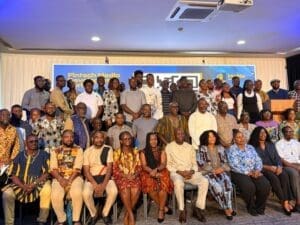
Mr. Haruna shared this during his address to editors and senior journalists at the second edition of the MMFL Media Development Series, a platform aimed at fostering collaboration with the media and enhancing understanding of developments in Ghana’s digital financial ecosystem.

He said although Ghana had made remarkable progress in mobile money adoption, the next phase of financial inclusion must focus on translating digital access into tangible economic opportunities, particularly for micro, small and medium-sized enterprises (MSMEs).

According to him, millions of small businesses remain trapped in subsistence operations despite the increasing availability of digital financial services, a situation that continues to undermine their growth potential and contribution to national development.

“We need to begin to build the next businesses that are going to shape Ghana’s economic development, create employment and build an ecosystem that fosters growth,” he stated.

Transforming Microenterprises into Sustainable Businesses

Mr Haruna identified the transformation of microenterprises as a central pillar of MMFL’s long-term growth strategy, stressing the need to move informal businesses beyond basic financial transactions towards structured enterprise development.

He explained that many traders and small business operators continued to use personal mobile money wallets for commercial transactions, making it difficult to distinguish business income from personal expenditure.

The practice, he noted, undermined effective financial management, complicated credit assessment and limited opportunities for business expansion.

To address the challenge, MMFL intends to collaborate with financial institutions and other strategic partners to develop tailored financial solutions that will enable microentrepreneurs to separate personal finances from business transactions.

The approach is expected to strengthen financial discipline, improve access to appropriate credit facilities and support the transition of informal businesses into sustainable enterprises.

“For us, we want to profile such a person as a small merchant because we want to take them on a certain growth journey,” he explained.

Illustrating the financial vulnerabilities confronting informal businesses, Mr Haruna recounted the experience of a small-scale avocado trader who relied on digital loans to sustain her operations but was compelled to divert her working capital to meet medical expenses.

He said the trader subsequently recovered and resumed her business, demonstrating both the importance of accessible financing and the need for financial products that respond to the realities of microentrepreneurs.

According to him, millions of similar businesses across Ghana require targeted interventions to strengthen their financial resilience, expand operations and create employment.

Digital Lending to Unlock Business Growth

Touching on access to credit, the MMFL CEO said digital financial technology was creating new opportunities for individuals and small businesses traditionally excluded from formal lending systems.

He explained that transaction histories and payment patterns could provide financial institutions with valuable information to assess creditworthiness, particularly among customers without conventional collateral or extensive financial records.

Unlike traditional lending arrangements, which often require substantial documentation and security, digital lending solutions could support alternative credit assessments and expand financing opportunities for underserved customers.

Mr Haruna, however, stressed the importance of responsible borrowing, repayment discipline and customer education to ensure the long-term sustainability of digital credit services.

He reaffirmed MMFL’s commitment to working with financial institutions and technology partners to develop accessible and responsible lending solutions capable of supporting enterprise growth.

Ghana’s Mobile Money Transactions Exceed GH¢4 Trillion

Highlighting the growing significance of digital financial services, Mr Haruna disclosed that Ghana’s mobile money industry processed transactions valued at more than GH¢4 trillion in 2025, reflecting the increasing integration of digital payments into everyday economic activities.

He clarified that the transaction value represented the total movement of funds within the mobile money ecosystem and should not be interpreted as revenue generated by service providers.

According to him, the figure included transactions involving agents, financial institutions, merchants and individual customers, with a substantial proportion attracting no service charges.

He explained that such transactions were essential to maintaining liquidity and ensuring the smooth functioning of the mobile money ecosystem.

Mr Haruna further noted that Ghana’s mobile money pricing structure incorporated transaction fee thresholds intended to promote affordability and encourage wider participation in digital financial services.

MMFL Processes Over 26 Million Transactions Daily

The CEO also revealed that MMFL currently processes more than 26 million transactions daily, reinforcing its position as a major player in Ghana’s digital financial infrastructure.

He said the volume of transactions placed considerable responsibility on the company to maintain reliable systems, strengthen cybersecurity and ensure uninterrupted service delivery.

To meet growing demand, MMFL undertook a major technological upgrade in 2025, nearly doubling its transaction-processing capacity.

Mr Haruna explained that the company continued to invest in infrastructure improvements, security updates and system enhancements to safeguard customer transactions and strengthen operational resilience. “We view ourselves as a national transaction rail,” he stated.

He emphasised that maintaining public confidence in digital financial services required sustained investment in technology, system reliability and customer protection.

Rising Digital Fraud Threatens Financial Inclusion

Mr Haruna expressed concern over the growing sophistication of digital financial fraud, warning that cybercriminals were increasingly exploiting vulnerabilities across interconnected digital platforms.

He described fraud as a major threat to financial inclusion, explaining that security breaches and fraudulent activities could undermine customer confidence and discourage the adoption of digital financial services.

According to him, fraudsters were extending their operations beyond mobile money platforms to social media, online marketplaces, messaging applications and other digital channels.

Recounting a personal experience, he disclosed that fraudsters attempted to compromise his WhatsApp account after he contacted what appeared to be a legitimate pizza outlet through an online search.

He explained that the perpetrators had used a deceptive online listing to initiate communication before attempting to obtain information that could facilitate an account takeover.

The incident, he said, demonstrated the increasingly sophisticated methods employed by cybercriminals to exploit unsuspecting internet users.

Mr Haruna stressed that combating digital fraud required coordinated action among financial institutions, telecommunications operators, technology companies, regulators and customers.

He also underscored the need for sustained public education to equip customers with the knowledge to identify fraudulent schemes and protect their personal information.

Artificial Intelligence to Strengthen Fraud Prevention

On emerging technologies, Mr Haruna identified artificial intelligence (AI) as a potentially powerful tool for detecting suspicious financial transactions and strengthening fraud prevention.

He explained that while criminals could exploit AI to develop sophisticated fraudulent schemes, financial institutions could equally deploy the technology to identify unusual transaction patterns and respond more effectively to security threats.

He advocated stronger collaboration and real-time information sharing among digital financial service providers to improve the detection and prevention of financial crimes.

According to him, fraudsters frequently move funds across multiple financial platforms, making it difficult for individual institutions to independently track suspicious transactions.

He maintained that integrating fraud-monitoring capabilities across the industry could significantly improve the effectiveness of financial crime prevention.

MMFL Pushes Adoption of MoMo App

Mr Haruna also outlined plans to accelerate the adoption of the MoMo mobile application as part of efforts to improve customer experience and expand access to digital financial products.

He acknowledged the critical role of Unstructured Supplementary Service Data (USSD) technology in Ghana’s mobile money development since 2009 but explained that the growing complexity of financial services required more convenient and integrated digital platforms.

According to him, customers accessing multiple products through USSD often had to navigate several menus, making transactions less convenient.

Mobile applications, he said, offered opportunities to simplify transactions, personalise services and integrate products from different financial service providers.

He disclosed that approximately 70 per cent of MMFL agents had smartphones, presenting significant opportunities to accelerate app-based service delivery.

The CEO, however, assured customers that the company would not discontinue USSD services, stressing that existing channels would remain available to those who depended on them.

He further revealed that MMFL was exploring the development of a broader digital ecosystem through which customers could access banking, fintech and other related services from a single application.

The proposed approach, he explained, could reduce the need for customers to install multiple applications while improving convenience and access to financial products.

Embedded Finance to Expand Savings and Insurance

Mr Haruna identified embedded finance as another strategic opportunity to deepen financial inclusion by integrating savings, investment and insurance products into everyday transactions.

He explained that many individuals struggled to make regular contributions towards insurance and investment products when such payments were treated as separate financial obligations.

Integrating these services into routine transactions, he said, could make financial planning more convenient and encourage consistent saving.

Illustrating the concept, he explained that a customer spending GH¢1,000 at a retail outlet could voluntarily allocate GH¢1 or GH¢2 towards an investment or insurance product.

Such arrangements, he noted, could enable customers to gradually accumulate savings and obtain financial protection without placing significant pressure on their daily expenditure.

He disclosed that MMFL was exploring opportunities with partners to develop embedded financial solutions tailored to customer needs.

Mr Haruna also called for innovative insurance products designed around the financial behaviour of customers rather than merely transferring conventional insurance services onto digital platforms.

Digital Gold Investment Could Become Accessible to Ordinary Ghanaians

The MMFL CEO further highlighted the potential of regulated virtual assets and asset tokenisation to broaden investment opportunities, particularly for individuals with limited financial resources.

He explained that emerging digital technologies could enable investors to acquire fractional interests in valuable assets, including gold, without purchasing large quantities.

Despite Ghana’s position as a major gold-producing country, he observed that many citizens had limited opportunities to invest directly in the precious metal.

Through asset tokenisation, he said, individuals could potentially acquire small fractions of gold using digital platforms and gradually build their investment portfolios.

He cited a hypothetical investment of GH¢10 as an example of how fractional ownership could make gold investment more accessible.

Mr Haruna, however, stressed that such innovations must operate within appropriate regulatory frameworks to safeguard investors and protect financial stability.

He disclosed MMFL’s interest in collaborating with regulated institutions to explore opportunities within the emerging digital asset ecosystem.

He expressed optimism that the necessary regulatory guidelines could be introduced before the end of 2026 to support the possible rollout of relevant services in 2027.

Cross-Border Payments to Boost African Trade

Mr Haruna also called for greater interoperability among African digital financial systems to facilitate cross-border payments and strengthen regional economic integration.

He observed that differences in regulatory frameworks continued to create barriers to seamless financial transactions between African countries.

According to him, addressing these challenges would enable microenterprises to participate more effectively in regional trade and take advantage of opportunities under the African Continental Free Trade Area (AfCFTA).

He said Ghana’s experience in mobile money interoperability offered valuable lessons for other African countries seeking to modernise their financial infrastructure.

Improved cross-border payment systems, he maintained, could reduce transaction barriers, expand market access and unlock new opportunities for small businesses engaged in regional commerce.

He consequently advocated closer collaboration among governments, regulators and private sector operators to develop interoperable financial systems capable of supporting trade and investment across the continent.

Bridging Gender and Identity Gaps in Financial Inclusion

The MMFL CEO further drew attention to persistent inequalities in access to digital financial services, particularly among women and informal business operators.

He acknowledged progress in narrowing gender disparities but maintained that structural barriers continued to prevent some individuals and businesses from participating fully in the formal financial system.

Among the challenges he identified were limited access to identification documents, business registration and financial products suited to the needs of underserved groups.

He observed that some businesses were registered in the names of men despite being operated and managed by women.

Addressing such disparities, he said, would strengthen women’s economic participation and ensure that the benefits of digital financial inclusion reached a broader segment of society.

Mmfl

MMFL Deepens Industry Collaboration

Mr Haruna reaffirmed MMFL’s commitment to strengthening partnerships with banks, fintech companies, regulators, industry associations and other stakeholders to accelerate innovation and support Ghana’s digital economic transformation.

He stressed that sustainable development of the financial technology sector required collaboration, knowledge sharing and coordinated efforts rather than isolated initiatives.

He cited the company’s participation in stakeholder engagements and the Bank of Ghana-led 3i Africa Summit as evidence of its commitment to supporting the broader fintech ecosystem.

He also referenced a fintech engagement held in September, which provided opportunities for Ghanaian industry players to interact with counterparts from other African markets.

According to him, MMFL remained interested in supporting Ghanaian fintech companies seeking to expand their operations beyond the country’s borders.

He expressed confidence in Ghana’s technological talent and innovation capabilities, stressing that these could be harnessed to develop competitive digital financial solutions for the African market.

Mr Haruna further commended editors and senior journalists for their continued engagement with the company, describing the Media Development Series as an important platform for promoting financial literacy, exchanging knowledge and strengthening public understanding of emerging financial technologies.

He reiterated that MMFL’s ultimate ambition was to build a more inclusive and resilient digital financial ecosystem in which individuals and businesses could move beyond basic transactions to access meaningful economic opportunities.

The company, he assured, would continue working with stakeholders to ensure that Ghana’s expanding digital financial sector translated into sustainable businesses, employment opportunities and improved financial well-being for citizens.


Ghana Property & Lifestyle Expo celebrates 10 years with landmark London edition showcasing Ghana to the diaspora

0

Two-day anniversary event brings 44 exhibitors, 16 speakers, property expertise and an expanded Lifestyle Pavilion to the Business Design Centre

The Ghana Property & Lifestyle Expo will mark its 10th anniversary with a flagship London edition on Friday 16 and Saturday 17 October 2026 at the Business Design Centre in Islington. The free two-day event will connect the diaspora, international investors, families and businesses with trusted opportunities across Ghanaian property, finance, business, tourism and lifestyle.

Held under the theme “A Decade of Impact: Bridging Continents, Building Futures,” the anniversary edition is being delivered in collaboration with the Ghana High Commission UK. It will bring together 44 property and lifestyle exhibitors and 16 expert speakers, giving visitors direct access to developers, banks, legal and investment specialists, public institutions and Ghanaian and African-owned brands.

“Ten years ago, we created this platform to give the diaspora direct access to credible organisations and the confidence to make informed decisions about Ghana. This anniversary celebrates how far the community has come, while opening the next chapter across property, finance, business, culture and lifestyle.”
Anna Agyekum and Victoria Agyekum, Co-Founders of the Ghana Property & Lifestyle Expo

A programme designed for informed investment

The programme begins from 11:00am each day and includes keynote addresses, fireside conversations, expert panels and audience Q&A sessions. Topics will cover Ghana’s real estate market, diaspora banking and property finance, cross-border funding, legal due diligence, business-building in Ghana, market intelligence and the practical experiences of diaspora buyers.

A reflective keynote from Goldkey Properties will examine its decade-long journey with the Expo and the growth of the diaspora into a major client base for Ghanaian property businesses.

Official guests and contributors include H.E. Mrs Sabah Zita Benson, Ghana’s High Commissioner to the United Kingdom and Ireland; The Worshipful the Mayor of Islington, Councillor Rosaline Ogunro; Diana Afriyie Addo, Head of Trade and Investment at the Ghana High Commission UK and Ireland; and senior representatives from the Expo’s sponsors, partner organisations and exhibiting companies.

Featured speakers include Charles Addo, Director of Personal and Private Banking at Absa Bank Ghana; Joshua Nkrumah, CEO of Jolly Homes; Nelly Gbogboe, Head of Sales at Landmark Homes; Michael Kyei-Ayensu, Founder and Director of Jacob West; Emmanuel Mate-Kole, Managing Partner at M&O Law Consult; Henry Asenso, Founder of Kuro Africa Analytics; and Anthony Lindsay, UK mortgage specialist.

Property and lifestyle under one roof

Alongside the property exhibition, the expanded Lifestyle Pavilion will showcase African-owned businesses across fashion, beauty, wellness, food and drink, interiors, tourism, gifts and cultural products. Curated with Go Africa Community Hub, the Pavilion is intended to give visitors a fuller view of the products, services and experiences shaping modern Ghanaian and African life.

Saturday’s programme will also feature a fireside conversation with Akua Kufuor, Founder of Akvance and creator of Countdown Africa, exploring how destination marketing, cultural storytelling and experiential platforms can strengthen Ghana’s international profile. Complimentary NoireFitFest fitness and wellness sessions, led by founder Lorraine Russell, will take place in the Experience Room at 5:00pm on both days, subject to capacity.

The National Identification Authority will be present to support eligible visitors with Ghana Card services. Anyone intending to use this service is encouraged to complete the required pre-registration before attending and bring the relevant supporting documents.

Key sponsors and partners

The 10th anniversary London edition is proudly sponsored by Absa Bank Ghana, Jolly Homes Ghana, Landmark Homes and Clifton Homes. Absa Bank Ghana joins as the Official Banking Partner, bringing specialist diaspora banking and property-finance expertise to the event. Jolly Homes, Landmark Homes and Clifton Homes will showcase residential opportunities and contribute to the programme’s property discussions.

The Expo is delivered in collaboration with the Ghana High Commission UK. Additional partners include Go Africa Community Hub, curator of the Lifestyle Pavilion, and BoConcept, the event’s furniture partner.

What visitors can expect

  • Direct conversations with established Ghanaian property developers and advisers.
  • Practical guidance on finance, mortgages, legal due diligence and cross-border investment through expert panels and audience Q&A sessions.
  • A curated Lifestyle Pavilion, cultural experiences and complimentary wellness sessions featuring African-owned businesses.
  • Ghana Card support from the National Identification Authority for pre-registered applicants, alongside networking and investment clinics.

Event information

Event Ghana Property & Lifestyle Expo 2026 – 10th Anniversary London Edition
Dates Friday 16 and Saturday 17 October 2026
Time 10:00am-6:00pm daily
Venue Business Design Centre, 52 Upper Street, Islington, London N1 0QH
Admission Free entry; advance registration is strongly encouraged
Website ghanapropertyexpo.com


Register free: https://ghanapropertyexpo.com/

The case against compulsory third-party insurance

0

By National Protocol Director of the New Patriotic Party (NPP), Kwadwo Afari

Ghana’s compulsory third-party motor insurance system was designed to protect accident victims. But after decades of experience, is it time to examine whether a more effective and accountable alternative exists?
Every vehicle owner in Ghana is legally required to purchase third-party motor insurance before using a public road. The rationale is straightforward: innocent victims of road accidents should have access to compensation for injuries, death, or property damage caused by negligent drivers.
Few would dispute that objective.
The question is whether the coercive power of the criminal law can be used to compel the purchase of a private financial product, particularly when this requirement creates a legally protected market for insurance providers and removes the freedom of consumers to decide how best to manage their own risks. Citizens are not merely encouraged to buy insurance; they are compelled to do so.
The legitimacy of any compulsory system depends not only on its intentions but also on its performance. When citizens are required by law to purchase a product, they are entitled to expect that the system will operate efficiently, transparently, and fairly. Yet complaints concerning delayed, disputed, and denied insurance claims continue to undermine public confidence in the industry.
This is not simply a consumer-protection issue. If the purpose of compulsory third-party insurance is to guarantee compensation for victims, policymakers should periodically assess whether the existing framework continues to serve that purpose of the public as effectively as possible.
Indeed, there is an even more fundamental question. Why should the coercive power of the state be used to compel citizens to purchase a private financial product? Driving without insurance is not treated merely as a regulatory violation. It can expose motorists to fines, vehicle impoundment, prosecution, and other criminal sanctions. The state may justify these powers on the grounds of protecting innocent victims, but that justification deserves ongoing scrutiny.
In a free society, citizens should be willing to ask whether criminal penalties are the most appropriate means of enforcing a private insurance arrangement, particularly when concerns persist regarding claims administration and public confidence in the system.
One alternative worthy of examination is a road-user compensation fund financed through a modest levy on fuel. Under such a model, contributions would be linked directly to road usage. Motorists who consume more fuel and place greater demands on public roads would contribute more, while those who drive less would contribute less.
The proceeds could be managed through a dedicated compensation fund overseen by the National Insurance Commission or an independent statutory authority. The primary objective would be straightforward: ensuring prompt and reliable compensation for victims of road accidents.
Such a proposal should not be viewed as an attack on Ghana’s insurance industry. On the contrary, it could encourage greater innovation and competition within the sector.
Compulsory third-party insurance provides insurers with a guaranteed market because every vehicle owner is legally required to purchase the product. While this arrangement serves important public-policy objectives, it may also reduce some of the competitive pressures that normally drive service improvement. If basic third-party compensation were handled through a public fund, insurers would be encouraged to compete more vigorously in voluntary markets such as comprehensive motor cover, life insurance, health insurance, business insurance, and other specialised products.
Rather than relying on a legally mandated customer base, insurers would need to attract and retain customers through superior service, faster claims processing, innovative products, and competitive pricing. That could strengthen the industry’s long-term efficiency and responsiveness while encouraging greater investment in new products and services.
This is a call for the immediate abolition of compulsory third-party insurance. What should be abolished is not compensation for accident victims, but the legal requirement that citizens purchase compensation through private insurers. We accept that such a significant reform would require careful actuarial analysis, stakeholder consultation, and legislative review.
It is also a call for something more fundamental: accountability.
A law that compels millions of citizens to purchase a product should never be exempt from scrutiny. The burden is not on motorists to prove that reform is necessary. The burden is on the state to demonstrate that the existing system continues to serve the public effectively, fairly, and transparently.
If compulsory insurance remains the best mechanism for protecting accident victims, a rigorous national review will only strengthen public confidence in it. If a more efficient and accountable alternative exists, Ghana should have the courage to pursue it.
The real issue is not whether accident victims deserve protection. They unquestionably do. The real issue is whether citizens should be compelled to finance a system simply because it has always existed, or because it continues to deliver the best results.
If the objective is to ensure compensation for accident victims, then criminal penalties should be directed at motorists who cause harm rather than at peaceful citizens who merely fail to purchase a financial product. The state should be required to justify why a person may be stopped, fined, detained, or deprived of liberty not for causing injury, but for failing to buy insurance from a private provider.
The Ministry of Finance, the National Insurance Commission, the Ghana Insurers Association, road-safety authorities, consumer groups, and Parliament should therefore undertake a comprehensive review of Ghana’s third-party insurance regime. An independent study, parliamentary inquiry, or carefully designed pilot programme could determine whether alternative compensation mechanisms might better serve motorists, accident victims, and taxpayers alike.
And no law that compels payment from every citizen should be immune from the simple question every motorist has a right to ask:
Does this system still serve the public, or has the public merely been conditioned to serve the system?
If the answer is uncertain, then the case for abolition of third-party insurance is no longer optional. It is overdue.

“I received no World Cup tickets” — Asutifi North MP challenges allocation claims

0

Asutifi North MP Ebenezer Kwaku Addo has disputed claims that every member of Parliament’s Youth and Sports Committee received tickets for Ghana’s participation in the 2026 FIFA World Cup, saying he received none while Ranking Member Vincent Assafuah received three.
Speaking on Bullet TV, Addo said his experience contradicted a statement he attributed to Assafuah that every committee member had received a ticket allocation. He challenged the ranking member to explain how he obtained three tickets if some people did not attend or participate in the tournament.
“I am putting it on record that Ebenezer Addo, who is a member of Parliament for Asutifi North and a member of the Sports Committee, never received allocation of tickets to watch the match,” he said.
Addo also distanced the entire committee from the Minority Caucus’s demand for Sports Minister Kofi Adams to resign over the World Cup visa scandal, stressing that the call followed a press conference by Minority members of the committee and did not represent a unanimous position.
He said the full committee had already engaged the minister and asked questions about Ghana’s participation in the tournament. According to Addo, the minister had undertaken to provide a comprehensive report to help the committee establish what happened.
The MP questioned why some Minority members were publicly repeating concerns they had raised during the committee’s engagement with the minister. He accused them of seeking to divert public attention from the government’s development agenda.
Addo also criticised the Minority for calling for investigations into the roles of the Sports Ministry, the National Sports Authority (NSA) and individuals alleged to have collected money in connection with the scandal, arguing that the allegations had not been substantiated with documentation.
He urged the public to await the minister’s report, adding that appropriate action should follow if its findings implicated the minister.
“If there are any issues within the report that seek to indict the sports minister, we will call for the proper actions to be taken,” he said.
The dispute comes amid calls by Minority members of the Youth and Sports Committee for accountability over the visa-related controversy surrounding Ghana’s 2026 World Cup participation.

Labadi Beach redevelopment to introduce restaurants, lounges and water sports

0

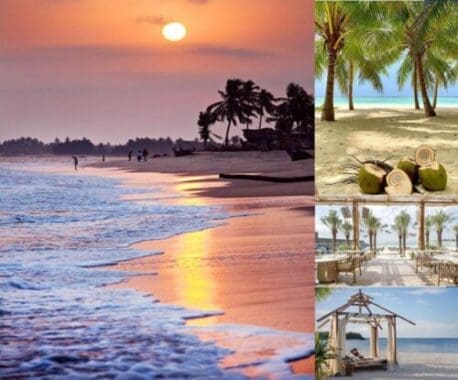
The proposed redevelopment of the Labadi beachfront is expected to transform the area into a modern tourism and leisure destination while preserving public access to the beach.

The project, linked to efforts by Labadi Beach Hotel and the Social Security and National Insurance Trust (SSNIT) to address longstanding encroachment, is expected to introduce restaurants, beach lounges, landscaped spaces, live music, wellness facilities, water sports and retail outlets.

According to the background provided, the hotel had struggled to expand its facilities because of encroachment on the beachfront. Attempts to secure the area were unsuccessful, leading management to seek SSNIT’s support. The Trust subsequently engaged National Security to help address the situation.

The encroachment reportedly created sanitation and waste management concerns, security risks for guests and visitors, and reports of inappropriate and illicit activities in the vicinity. These conditions, the background document said, undermined the ambience, safety and standards expected of a five-star hospitality establishment.

A committee involving relevant stakeholders has since been established to review outstanding issues, agree on the necessary arrangements and coordinate the next steps. The project is expected to begin after stakeholder engagement, with an initial focus on cleaning and restoring the area to a safer, more attractive and properly managed environment.

The proposed development is intended to combine hospitality, recreation and entertainment in a coastal setting for local and international visitors. It is envisioned as a place where people can dine, socialise, relax and enjoy the natural environment of Labadi Beach.

Beyond tourism, the redevelopment could create employment and business opportunities for residents of La and surrounding communities through the provision of goods and services, local enterprise and participation in the wider tourism value chain.

However, meaningful consultation with chiefs, traditional authorities, community leaders and residents will be important in addressing concerns over livelihoods, employment, environmental protection, public access and the future use of the beachfront. Community participation is expected to help ensure that local residents benefit from the project.

SSNIT’s involvement is tied to its responsibility to protect and manage assets held in trust for contributors and pensioners. The Trust maintains that safeguarding its investments against unauthorised occupation and ensuring their long-term value are essential to its mandate of administering Ghana’s Basic National Social Security Scheme.

SSNIT has assured the public that the beachfront will remain accessible as a public beach. The success of the redevelopment will therefore depend not only on its tourism and commercial ambitions but also on how effectively it protects public access, addresses community concerns and delivers economic benefits to surrounding residents.

Six months on, PDS probe yields frozen accounts, no charges

0

Investigators have spent six months on a criminal probe into Power Distribution Services Ghana Limited (PDS), the company that briefly ran the Electricity Company of Ghana’s (ECG) power distribution network. In that time they have frozen about 66 bank accounts, detained two company officials and two of their lawyers, and set bail at up to GH¢100 million. Nobody has been charged.

The case centres on about GH¢850 million that the State says left a CalBank account allegedly belonging to ECG. It has become a test of how far Ghana’s anti-graft agencies can go before a court rules, and of whether the outcome of an international arbitration can be revisited through criminal law.

PDS has asked the High Court to review the investigation. Civil society groups are pressing the Economic and Organised Crime Office (EOCO) to either charge the suspects or lift the restrictions on them.

How the dispute began

PDS took over ECG’s distribution operations on 1 March 2019. The concession was part of a power sector reform backed by the United States Millennium Challenge Corporation. Within months it collapsed over the validity of PDS’s payment guarantees, and Ghana lost US$190 million in compact funding.

The contract dispute went to the London Court of International Arbitration. In November 2025, the tribunal ruled in ECG’s favour and dismissed PDS’s compensation claim, reported at around US$390 million.

What the award left unsettled now drives the criminal case. Benjamin Boakye, Executive Director of the Africa Centre for Energy Policy, has said the tribunal cleared PDS of the fraud claims ECG pursued. He has also said it declined jurisdiction over the Interim Protocol, the arrangement that governed money between the two sides after the concession was suspended. If he is right, no forum has yet reconciled what PDS collected, what it paid out and what, if anything, it owes ECG.

PDS’s lawyers describe the arbitration differently. They say the Interim Protocol ran for less than three months in 2019 and was dealt with in the arbitration, and that PDS owes ECG nothing.

The State’s case

On 4 May 2026, Felix Kwakye Ofosu, Minister of State in charge of Government Communications, announced the arrests. He said the Bureau of National Intelligence (BNI) had picked up four people affiliated with PDS over transfers of large sums believed to belong to ECG.

Benjamin Alpha, spokesperson for the Attorney-General’s Office, later put the amount at about GH¢850 million. He said money that should have remained in the account after ECG’s arbitration win had been depleted.

According to court records summarised by the pressure group OccupyGhana, EOCO relies on a petition from the Financial Intelligence Centre. The petition alleges fraud involving insurance guarantees and transfers by directors to third parties. EOCO also cites suspicious transactions, near-total withdrawals and a risk that assets could be dissipated.

Raymond Archer, who heads EOCO, told JoyNews’ Newsfile on 9 May 2026 that the agency was doing “very professional and methodical work” on the case.

The measures taken so far

OccupyGhana’s statement of 30 September 2026 sets out the following sequence:

  • 7 to 10 April 2026: EOCO froze about 66 accounts belonging to PDS and people linked to it. A High Court later confirmed the freeze on an application made without notice to PDS.
  • 30 April 2026: The BNI detained Board Chairman Philip Ayesu and Project Director Viraj Bhat for two days and set bail at GH¢50 million each.
  • 6 May 2026: Their bail was raised to GH¢100 million each, and both were barred from leaving Ghana.
  • From May 2026: They and the two lawyers have been required to report to EOCO three times a week, about 60 visits each by the end of September.

The two lawyers are Justice Kusi-Minkah Premo and Sophia Kokor of Minkah-Premo, Osei-Bonsu, Bruce-Cathline and Partners. According to their firm, they went to the BNI on 30 April to represent the two officials and were instead declared persons of interest. They were questioned over alleged dishonest receipt and abetment of money laundering, held until 1 May and bailed at GH¢50 million each. They say they were also questioned about their professional fees, and that their personal and firm accounts were later frozen. The firm called the arrests an attack on the right to legal counsel.

Those affected also say accounts belonging to businesses unconnected to PDS were frozen.

Defenders and critics

Attorney-General Dominic Ayine has defended high bail set by EOCO in general terms, not specifically in the PDS case. In Parliament in November 2025, he said “bail depends on the crime and the gravity of the offence.” He argued that low bail could let suspects evade trial in cases involving large potential losses to the State.

Critics say the PDS case shows how that reasoning can be stretched. Boakye argues the State is using criminal powers to settle what is in essence a civil accounting dispute, and that it cannot “criminalise the disputed account first and reconcile it later.”

Journalist Manasseh Azure Awuni wrote on 24 September 2026 that neither ECG nor any state agency had reported funds stolen. He also wrote that no one had told PDS a reconciliation showed a debt.

OccupyGhana has called on the agencies to charge the suspects or release them. It has also asked the Attorney-General to review the use of freezing orders and agency-imposed bail.

Questions over independence and CalBank

The Attorney-General is the minister responsible for EOCO. According to PDS’s lawyers, he was also part of ECG’s legal team in the arbitration. The firm has named him, together with ECG Managing Director Julius Kpekpena, as people with knowledge of important facts about how the dispute was resolved. It says Kpekpena worked on the Interim Protocol as Chief Operating Officer of the Millennium Development Authority. Neither man has been accused of wrongdoing.

Boakye has also said EOCO began moving frozen funds into an account under its control. He said most banks refused to do so without a specific court order, and CalBank was the only one that complied. NewsGhana found no public statement from CalBank on the claim.

What comes next

PDS filed for judicial review at the High Court’s Economic and Financial Division in Accra on 27 August 2026 (Suit No. GJ/1046/2026). It is seeking declarations that the freeze is unlawful. A hearing date has not been set, and the State’s response has not been made public.

The law sets an outer limit on the freeze. Section 38 of the EOCO Act requires a court to order frozen property released if the person under investigation is not charged within 12 months of the investigation beginning. For accounts frozen in April 2026, that point falls in April 2027.

Kojo Bamba urges NPP France executives to win back inactive members

0

Kojo Fosu Boadu, the New Patriotic Party’s (NPP) First National Vice Chairman, has told party executives in France to bring back members who have drifted away from party activity.

Boadu, widely known as Kojo Bamba, made the appeal at a meeting with the party’s France chapter. He asked executives to contact former members and supporters who no longer attend meetings, and to tell them the party has new leadership that needs their experience and support.

The NPP is rebuilding after losing the December 2024 general election. It has now begun preparing for the 2028 polls under a national executive elected on 3 October 2026.

Boadu also asked members abroad to keep funding the party. He urged them to support it “with your money, whether little or much, and with your work.” He credited diaspora members with backing the party since the administration of former President John Agyekum Kufuor.

The appeal matches the message that carried him to office. During the campaign, he argued that the party’s return to power depends on constituency executives and grassroots activists. He described them as members who mobilise voters and protect polling stations but are often sidelined once the party wins.

Some commentators link that pitch to the 2024 result. Private legal practitioner Austin Brako-Powers has said many NPP supporters in the party’s strongholds stayed away from the polls in 2024 because they felt the party had lost touch with its base. He described Boadu’s election as one of the answers to that defeat.

Boadu topped the vice-chairmanship contest at the National Delegates Conference at the Baba Yara Sports Stadium in Kumasi. He polled 3,116 votes in a field of 13 candidates. Henry Nana Boakye, the immediate past National Organiser, came second with 3,061 votes. Under the party’s amended rules, the three highest scorers became First, Second and Third National Vice Chairman.

His rise has drawn scrutiny. Boadu is an auto mechanic from Asafo in Kumasi and was previously linked to Delta Force, a pro-NPP group. In March 2017, police arrested him after members of the group stormed the office of the then Ashanti Regional Security Coordinator, and reports at the time identified him as the group’s organiser. Members of the group were later convicted and fined.

Mustapha Gbande, Deputy General Secretary of the governing National Democratic Congress, has said Boadu’s election raises questions about the NPP’s stance on political vigilantism. Solomon Owusu, Communications Director of the United Party, has argued it will weaken the NPP’s appeal to middle-class voters. NPP figure Gabby Asare Otchere-Darko’s associate Egyapa Mercer has countered that Boadu’s past does not bar him from party office.

Boadu was absent from photographs of the new executive’s courtesy calls on Dr Mahamudu Bawumia and, on 8 October 2026, on former President Kufuor. The absences prompted speculation of a rift with Nana Boakye, which Boadu has publicly denied.

Oil palm finance needs digital payments to reach farmers, says TCDA

0

Ghana’s planned $500 million oil palm finance facility will struggle to reach farmers unless cash payments in the sector give way to digital systems, the Tree Crops Development Authority (TCDA) said.

Chief Executive Dr Andy Osei Okrah told a stakeholder workshop in Accra that most transactions along the oil palm value chain still happen in cash. That leaves farmers without the payment records lenders use to assess credit. “Finance alone cannot transform the sector,” he said.

The Better Than Cash Alliance, a United Nations-based partnership that promotes digital payments, hosted the workshop. Its co-organisers were the TCDA, the Oil Palm Development Association of Ghana (OPDAG) and the United Nations Development Programme (UNDP).

The money at stake is large. Finance Minister Dr Cassiel Ato Forson announced a US$500 million Oil Palm Development Finance Facility in the 2026 budget in November 2025. It offers long-term loans with a five-year repayment break and concessional rates, and covers up to 70 per cent of project costs. In the mid-year review in July, he said the government was finalising a World Bank financing agreement for the programme, due before Parliament by the end of 2026. He said the programme could create more than 250,000 direct and indirect jobs.

Okrah said digital payments should be the entry point to savings, credit and insurance, not just a swap of cash for mobile money. That would need reliable telecoms coverage, bank accounts or digital wallets, working mobile money agents and loan products designed for farmers. He warned that a poorly managed shift could shut out women and smallholders with limited digital skills, and called for safeguards on fraud, data privacy and consumer protection.

Ghana’s existing digital base shows the gap he described. The Bank of Ghana says only 26.4 million of 85.8 million registered mobile money accounts were active in the three months to August 2026, roughly three in 10.

The finance is meant to close a domestic supply shortfall. OPDAG President Paul Amaning said Ghana produces about 250,000 tonnes of crude palm oil a year against demand of roughly 400,000 tonnes, a shortfall of about 150,000 tonnes. He said the facility could ease some constraints, but its impact would depend on how well the money is deployed and whether producers can actually get it.

Ghana imported an average of about 257,400 tonnes of crude palm oil a year between 2019 and 2023, mainly from Malaysia, Indonesia, Côte d’Ivoire and Colombia, according to Food and Agriculture Organization (FAO) data cited by Ecofin. Since July 2025, the TCDA has required palm oil importers to register and obtain permits.

Power supply drives 94% of utility complaints in Ashanti, PURC says

0

Problems with the quality of electricity supply made up 94 per cent of the 1,141 utility complaints the Public Utilities Regulatory Commission (PURC) received in Ashanti Region between July and September 2026.

Supply complaints, which cover outages, low voltage and faults, numbered 1,072. The rest were spread thinly: 38 on billing, 15 on metering, nine on customer service, four on payments and three on unlawful disconnection.

Almost all the cases involved the Electricity Company of Ghana (ECG), which drew 1,090 complaints, or 95.5 per cent. Ghana Water Limited accounted for 51.

The regional office resolved 1,076 of the complaints, a 94.3 per cent resolution rate, leaving 65 open at the end of the quarter, Regional Public Relations Officer Richard Asiedu told a press briefing. It secured GH¢338,453 in refunds for customers who were wrongly billed or overcharged. It also recovered GH¢2,969,052 for the utilities from consumers who owed them, bringing the money handled to about GH¢3.3 million.

The regulator also pushed for repairs. Four faulty electric poles, three faulty transformers and one defective meter were replaced, and 35 delayed service connections were completed.

Most cases did not start with a customer coming forward. PURC staff picked up 810 complaints, or 71 per cent, during field activities. Another 236 came through WhatsApp, 37 from walk-ins, 26 from consumer service committees, 18 in writing and 14 by phone. That suggests many customers with supply problems do not report them unless officials come to them.

The supply figures echo earlier strain on the Kumasi network. In March, ECG’s Ashanti Regional Public Relations Officer, Benjamin Obeng, blamed frequent outages in parts of Greater Kumasi on vehicles hitting power poles, cable theft and unlicensed electricians working on ECG installations. He said the outages were not caused by a shortage of power generation.

Regional Manager Edward Boduah said the results came from the office’s proactive interventions during the quarter.

Fiat unveils Multiplay concept that turns from family car into pick-up

0

Fiat unveiled the Multiplay, a concept vehicle that converts from a seven-seat family car into a four-seat pick-up, at a Stellantis event in Paris on the eve of the 2026 Paris Motor Show.

The 4.45-metre concept combines the space of a people carrier, the look of a sport utility vehicle (SUV) and the open load bed of a pick-up. Fiat calls it a test bed for ideas, not a preview of a production model.

The launch also marks a handover at the top of the Italian brand. Olivier François, who has run Fiat and other Stellantis brands during more than 30 years with the group, presented the car and symbolically passed the keys to Arnaud Belloni. Stellantis named Belloni chief executive of Fiat, Abarth and Lancia and chief marketing officer for Europe on 31 August, with François moving to a strategic adviser role. Belloni joined from Renault Group, where he had been chief branding officer since May 2023.

The concept centres on a sliding rear section built around the C-pillar, the roof support behind the rear doors, which Fiat calls “Metamorfosi”. Moving the module turns the enclosed cabin into a pick-up with an open bed for bicycles, sports gear and bulky items. In that mode, the rear spoiler rotates into a rack for up to two bicycles.

Inside, the family setup offers six seats plus a modular unit Fiat calls the “Petsenger seat”. It can hold a child seat or a pet, or serve as a table or storage box. Part of its cushion detaches as a dog leash, and a door compartment holds a folding bowl. The rear row can seat two children or one adult. When parked, the front passenger seat turns to face backwards and uses the dashboard as a backrest. A screen in the dashboard hides from view when the car is switched off.

Fiat said most soft surfaces use a single-material textile knitted without stitching to cut waste. The green body and pink-and-red cabin take their colours from a watermelon.

The concept draws on two earlier Fiat models. The 600 Multipla of 1956 seated six in about 3.5 metres, and the 1998 Multipla fitted six seats in two rows in under four metres.

Belloni said families’ needs were changing and the concept let Fiat explore solutions that “change with them”. Fiat did not give a powertrain, price or production timeline.

The Paris Motor Show opens to the public at Paris Expo Porte de Versailles on 13 October and runs until 18 October.

WEF opens first future leaders meeting in Dubai on Tuesday

0

The World Economic Forum (WEF) will hold its first Annual Meeting of Global Future Leaders in Dubai from 13 to 15 October, bringing more than 500 participants together on artificial intelligence (AI), jobs and economic uncertainty.

The Geneva-based forum is organising the meeting with the Government of the United Arab Emirates (UAE). It says about 15 ministers and nearly 150 chief executives and chairs will join members and alumni of its Young Global Leaders community, along with selected Global Shapers and social innovators.

The meeting is the forum’s first major new gathering since its leadership changed this year. Alois Zwinggi took charge after Børge Brende stepped down in February 2026 following about eight and a half years as president. The meeting also gives the UAE another platform for its ambition to host global economic dialogue, after the Gulf state helped launch the event with the forum in June.

Organisers say talks will centre on how AI and other new technologies are reshaping work. Sessions include one on trust in AI systems that act on their own, and others on how humans and machines share work and on trade in a changing world. The agenda also covers geopolitical change, economic resilience, leadership, science and climate.

Zwinggi, the meeting’s principal chairman, said emerging leaders “should have a voice” in decisions that will shape the world they inherit. His fellow principal chairman is Mohammad Al Gergawi, the UAE’s Minister of Cabinet Affairs. He said preparing future leaders mattered more than ever at a time of rapid technological, economic and geopolitical change.

The co-chairs are:

  • Milojko Spajić, Prime Minister of Montenegro
  • Ohood Bint Khalfan Al Roumi, the UAE’s Minister of State for Government Development and the Future
  • Fadel Adib, a professor at the Massachusetts Institute of Technology
  • Khalfan Belhoul, Chief Executive of the Dubai Future Foundation
  • Mirjam Staub Bisang, Chair of BlackRock Switzerland

The forum will launch Future20, a group of 20 young leaders working on growth, innovation and resilience. It will also publish a framework on leadership commitments, research on AI uses for sustainable development in the Middle East and North Africa, and a study on optimising data-centre infrastructure.

Findings will feed into the forum’s Annual Meeting 2027 in Davos-Klosters, Switzerland, in January.

Ghana bond market turnover jumps 32% to GH¢8.98 billion

0

Trading on Ghana’s fixed income market rose 31.6 per cent to GH¢8.98 billion in the week ending 9 October 2026, as investors piled into restructured government bonds.

The figures come from the weekly report of the Ghana Fixed Income Market (GFIM), the secondary market run by the Ghana Stock Exchange. Turnover the previous week was GH¢6.82 billion.

Bonds issued under the Domestic Debt Exchange Programme (DDEP) drove most of the increase. Trades in those bonds rose 44.8 per cent to GH¢4.0 billion, from GH¢2.76 billion. Investors concentrated on the middle of the curve. The nine-year bond maturing in February 2032 traded GH¢1.13 billion and the six-year bond due in February 2029 traded GH¢1.12 billion. The seven-year paper maturing in February 2030 saw the sharpest jump, to GH¢867 million from GH¢40.5 million a week earlier.

Treasury bills remained the largest single segment at GH¢4.19 billion, up 15.2 per cent. Sell/buy-back trades, a short-term financing deal in which securities are sold and repurchased, rose 66.1 per cent to GH¢684.1 million.

The smaller segments moved the most in percentage terms. Trades in new government bonds issued outside the DDEP rose to GH¢78.3 million from GH¢1.2 million. Corporate securities more than tripled to GH¢30.7 million from GH¢9.5 million. Pre-DDEP bonds fell 10.4 per cent to GH¢592,330.

The rush into bonds reflects the gap between short-term and long-term returns. The 91-day Treasury bill rate fell to 5.4 per cent, down from 10.3 per cent a year earlier, the Bank of Ghana said when it held its policy rate at 14 per cent on 25 September. Most DDEP bonds trade at yields between 12 and 15.5 per cent. With inflation at 5.2 per cent in September, according to the Ghana Statistical Service, those bonds give holders a real return of roughly 7 to 10 percentage points. That pull is drawing investors further out on the curve.

Yields moved in both directions. The shortest DDEP bond, maturing in February 2027, rose 67 basis points to 11.02 per cent, the biggest move of the week. The 12-year bond due in 2035 climbed 44 basis points to 14.80 per cent. The 11-year bond due in 2034 fell 24 basis points to 14.77 per cent, and the 15-year paper due in 2038 eased 18 basis points to 14.75 per cent. The 13-year bond maturing in 2036 held at 15.50 per cent, the highest on the curve.

Among the newer bonds, the four-year paper due in September 2030 eased to 11.65 per cent from 11.80 per cent. The seven-year bond maturing in March 2033 slipped to 12.52 per cent from 12.60 per cent.

Inflation has edged up from 4.6 per cent in July, and crude oil is trading above $100 a barrel. Bond investors will watch whether that pressure filters into domestic prices and pushes yields at the short end higher still.

Tarkwa court jails mason 15 years for defiling seven-year-old

0

The Tarkwa Circuit Court has sentenced 19-year-old mason Alfred Mensah to 15 years in prison with hard labour after he pleaded guilty to defiling a seven-year-old girl.

Mensah, of the Western Region, was convicted on his own plea. Her Honour Bernice Mensima Ackon presided.

The prosecutor, Assistant Superintendent of Police Joseph Lartey, told the court that the offence took place on 26 April 2026. The convict, who was known to the child’s family, lured the kindergarten pupil into a room and sexually assaulted her. An adult who entered the room found him with the child and alerted the girl’s mother. The mother reported the matter to the police, and the child received medical treatment. An endorsed medical report confirmed the abuse.

Under Ghana’s Criminal Offences Act, defilement of a child under 16 carries a prison term of seven to 25 years. Courts in Tarkwa have handed down sentences across that range in recent cases involving young children.

Anyone with concerns about the abuse of a child can contact the Domestic Violence and Victim Support Unit (DOVVSU) of the Ghana Police Service or the nearest police station.

Kumchacha accuses NDC appointees of ignoring former supporters

0

Prophet Kumchacha, a preacher who backed the National Democratic Congress (NDC) in opposition, has accused some of its ministers, lawmakers and state chiefs of ignoring supporters’ calls since taking power.

The leader of Heaven’s Gate Ministries International told Accra-based Aluta FM that some government appointees no longer answer or return calls, and that others have blocked contacts. He said politicians are approachable in opposition but stop responding once they hold office, adding that not everyone who calls is asking for money. He said he had received many complaints about the NDC and urged appointees of President John Mahama to change their attitude towards people who supported the party before it returned to power.

He singled out three officials for praise: Food and Agriculture Minister Eric Opoku, Ghana Gold Board (GoldBod) Chief Executive Sammy Gyamfi, and Eric Adjei, Chief Executive of the National Entrepreneurship and Innovation Programme. He said they help people who visit their offices and sometimes use their own money to do so.

Kumchacha said he had not benefited from the government since the NDC took office in January 2025, but that he remained on good terms with the President and First Lady Lordina Mahama. “John Mahama, as a person, is very good,” he said.

He warned appointees that the government’s remaining time in office would pass quickly, putting it at two years. The NDC’s current term runs until January 2029, about two years and three months away.

The preacher has made similar complaints before. Earlier this year, he publicly appealed to Mahama for an appointment, citing his sacrifices to help bring the NDC back to power.

None of the officials or the party has responded to his remarks.

Mahama credits Ahafo prophet for keeping him in politics

0

President John Mahama says he nearly quit politics after leaving office in 2017, and credits Goaso-based Prophet Thomas Iddrisu with persuading him to run again.

Mahama spoke at the prophet’s church in Goaso during the second day of his Resetting Ghana Agenda tour of the Ahafo Region, in remarks reported on 10 October. He said he lost hope after leaving government, and that Iddrisu encouraged him and told him God was not done with him. “He told me that I would be elected president again,” Mahama said. He described the prophet as a friend and brother.

Mahama first became president in July 2012 on the death of John Evans Atta Mills, then won a full term in the 2012 election. He lost the 2016 election to Nana Addo Dankwa Akufo-Addo and was defeated by him again in 2020, before winning the presidency in the 2024 election.

The visit has drawn attention for what the prophet said next. Iddrisu told the congregation that former Vice-President Dr Mahamudu Bawumia, the New Patriotic Party’s flagbearer, would never become president. He dared traditional authorities to drive him from his place of worship if he was proved wrong, and urged Ghanaians to vote for Mahama in 2028. Neither Bawumia nor the NPP has responded.

That appeal runs into the constitution. Article 66 of Ghana’s 1992 Constitution limits a president to two four-year terms. Mahama’s 2013 to 2017 term and his current term, which began in January 2025, count as his two terms, so he is barred from standing in 2028.

Mahama is not the only politician whose return has been tied to a prophecy. Prophet Nigel Gaisie said in early 2025 that he faced arrests and abuse after predicting Mahama’s comeback.

NDC sets GH¢100k fee for national chairman aspirants

0

Aspirants for national chairman of Ghana’s governing National Democratic Congress (NDC) must pay a GH¢100,000 filing fee, 20 times the charge for constituency chairman, under rules released on 12 October.

The party’s Functional Executive Committee approved fees for 14 national executive positions. With the GH¢2,000 nomination form, a chairmanship bid costs GH¢102,000 before any campaign spending. The schedule is one of three fee tiers the party has set for its 2026 internal elections, and it shows the cost of seeking office rising sharply at each level.

At national level, the General Secretary position carries a fee of GH¢80,000 and National Organiser GH¢70,000. National Vice Chairman and Deputy General Secretary aspirants pay GH¢60,000 each, and National Communication Officer GH¢50,000. National Youth Organiser, National Women’s Organiser and National Zongo Caucus Coordinator cost GH¢40,000 each. Deputy national organiser, communication, youth and women’s organiser posts cost GH¢30,000. National Executive Committee membership is the cheapest at GH¢10,000.

Women and persons with disabilities pay half the filing fee for every position except Women’s Organiser and Deputy Women’s Organiser. Women with disabilities contesting those two posts still get the 50 per cent reduction. All payments must be made online through the party’s portal.

The regional schedule, released on 30 September, sets the regional chairman fee at GH¢50,000. Regional vice chairman, secretary and organiser cost GH¢30,000; treasurer and communication officer GH¢20,000; youth organiser, women’s organiser and Zongo caucus coordinator GH¢15,000; and deputy positions GH¢10,000. Nomination forms cost GH¢1,000. The party said it would accept no banker’s drafts or bank payments, and that nomination and filing fees are non-refundable.

At constituency level, chairman aspirants pay GH¢5,000. Vice chairman, secretary and organiser cost GH¢3,000 each and communication officer GH¢2,500. Treasurer, Zongo caucus coordinator, youth organiser and women’s organiser cost GH¢1,500 each. Deputy and youth representative positions cost GH¢1,000, and the eight other executive member slots GH¢500 each. Nomination forms cost GH¢200. The same 50 per cent concession for women and persons with disabilities applies.

The cost has already drawn help from party figures. In September, Ahafo Regional Vice Chairman Joseph Balado paid the nomination filing fees for all 168 constituency executives in the region’s six constituencies, saying unpaid grassroots officers should not bear the cost of seeking re-election.

Mahama says 12,000 recruited towards 40,000 security jobs target

0

President John Mahama says Ghana’s security services took in 12,000 recruits in 2025, leaving about 28,000 to hire by 2028 to meet his 40,000 target, speaking at a Goaso town hall.

The figure gives the first public measure of progress on a target the President doubled from 20,000 in March 2026 after meeting heads of the security agencies. He told residents, chiefs and opinion leaders in the Ahafo Regional capital that the Ghana Armed Forces had recruited more than 5,000 people since he took office. The Ghana Police Service took about 4,000, and the Ghana Immigration Service, Ghana Prisons Service and Ghana National Fire Service together about 2,000.

Recruitment quotas will rise from 2026 to 2028, he said, giving applicants who missed out another chance. “From 2025 to 2028 we will recruit about 40,000 youth in the security services,” he said. Candidates must still meet the qualifications and pass interviews and medical examinations.

The town hall was part of the government’s Resetting Ghana Citizen Engagement series, where the President answers questions on the government’s record.

More say for chiefs

Responding to traditional leaders, Mahama said the constitutional review offered a route to deliver his 2024 campaign promise of a greater role for chiefs in running their communities. He said he had asked the National House of Chiefs to submit proposals to the review committee, and that some had been included in its recommendations. Among them is an expansion of district assemblies to seat traditional authorities, young people, women and other interest groups.

New hospitals

Mahama said Goaso would get a new regional hospital as part of plans to build regional hospitals in the six regions created in 2019, which include Ahafo. The existing Goaso Hospital will be renovated and kept as a municipal hospital. He said he would ask the Regional Minister to look at a request for an infectious disease centre.

He also announced three new psychiatric hospitals, in Kumasi, Tamale and the Volta Region. Ghana’s three existing public psychiatric hospitals, Accra, Pantang and Ankaful, are all in the south. The Kumasi facility would serve the middle belt, including the Ashanti, Ahafo, Bono and Bono East regions, while Tamale would cater for the north. The President did not give a timeline or cost for any of the hospitals.

The government is also directing selected nursing training institutions to produce specialists in critical care, operating theatre work and psychiatric nursing, he said.

Tribe Culture Fest CEO denies minister’s US$611k visa claim

0

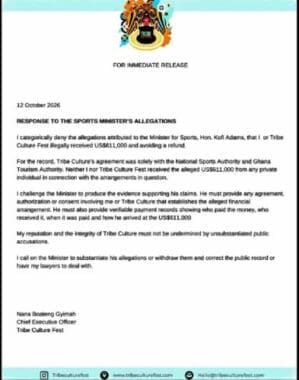
Tribe Culture Fest chief executive Nana Boateng Gyimah on 12 October denied Sports Minister Kofi Adams’s claim that he unlawfully received $611,000 linked to World Cup travel arrangements.

In a statement, Gyimah said his company’s agreement covered only the National Sports Authority (NSA) and the Ghana Tourism Authority (GTA). He said neither he nor the festival received the sum from any private individual in connection with the arrangements. “I categorically deny the allegations,” he said.

He challenged Adams to produce any agreement, authorisation or consent linking him or the company to the payment. He also asked for verifiable records showing who paid the money, who received it, when it was paid and how the minister arrived at the figure. Gyimah called on Adams to substantiate or withdraw the claims and correct the public record, and said his lawyers would otherwise deal with the matter.

The exchange marks the first time a private party has been publicly accused of holding money in the visa row, and it widens a dispute that has so far centred on state agencies. In a television interview on 11 October, Adams accused Gyimah of feeding the Minority in Parliament with false information to divert attention from money the minister said was collected under an agreement with the NSA to take Ghanaians to the tournament. Adams said Gyimah had received about $611,000 unlawfully and was avoiding a refund. He said criminal action should follow if it is established that people were deceived from the start. Adams has not publicly released documents supporting the figure, and no agency has filed charges.

Adams has also said the United States Embassy introduced Tribe Culture Fest, a private events organiser, to the NSA and the GTA at a meeting at the embassy. He has said the NSA did not inform his ministry of any visa arrangement with the embassy.

The Minority, led on the issue by Old Tafo MP Vincent Ekow Assafuah, has demanded the dismissal of Adams and GTA Chief Executive Maame Efua Houadjeto pending investigations. Assafuah alleges that lists submitted to the US and Canadian embassies presented people as NSA staff, media personnel and GTA board affiliates without verified links to those bodies. The Sports Ministry rejects any suggestion that Adams selected applicants or benefited personally. None of the competing allegations has been tested by an investigation or a court.

Africa logs cyberattack every eight minutes, Mastercard study finds

0

African organisations faced a cyber event roughly every eight minutes in 2025, while about 200,000 security jobs went unfilled, a Mastercard white paper published on 12 October said.

The study, titled Africa Digital Defense Race and commissioned by the payments company, says cyberattacks on African organisations rose more than 421 per cent between 2016 and 2025. Over the same period the global increase was 307 per cent. Mastercard Cyber Insights, the company’s threat intelligence platform, recorded 69,236 cyber events targeting organisations on the continent in 2025.

The gap between threat and defence is the report’s sharpest warning. Mastercard estimates that around 200,000 cybersecurity roles were vacant across Africa at the end of 2025, equal to 23 per cent of the existing cyber workforce. The paper says artificial intelligence is making attacks easier to automate, which puts more pressure on that thin pool of defenders.

The attacks are following the money. The white paper says mobile money use in Africa grew sixfold between 2016 and 2025, e-commerce activity roughly fourfold and digital banking users 4.7 times. It projects that the continent’s digital payments economy could reach $1.5 trillion by 2030. Technology, government and financial services together accounted for 44 per cent of observed activity.

Four markets drew more than half of the observed threat activity: Nigeria, South Africa, Kenya and Morocco. Nigeria’s large fintech sector took a significant share of attacks, and South Africa’s concentrated banking sector was the target of 12.6 per cent of them. The report singles out Kenya’s mobile money system, particularly M-Pesa, as critical infrastructure that could attract criminals seeking personal and financial data.

Shabir Ahmed, Mastercard’s senior vice-president for Africa, said that as threats become more sophisticated, the response “has to be just as coordinated”. The company has set up an Africa Cybersecurity Center of Excellence to bring public and private bodies together to share threat intelligence and run readiness drills.

Independent law enforcement data points the same way. The International Criminal Police Organization (INTERPOL) said in its 2025 Africa Cyberthreat Assessment Report that cybercrime accounts for more than 30 per cent of all reported crime in West and East Africa. It found that just 30 per cent of African countries have an incident reporting system and 19 per cent a cyberthreat intelligence database. Some countries saw suspected scam notifications rise by up to 3,000 per cent in a year, according to data from Kaspersky, one of INTERPOL’s private-sector partners.

NLA PAYS GH¢10 Million Dividend to the Consolidated Fund

0

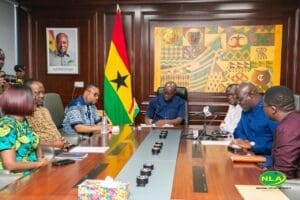
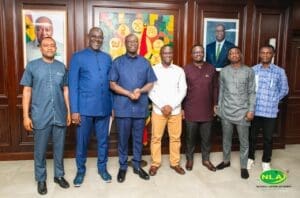
The National Lottery Authority (NLA) has paid a GH¢10 million dividend to the Ministry of Finance for the Consolidated Fund. This payment marks a significant milestone in the Authority’s efforts to strengthen financial accountability and enhance its contribution to national development.

The NLA team was led by Board Chairman Mr Frederick Amissah, who informed the Minister of the Authority’s interventions to shore up revenue, including a directive for all Private Lotto Operators (PLOs) to cease manual operations and migrate to Point of Sale terminals.

He also entreated the Minister to support the Authority in acquiring logistics to enhance operational efficiency.

Presenting the cheque on behalf of the NLA’s Board, Management and Staff, the Director-General, Mr. Mohammed Abdul-Salam, described the payment as a clear indication that the Authority’s ongoing reforms are beginning to deliver positive results.

He emphasized that the NLA, as a state-owned institution, has a responsibility to generate value for the people of Ghana and to contribute meaningfully to government revenue.

According to the Director-General, the NLA has launched a comprehensive reform programme to improve efficiency, transparency and revenue generation. Key measures include reviewing revenue-sharing arrangements with private operators, adopting an open, competitive licensing framework to eliminate exclusivity, and implementing independent, real-time revenue-monitoring systems across all licensed operations.

He also announced plans to introduce a Sports Fund Lotto in collaboration with the Ghana Sports Fund to support sports development in Ghana and increase contributions to national development.

Nla

Receiving the cheque on behalf of the Government of Ghana, the Minister for Finance, Hon. Dr. Cassiel Ato Forson, welcomed the Authority’s return to contributing to the Consolidated Fund, a positive step towards restoring its role in supporting government finances.

He said the Ministry of Finance will collaborate with the Office of the Attorney-General to review existing agreements that affect the Authority’s revenue position, ensuring national interests are adequately protected.

While commending the NLA for its GH¢10 million contribution, the Minister stressed that the Authority could generate significantly higher returns for the state. He urged the NLA to remain focused on its core mandate and remit surplus funds to the government to support public services and national development initiatives.

The presentation demonstrates the National Lottery Authority’s renewed commitment to transparency, good governance and improved financial performance, positioning the institution to make stronger contributions to Ghana’s socio-economic development in the years ahead.

Nla


Sefwi Wiawso MP urges students to take pride in heritage

0

Sefwi Wiawso lawmaker Kofi Afful Benteh has urged Ghanaians to take pride in their ethnic roots and local languages, speaking to students at St Joseph Senior High School, Datano.

The Member of Parliament (MP) told students that no one should feel ashamed of where they come from, whether Sefwi, Ewe, Asante, Ga or any other group. He said these identities are part of what makes a person Ghanaian and add to the country’s heritage. He also urged young people to value their indigenous languages as a marker of who they are, and called on communities to keep practising their traditions so they pass to future generations.

The school, in the Sefwi Wiawso Municipality of the Western North Region, was a stop on a cultural and talent tour organised by musician Andrew Kwarteng, known as Mandem Yopic. He told students that knowing their roots was central to understanding their identity. He encouraged them to speak and promote their native languages with the same enthusiasm they bring to English, and to stay disciplined and focused on their studies.

The appeal comes as the government pushes Ghanaian languages back into the classroom. In October 2025, Education Minister Haruna Iddrisu ordered the Ghana Education Service to enforce mother tongue instruction in public basic schools. His deputy, Dr Clement Apaak, later clarified that the directive applies from kindergarten to Primary Three. In an August 2026 statement on the revised basic school curriculum, the Ministry of Education said Ghanaian languages would be the main medium of instruction up to Primary Three. Both Ghanaian languages and English would then be used from Primary Four to Primary Six.

The ministry says children learn better when they start school in a familiar language. Teacher training and materials remain the test. A University of Cape Coast lecturer, Joyce Tawiah-Mensah, has warned that not all teachers are fluent in local languages, and most textbooks are still written in English. The ministry is working with the Bureau of Ghana Languages and academic institutions to translate core materials in mathematics and science into selected Ghanaian languages.

Ablakwa and UK envoy review security ties before Mahama visit

0

Foreign Affairs Minister Samuel Okudzeto Ablakwa and British High Commissioner Dr Christian Rogg met on 9 October to prepare for President John Mahama’s official visit to Britain.

The two reviewed relations between Ghana and the United Kingdom (UK), according to a 3News report of the meeting. They said progress on the countries’ security partnership was satisfactory and committed to closer work against organised crime and violent extremism in the region. No date for Mahama’s visit has been made public.

The security pledge carries regional weight. The UK is one of Ghana’s main partners in counter-terrorism and policing cooperation, and both governments regard the spread of violent extremism along West Africa’s coastal states as a shared threat.

The meeting also covered rising British investment, with particular attention to a port project in Takoradi that the two sides expect to begin this year. The most significant UK-backed project announced there in 2026 is the Takoradi Floating Dock. In June, at the Ghana-UK Investment Summit in London, Rogg said the UK-backed Private Infrastructure Development Group (PIDG) was investing £101 million in that ship repair and dry-docking facility. He said it would create up to 430 jobs, with 30 per cent reserved for women.

The dock is the flagship of a UK-Ghana Growth Partnership signed in London, a framework for 2026 to 2028 backed by investment commitments of up to £215 million. Rogg said at the summit that UK foreign direct investment in Ghana reached £1.8 billion last year and bilateral trade £1.6 billion.

Ablakwa thanked Britain for taking part in two events Ghana convened on the sidelines of the 81st session of the United Nations General Assembly in New York: one on reparatory justice and the Accra Reset initiative. The two officials also discussed Ghana’s priorities for the 28th Commonwealth Heads of Government Meeting (CHOGM), due in Antigua and Barbuda from 1 to 4 November 2026.

Ministry summons GAUA to talks as strike delays university reopening

0

Ghana’s Ministry of Education summoned striking university administrators and the tertiary regulator to urgent talks on 12 October, after the walkout forced two leading universities to postpone reopening.

The ministry invited the leadership of the Ghana Association of University Administrators (GAUA) and the Ghana Tertiary Education Commission (GTEC). Its Press Secretary, Hashmin Mohammed, said in a statement on 11 October that the meeting aimed at “an amicable resolution of the ongoing strike action”. The ministry urged both sides to negotiate in good faith, given the strike’s effect on students and university communities.

The stakes are rising for thousands of students. The University of Ghana (UG) has postponed the start of its 2026/2027 academic year, which was due on 12 October, and suspended online registration for first-year and continuing students. The Kwame Nkrumah University of Science and Technology (KNUST) has postponed its 13 October reopening indefinitely, saying the strike had impaired its operations and administration. The University of Energy and Natural Resources has also delayed reopening.

GAUA members walked out on 10 August, more than two months ago. They are demanding payment of allowances they say were negotiated and approved, and action on what they call disparities in allowances, salary structures, market premiums and other conditions of service. The association’s president told Asaase Radio that members were frustrated by stalled talks and wanted to see results “on our payslips”. He warned that the strike threatens the universities’ efforts to return to their pre-COVID academic calendar.

Pressure on the government has been building from several directions. Deputy Education Minister Dr Clement Apaak said on 9 October that talks on the administrators’ conditions of service were continuing and that GTEC was involved. The same day, Vice Chancellors Ghana appealed to GAUA to return to work while talks continue. It said it had engaged the education minister and the Fair Wages and Salaries Commission (FWSC), which had assured it of its commitment to a settlement.

The ministry said it hoped the meeting would allow a swift return to normal academic and administrative work at affected institutions.

Prosecution details GH¢49.1m money trail in Adu-Boahene trial

0

Prosecutors set out in a 9 October filing how they say GH¢49.1 million in state funds reached a private account linked to former National Signals Bureau head Kwabena Adu-Boahene.

The filing is the Attorney-General’s response to a submission of no case to answer by Adu-Boahene, his wife Angela Adjei Boateng and their company, Advantage Solutions Limited. It asks the High Court in Accra, presided over by Justice Francis Achibonga, to rule that the evidence requires the accused to open their defence. In the document, signed by Deputy Attorney-General Dr Justice Srem-Sai, the prosecution alleges that the money was spent on the accused, their families, friends and associates instead of official business. None of these allegations has been tested by a ruling.

The three accused face charges including stealing, conspiracy to steal, defrauding by false pretences, wilfully causing financial loss to the state, using public office for profit and money laundering. They were arraigned on 30 April 2025.

The prosecution’s account centres on three cheques. It says Adu-Boahene, then Director of the Bureau of National Communications (BNC), deposited a cheque for GH¢27.1 million on 6 February 2020 into an account at Universal Merchant Bank. The account was named BNC Communications Limited – Operations, but the prosecution says its opening documents show it belonged to a private company, BNC Communications Bureau Limited. Two further cheques, for GH¢1 million and GH¢21 million, followed into the same account. The prosecution says Advantage Solutions was the company’s sole shareholder and that Adu-Boahene and his wife were its directors.

The filing also disputes the stated purpose of a transfer from that account. According to the prosecution, Adu-Boahene requested GH¢9,537,500 on 6 February 2020 to buy a cyber defence system, backed by a sale contract and invoice. It says the National Signals Bureau has denied having a contract with the named supplier, ISC Holdings Limited, in January 2020. The bureau’s finance director testified that the invoice number matched a 30 March 2020 invoice for a digitised investigative audit system, not a cyber defence system. The prosecution also says the bureau’s inventory shows no such system was delivered, and that the account balance had fallen to GH¢683,609.65 by 3 August 2020.

The defence rejects the case. In their submission filed on 25 September, lawyers led by Samuel Atta Akyea argued that the prosecution relied on hearsay and failed to prove the purpose of the funds. They said hundreds of pages of bank statements were missing from the evidence and that no bank officials were called to authenticate banking documents. They also argued that key officials who could explain the national security arrangements around the funds were never called. Evidence before the court showed the cheques also bore the signature of the National Security Coordinator, which the defence says undermines any suggestion that Adu-Boahene had sole control of the money.

The prosecution called four witnesses. The defence now has seven days to reply to the Attorney-General’s response, and the court is due to rule on 5 November 2026 on whether the accused have a case to answer.

Ashanti Cocoa Farmers Welcome New Ghana Cocoa Board Act, Call Improved Support and Greater Transparency

0

Cocoa farmers and traditional leaders in the Ashanti Region have expressed satisfaction with the Ghana Cocoa Board Act, 2026 (Act 1182), while acknowledging the rationale behind the producer price announced for the new cocoa season, despite their initial expectations of a higher price.

The views emerged during the first phase of farmer and stakeholder engagements organised by the Ghana Cocoa Board (COCOBOD), in collaboration with the Cocoa Health and Extension Division (CHED), across seven cocoa-growing districts in the region.

The engagements, which covered Offinso, Kyerayaso, Toase, New Edubiase, Kuntenase, Kona and Juansa, provided a platform for farmers and traditional leaders to discuss key provisions of the new law, the producer price determination process and interventions aimed at improving productivity and strengthening farmers’ livelihoods.

Although some participants had hoped for a higher producer price, they indicated that the explanations provided on the factors underpinning the announced price had helped them better understand the decision and the broader considerations confronting the cocoa sector.

The discussions underscored the importance of sustained dialogue between COCOBOD and cocoa farmers in building mutual understanding of policy decisions and the economic realities shaping the industry.

Participants welcomed the reforms introduced under the new Cocoa Board Act and called for sustained public education to deepen farmers’ understanding of the legislation, particularly provisions aimed at protecting cocoa-growing communities and farmlands from destructive activities, including illegal mining and unauthorised sand winning.

They also urged stakeholders to support the depoliticisation of cocoa-related issues, stressing the need for a more unified, long-term approach to managing the sector in the national interest.

On farmer support, participants called for improvements in the free distribution of agricultural inputs, particularly to ensure that fertilisers and other essential supplies reach farmers in adequate quantities and at the appropriate time.

They further appealed for the speedy implementation of the proposed Farmer Pension Scheme, describing it as an important step towards improving the long-term welfare and financial security of cocoa farmers.

The participants also emphasised the need for transparency in the administration of the cocoa tertiary education scholarship scheme to ensure fairness, accountability and equitable access for eligible beneficiaries.

Leading the COCOBOD team, Deputy Head of Public Affairs, Mr Benjamin Larweh, underscored the importance of keeping farmers informed and actively involved in discussions on policies and decisions that directly affect their livelihoods.

He said the engagements reflected COCOBOD’s commitment to open communication, stakeholder participation and a shared understanding of the reforms and interventions required to sustain Ghana’s cocoa industry.

Mr Larweh noted that constructive engagement was essential to strengthening trust between the Board and farmers, adding that the concerns and recommendations raised during the sessions would be submitted to Management for consideration.

The Ashanti Regional Manager of CHED, Mr Isaac Adu, also announced plans for further engagements with farmers on the distribution of fertilisers and other agricultural inputs, as well as the mass spraying exercise under the Cocoa Diseases and Pests Control Programme (CODAPEC).

The completion of the Ashanti phase marks the first stage of a wider national engagement programme designed to bring COCOBOD’s policies and interventions closer to cocoa farmers and other industry stakeholders.

Burnham’s EU reset could speed wealth flight, adviser warns

Closer UK ties with the European Union (EU) could lift growth but make it easier for wealthy Britons to leave, deVere Group chief executive Nigel Green warned on 12 October.

Green spoke as Prime Minister Andy Burnham prepared to ask MPs to back a closer relationship with the bloc. Burnham’s office said he would tell Parliament that Brexit had done more harm than good and that turning away from a possible new deal with the EU would be a dereliction of duty. He has not ruled out a future manifesto pledge to rejoin, and has not said whether another referendum would be needed.

Green, whose firm advises internationally mobile and high-net-worth clients, said cutting the paperwork, border checks and delays that followed Brexit would feed through to exports, productivity and business confidence. He expected sterling to benefit if relations with Europe looked more settled, and argued that British shares, long cheap against their peers, could rerate. Talk of a second referendum would bring some volatility, he said, but investors mainly want to know which direction the country is heading.

The warning matters for Britain’s tax base. Green said the same changes that ease trade with Europe would also ease the movement of people and their money. Entrepreneurs, senior executives and mobile families were already weighing moves abroad as taxes rose, he said, and freer movement in Europe would remove one more obstacle. He argued the government must pair the EU reset with a competitive tax system, faster planning and policy stability. “Get only one right and it simply becomes easier for people to leave,” he said.

Burnham’s push comes with a sharp claim about the 2016 vote. On The Rest Is Politics podcast, broadcast on 12 October, he said he had asked for high-level advice after becoming prime minister in July and was told Russia had interfered in the referendum. He is the first British prime minister to say so openly. He also said German Chancellor Friedrich Merz had told him the far-right Alternative for Germany party was linked to Russia.

Ministers have struggled to give detail. On BBC Radio 4’s Today programme, minister Stephen Doughty declined to discuss specifics and pointed instead to Russian attempts to interfere in a range of democratic events. He told LBC that Russia had spent €1.5 billion on disinformation this year alone. Conservative shadow minister Andrew Bowie criticised the government’s messaging. Russia has denied meddling in the Brexit vote and in British politics generally.

The claim revisits an old dispute. In 2020, Parliament’s Intelligence and Security Committee said the government had never assessed possible Russian interference in the referendum and called for one, while finding credible evidence of Russian influence efforts around Scotland’s 2014 independence vote.

Burnham is due to address MPs on the EU relationship this week.

Jubilee USA urges IMF Ebola debt relief for DR Congo

Jubilee USA urged the International Monetary Fund (IMF) on 12 October to provide $205 million in debt relief and aid to fight Ebola in the Democratic Republic of Congo (DRC).

The call came as finance ministers, central bank governors and development officials gathered in Bangkok for the annual meetings of the IMF and World Bank Group, which run from 12 to 18 October at the Queen Sirikit National Convention Center. Jubilee USA Network, a coalition of faith groups, development organisations and labour unions, launched a petition asking the fund to provide at least $205 million. The group says that equals the debt payments the DRC owes the IMF over the next 12 months.

The case for relief rests on the scale of the outbreak. Caused by the Bundibugyo strain of the virus, the epidemic has killed more than 4,000 people and infected about 8,300, according to Congolese government figures released on 2 October. It is the deadliest Ebola epidemic in the DRC’s history, and the World Health Organization (WHO) has warned it could surpass the 2014 to 2016 West Africa outbreak, which killed more than 11,000 people. The WHO declared it a public health emergency of international concern on 16 May.

Jubilee USA wants the IMF to use its Catastrophe Containment and Relief Trust (CCRT) to cancel the DRC’s payments. The fund used the trust to relieve debt for Guinea, Liberia and Sierra Leone during the West Africa epidemic, and again for dozens of the poorest countries during the COVID-19 pandemic. Eric LeCompte, Jubilee USA’s executive director, said the trust can also deliver grant-like support: the IMF can lend new money and then use the CCRT to cancel that debt. “This is low-hanging fruit as the IMF already holds the tools,” he said.

The IMF has not publicly responded to the petition.

Ebola joins a crowded agenda. LeCompte said discussions would be dominated by high national debts, rising food and fuel prices and the challenges of artificial intelligence. The final G20 finance ministers’ and central bank governors’ meeting of the year is being held on the sidelines. Brent crude traded near $104 a barrel on 12 October after Houthi strikes on Saudi Arabia, adding to fuel costs for importing countries.

The host city is itself recovering from disaster. Floods have killed 60 people across Thailand since 16 September, according to the interior ministry. Areas in 28 provinces, including Bangkok, remain affected, touching 1.15 million households. Authorities have kept drainage crews and mobile pumps on standby around the venue, and the Thai government expects about 15,000 participants from more than 190 countries.

Thailand is the third host in a row outside Washington to face a natural disaster around the meetings. Weeks before the 2018 meetings in Bali, Indonesia, an earthquake and tsunami struck Sulawesi. A deadly earthquake hit Morocco a month before Marrakech hosted in 2023. LeCompte said lenders will need more relief tools as disasters become more frequent.

Black Starlets coach wants more goals after narrow Togo win

0

Black Starlets coach Kassim Ocansey said his side should have beaten Togo by more after a 1-0 win opened Ghana’s regional U-17 qualifying campaign in Ouagadougou on 10 October.

David Kwarteng scored in the seventh minute at the August 4 Sports Stadium in Burkina Faso, the first goal of the 2026 West African Football Union (WAFU) Zone B U-17 Championship. The tournament serves as the qualifying route to the 2027 U-17 Africa Cup of Nations (AFCON).

The goal came from a set piece. Abdul Latif Wunzalgu’s delivery was blocked and the ball broke loose in the box. Captain Abdul Rafiu Issah’s follow-up fell to Kwarteng, who finished.

Ghana created more chances but could not add to the lead. Striker Alidu Issah, winger Yaw Acheampong and Wunzalgu, later named man of the match, all missed openings to extend the advantage.

“We won, but I expected more from my boys,” Ocansey said. He said the team would work on its finishing and argued that converting the chances it creates would bring three or four goals a game.

The narrow margin matters in a tight group. Hosts Burkina Faso drew 0-0 with Benin in the other Group A match. That leaves Ghana top with three points, Burkina Faso and Benin on one each, and Togo without a point.

The Black Starlets face Benin on Tuesday 13 October. The tournament runs until 23 October.

Black Meteors expand camp to 32 for Libya U-23 qualifier

0

Ghana’s Black Meteors return to camp on 12 October with 32 players, six more than called last month, for their U-23 Africa Cup of Nations (AFCON) qualifier against Libya.

Head coach Desmond Ofei will work with the group at the Ghanaman Soccer Centre of Excellence in Prampram ahead of the two-legged tie. The tie will be played during the international window from 9 to 17 November 2026, the Ghana Football Association (GFA) said. The squad will be trimmed as preparations go on, and six foreign-based players are expected to join before the matches.

The stakes reach beyond a youth title. The eight-team U-23 AFCON finals in Egypt in 2027 serve as Africa’s qualifying event for the men’s football tournament at the 2028 Olympic Games in Los Angeles. Ghana have not played at an Olympics since Athens in 2004.

The larger camp follows Ofei’s first call-up of 26 players, who reported to Prampram on 29 September for friendly matches. Locally based players will stay in camp until the qualifiers. Their clubs can request weekly temporary releases so they can play in Ghana league matches.

Ghana received a bye into the second round as one of the exempted nations. They now face a Libya side that beat Togo 4-1 on aggregate in the preliminary round, drawing 1-1 in Lomé before winning 3-0 at home.

The Black Meteors play the first leg away in Libya and host the return. The aggregate winner advances to the final qualifying round, scheduled for 22 to 30 March 2027, against either Equatorial Guinea or Niger.

The three-round campaign will decide the seven teams that join hosts Egypt at the finals.

NPP’s David Boakye questions La MP over Pleasure Beach demolition

0

New Patriotic Party (NPP) communicator David Boakye questioned on 10 October how La Pleasure Beach was demolished without the knowledge of the area’s MP, a deputy local government minister.

Speaking on JoyNews’ Newsfile programme, Boakye challenged the account of Rita Naa Odoley Sowah, the National Democratic Congress (NDC) MP for La Dadekotopon and Deputy Minister for Local Government, Chieftaincy and Religious Affairs. Sowah has said she was not told about the 2 October operation. Boakye asked how a demolition could happen in her constituency while she served as deputy minister in the same government and still did not hear of it. He accused her of a public show of distress to win sympathy from constituents.

He also raised the cost of the operation. Sowah has said affected businesses will be compensated. If the state pays that compensation, Boakye said, whoever authorises the payment should in future be held accountable for causing financial loss to the state, an offence under Ghana’s criminal law. He asked whether the money would come from the state, the beach’s management or National Security.

Boakye said he had not visited the site and could not verify accounts of losses he had heard. He questioned whether the authorities could have found a way to keep the businesses running instead of pulling them down.

The question of who ordered the demolition remains in dispute. Personnel of the 48 Engineer Regiment of the Ghana Armed Forces, supported by the police, began pulling down structures at about 4am on 2 October. They cleared La Pleasure Beach and the adjoining Polo Beach Club, including the Vienna City club, shops, stalls and pub sheds. Workers said they were ordered off the premises minutes before the demolition began.

Deputy Chief of Staff Stan Xoese Dogbe, who leads the government’s anti-flood taskforce, said the exercise was not part of flood mitigation. He said National Security carried it out at the request of the Labadi Beach Hotel. Graphic Online reported that National Security acted at the request of the Social Security and National Insurance Trust (SSNIT). At the site, Sowah confronted the soldiers and said she had been assured the area would be spared. She said the government had no knowledge of the operation and named the hotel and its board chairman as leading it.

The La Traditional Council said it was not formally informed or involved. The council had first learned of the planned demolition on 16 September.

On 6 October, Sowah told Parliament’s Committee on Local Government and Decentralisation that a committee would be formed to determine compensation. She said it would include SSNIT, the La Dadekotopon Municipal Assembly, traditional authorities, beach management and herself as MP, and that data on affected people had already been collected. Abdul Rahman Ashitey, communications director of La Pleasure Beach, said no compensation had yet been agreed and that figures would follow the committee’s assessment.