

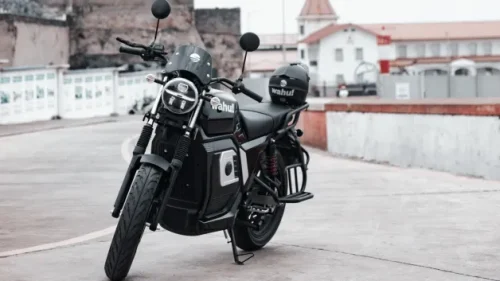
Ghana’s District Assemblies Common Fund (DACF) and manufacturer Wahu Mobility are placing an electric motorcycle in each of the 261 districts, the first step in a planned 5,000 unit rollout.
The pilot, 280 electric motorcycles in all, was announced at the Ghana-UK Investment Summit 2026 in London, where President John Dramani Mahama joined more than 800 investors and policymakers. It puts at least one bike in each of the 261 Metropolitan, Municipal and District Assemblies (MMDAs) and the 16 Regional Coordinating Councils, paid for through the DACF Grant Mobilisation Programme under a memorandum of understanding between the government and Wahu.
The point is reach. District assemblies struggle to collect revenue or deliver services in places their staff cannot easily get to, and the bikes are meant to fix that. Each one is assigned to a revenue and service officer to assess property rates and business permits, collect market tolls, and carry out sanitation, environmental health, agricultural extension, welfare and disaster duties. The machines transmit location, distance and energy use to a dashboard, which the partners say will let district leaders link an officer’s field activity to the revenue actually collected.
The partners put hard numbers on it, though these remain projections. They estimate each bike could save GH¢9,000 to GH¢12,000 a year in fuel and maintenance against a petrol equivalent, and lift a district’s internally generated funds by 5 to 10 percent through better field coverage. Each electric bike that replaces a petrol one, they add, avoids about 1.8 tonnes of carbon dioxide a year. Wahu’s chief executive, Valerie Labi, framed it as government “moving away from petrol and driving real efficiencies in operations.”
There is also a carbon play. The monitoring is built to meet the Paris Agreement’s Article 6.2 rules, and Wahu already has a carbon mitigation arrangement with Switzerland’s KliK Foundation tied to rolling out electric bikes in Ghana. The partners claim the scheme would make Ghana the first African government to earn carbon revenue from electrifying district fleets, with the proceeds returning to the districts. A later phase, they say, would issue a commercial paper instrument to draw private investors into the expansion, and extend charging points to every district.
Wahu, led by Labi, runs what it calls Ghana’s first completely knocked down (CKD) assembly plant for electric two wheelers, in Accra, with capacity of around 200 bikes a month. The DACF Administrator, Harry Yamson, cast the programme as basic infrastructure for local government rather than a simple vehicle purchase.
The ambition outruns the pilot for now. Two hundred and eighty bikes works out at roughly one per district, well short of the 5,000 target, and the money for that scale, from private capital and carbon sales, has yet to be raised. The projected savings and revenue gains are forecasts, not results. The pilot is designed to test whether they hold.

